
The trend of RWA perpetual futures continues to gain momentum within the cryptocurrency market. As of the third quarter, total trading volume surpassed the impressive $2 trillion mark.
RWA perpetual futures have maintained their upward trajectory in Q3. According to data from Cryptorank, collective trading volume has exceeded $2 trillion this quarter, significantly rising from $1.2 trillion in Q2. The monthly trading volume crossed the $100 million threshold in June, reaching peak activity levels in July.
The market for RWA perpetual futures started off as a relatively niche area, primarily overshadowed by the broader activities surrounding Bitcoin and various altcoins. However, the disappointing bear market of 2026 prompted many crypto traders to explore alternative liquidity options, and advancements in technology have facilitated the on-chain representation of various stocks and commodities.
As noted by Cryptopolitan, RWA assets have increasingly been utilized as collateral within decentralized finance (DeFi) protocols, leading to broader acceptance and increased influence. The market capitalization for RWA assets has now surpassed $45 billion, with over half (51.9%) of this market operating on the Ethereum blockchain, according to Token Terminal data.
Both institutional investors and individual traders have shown interest in RWA, thanks to its highly liquid market environment, which significantly reduces the risks of rug pulls or major crashes commonly associated with cryptocurrency tokens.
Focus on Prominent Assets in RWA Perpetual Futures
By September 2026, RWA perpetual futures were generating approximately $400,000 in daily fees, positioning them among the top-performing applications in the blockchain space. Data from DeFi Llama indicates that Trade XYZ hosts the most active contracts, with the S&P 500 contract being particularly prominent, while oil and gold also saw notable trading activity.
In September, the trading focus shifted towards a select number of AI-driven companies, including SK Hynix. Contracts related to gold and oil remained highly traded, exhibiting greater volatility in single equity transactions.
A significant portion of cumulative trading volume in perpetual futures arose from a surge in late July, fueled by the public sale of SpaceX (Nasdaq: SPCX).
For the majority of 2026, Binance was the predominant platform for RWA perpetual futures. However, in August, a change occurred with HIP-3 gaining traction, shifting favor towards decentralized exchanges (DEX).
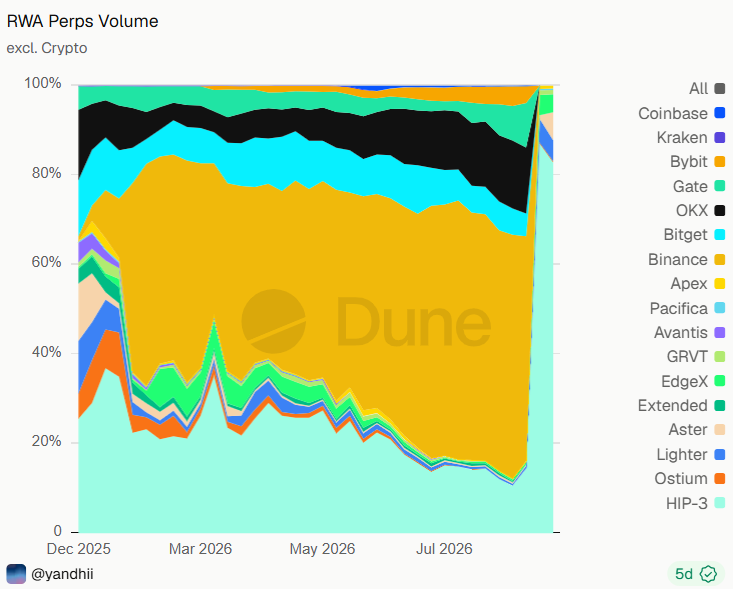
As of August 24, HIP-3 accounted for over 87% of all RWA perpetual futures trading and more than 73% of total DEX trading in this category.
Traditional exchange leaders like Kraken, Coinbase, and OKX held only a minor portion of the perpetual futures market in September. The trend indicates that decentralized platforms may drive the future adoption of RWA perpetual futures.
Can RWA Enhance Liquidity in Cryptocurrency?
Hyperliquid’s HIP-3 has distinguished itself as the leading platform for introducing RWA perpetual futures contracts. The platform has demonstrated its capability to rapidly launch contracts, leveraging instances like SK Hynix or China’s CXMT, coinciding with heightened interest in their respective stocks.
Currently, platforms for perpetual futures predominantly focus on major U.S. stocks, complemented by select Asian companies aligned with the RWA narrative, while smaller or niche assets remain underutilized.
The recent surge in RWA trading presents fresh opportunities for liquidity influx into the cryptocurrency sector. Although the RWA market is currently modest in size compared to earlier trading activities involving coins and tokens, its growth trajectory over the past 18 months has been remarkable.
In terms of liquidity, the RWA market is still significantly smaller than previous institutional treasury ventures. However, it has secured over $16 billion in liquidity in the past year, which pales in comparison to funds held in treasury markets.
The key distinction with RWA assets is their potential to expand and be used as collateral, which can provide more stable liquidity in decentralized markets. A vibrant RWA sector could promote lending based on more secure assets and help mitigate the risks traditionally associated with crypto-backed collateral liquidations.
Apart from stocks and commodities, the majority of value remains within tokenized bonds and money markets, which have yet to fully engage with decentralized lending or DEX trading.