
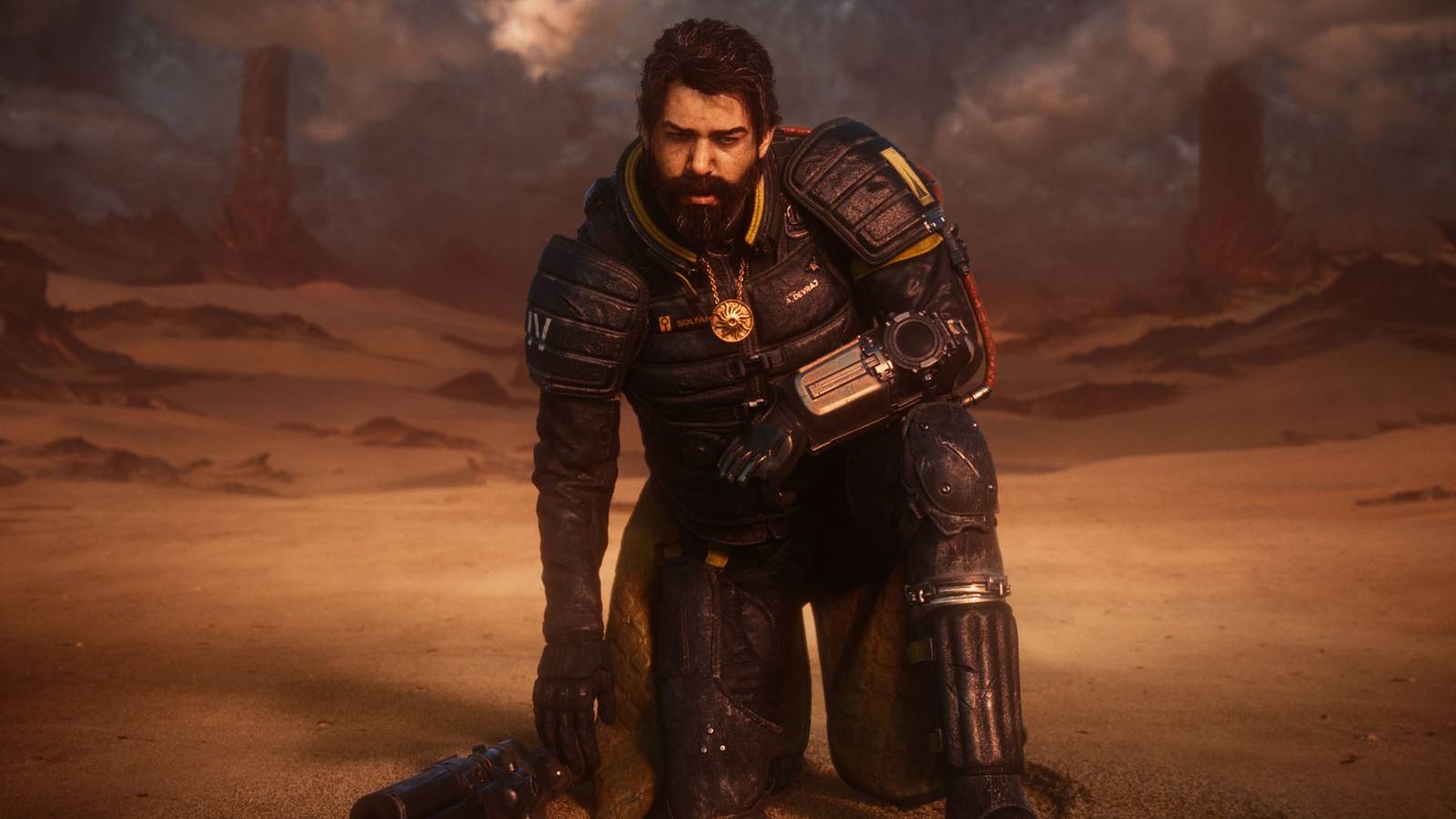
The Saros gameplay trailer, which debuted during the September 24th State of Play event, immediately signaled that Housemarque’s latest project shares DNA with their critically acclaimed 2021 roguelike, Returnal. However, this time around, the studio appears to be drawing inspiration from different sources as they plunge protagonist Arjun Devraj into an extraterrestrial bullet-hell time loop. Notably, a connection to the 19th-century literary work, The King in Yellow, seems to be present.
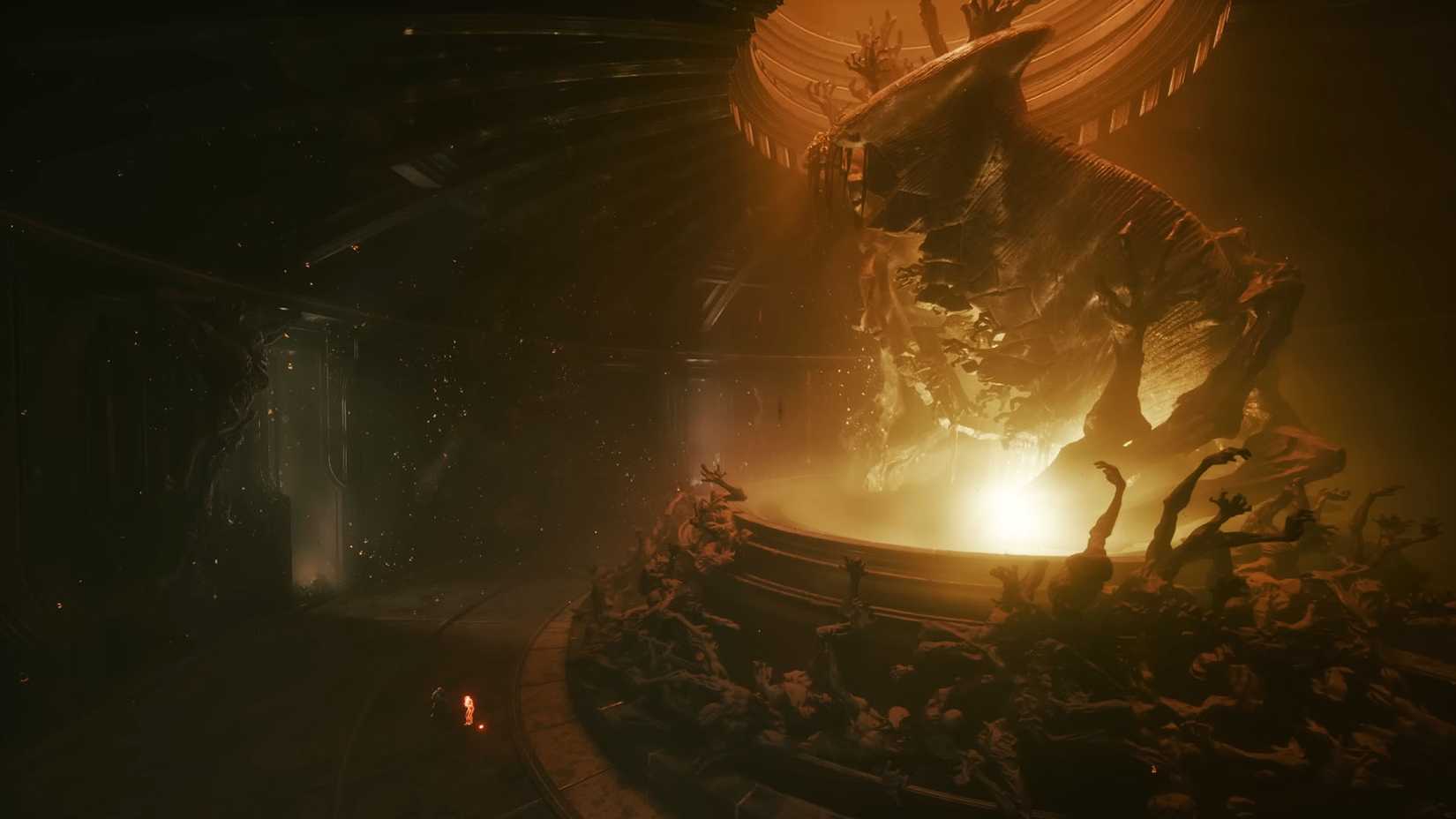
Arjun finds himself trapped on Carcosa, a strange world characterized by towering structures, hostile alien technology, and a sky illuminated by unsettling yellow sunlight. This enigmatic planet conceals dangers yet unknown. The trailer showcases a colossal humanoid entity, boasting six arms, each brandishing a fiery sphere. Adorned with a golden helmet, the creature’s eyes are obscured by two additional hands. This spectacle, both terrifying and thrilling, evokes the same sense of mystery that permeated Returnal’s marketing. While the game’s plot remains largely a secret, Housemarque has seemingly left subtle clues for fans to uncover.
The name “Carcosa” may ring a bell for some. It has appeared in media such as the first season of the TV series True Detective and was later integrated into the Cthulhu mythos by August Derleth in his short story “The Return of Hastur,” expanding on the original works of H. P. Lovecraft. However, the genesis of Carcosa and its related mythology lies with a different author.
The aura of mystery surrounding Carcosa is a legacy of Robert W. Chambers, an American author whose collection of short stories, The King in Yellow, published in 1895, first introduced this enigmatic location. The collection comprises ten stories, with four – “The Repairer of Reputations,” “The Mask,” “In The Court of the Dragon,” and “The Yellow Sign” – featuring characters who encounter the fictional play “The King in Yellow,” which is said to drive readers to madness after the second act.
Chambers never explicitly revealed the events of the play or the meaning of the cryptic symbols – “Carcosa,” “The King in Yellow,” and the “Yellow Sign” – that he scattered throughout the stories. Information about these elements is pieced together from character’s remarks, brief mentions of sightings of the King in Yellow, or lists of individuals marked by the Yellow Sign. These enigmatic symbols are so woven into the characters’ realities that lengthy explanations are omitted, creating an atmosphere of unsettling ambiguity throughout Chamber’s tales.
The most direct description of Carcosa within Chamber’s collection comes from a quote titled “Cassilda’s Song” taken from Act One, Scene Two of the play that prefaces the collection of stories. This poem of four stanzas paints Carcosa as a place under twin suns and strange moons, marked by black stars in the sky. It lies near a shore and is where the King can be found.
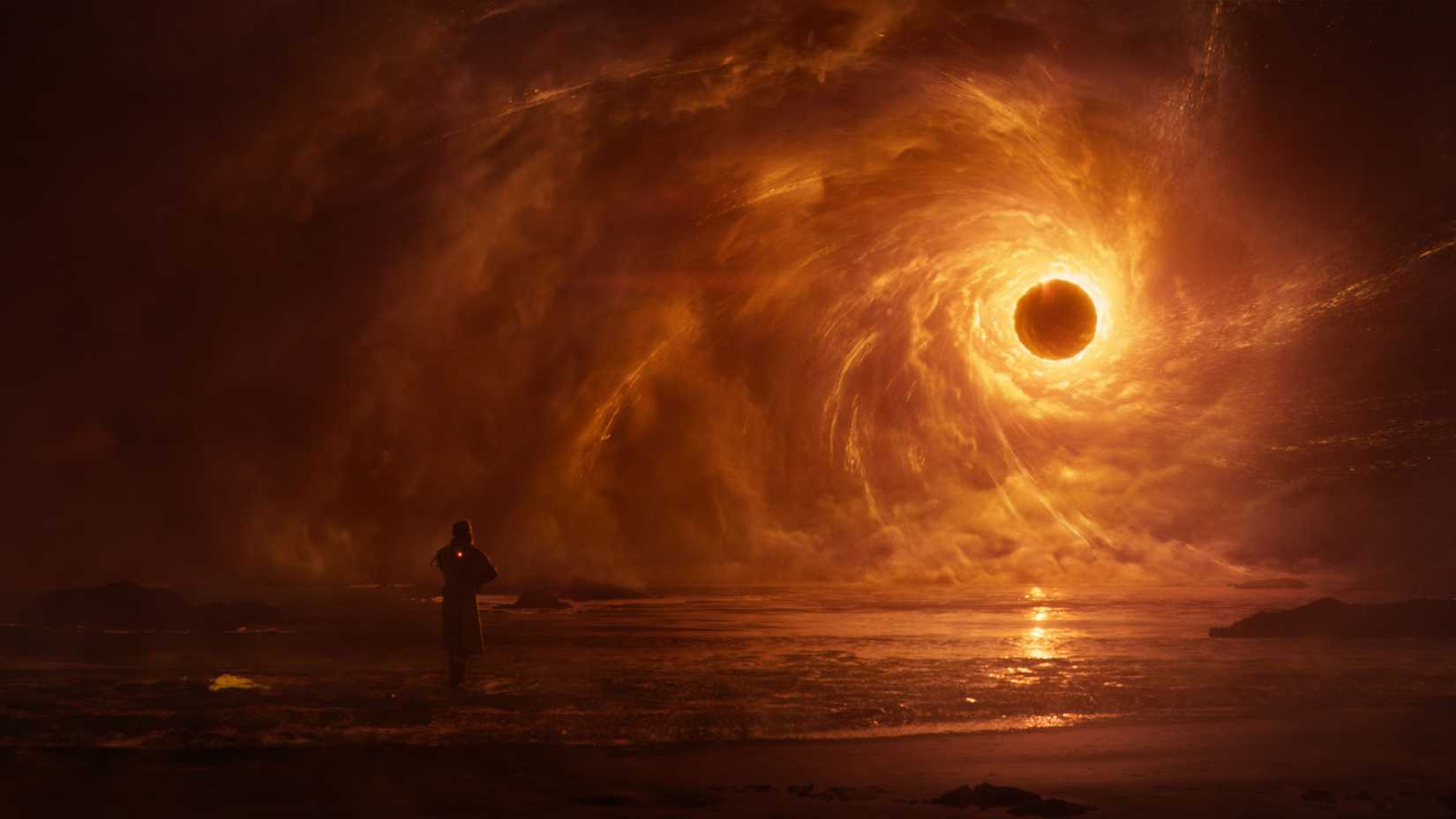
The connection between Saros and Chamber’s work extends beyond merely naming the game’s primary setting “Carcosa.” The Saros announcement trailer, unveiled during Sony’s February 2025 State of Play, depicted Arjun lying on a beach, his face splashed by the receding waves of an unfamiliar ocean. A yellow medallion is visible around his neck, and as he rises, the sun-like emblem on the medallion becomes clearer. An eclipse – a black star! – is underway, and from the water emerges a towering humanoid figure with eight arms and a crown-like adornment.
While these elements directly mirror The King in Yellow’s iconic imagery, this does not necessarily imply that Saros is a direct adaptation of the short stories. The ambiguity inherent in Robert Chamber’s writing makes The King in Yellow an intriguing source of inspiration, with powerful metaphorical symbols, especially the color yellow. According to journalist Carlos Orsi, who provided footnotes for the 2014 Brazilian edition of the book, yellow in 19th-century Western culture symbolized decadence, immorality, and madness. By referencing Chamber’s work, Saros may suggest that Carcosa is an extension of Arjun, an exploration of his psyche and emotions.
Simultaneously, the term “Carcosa,” which Chambers borrowed from Ambrose Bierce’s 1886 short story “An Inhabitant of Carcosa,” evokes a sense of the unknown and the desire to return to one’s true home. In both trailers released by Housemarque, Arjun can be heard speaking to someone, declaring his intention to find them. Who is this significant person for whom the protagonist repeatedly battles and dies on a bizarre planet?
Answers to these questions are still months away. Perhaps these are only theories, and Saros is merely a game about shooting aliens. Given Housemarque’s achievements with Returnal, which intricately wove a narrative around an alien planet giving form to an astronaut’s internal struggles, it’s easy to imagine that Saros will have a similar degree of complexity. Carcosa is waiting.