


The aggregate value of all stablecoins in circulation has surpassed 300 billion dollars, a significant milestone demonstrating their growing importance as a bridge connecting traditional financial systems and the digital asset world.
This achievement underscores rising investor interest and the evolving landscape of stablecoin models, which encompass everything from those backed by fiat currencies to those offering yield-generating opportunities.
Tether (USDT) continues to be the dominant player, commanding over half the market with a valuation exceeding $176 billion. Circle’s USDC holds the second position at $74 billion, while Ethena’s USDe has experienced rapid expansion, amassing $14.8 billion and showcasing the demand for alternative stablecoins that generate returns.
Other issuers such as Sky and WLFI are also noteworthy, becoming increasingly competitive as second-tier alternatives to the more established leaders.
Ethereum remains the preferred network for stablecoins, hosting close to $177 billion in assets originally created on its blockchain. Tron follows in second place with $76.9 billion, while Solana and Arbitrum hold $13.7 billion and $9.6 billion, respectively.
This year’s remarkable stablecoin expansion has prompted leading financial institutions to reassess their perspectives on the industry. A Coinbase projection suggests that the stablecoin market capitalization could approach $1.2 trillion by the year 2028.
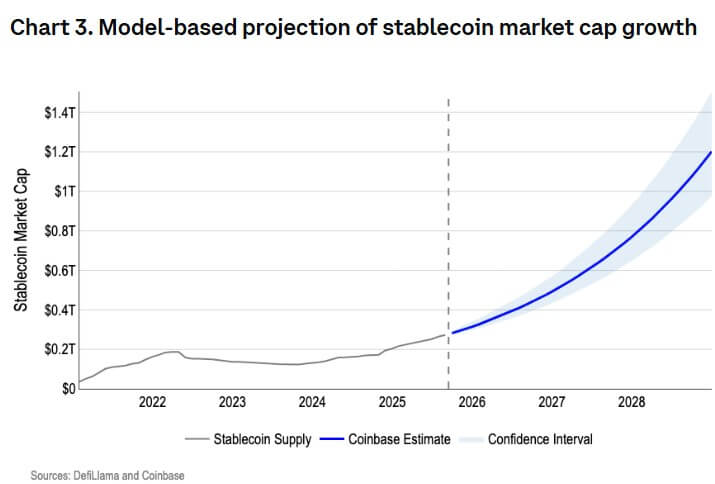
The firm attributes this anticipated growth to increasing adoption driven by supportive regulations and broader acceptance of tokenized assets.
Impact on Bitcoin and Ethereum
A study conducted in 2021 concluded that the introduction of new stablecoins contributes to more efficient price discovery and improved overall efficiency in cryptocurrency markets.
For example, the issuance of Tether tends to increase trading volumes without directly affecting the returns of Bitcoin or Ethereum. Notably, periods of Bitcoin price declines often see an increase in Tether activity, reinforcing its role as a temporary safe haven asset.
Furthermore, the same research discovered a link between stablecoin issuances and arbitrage opportunities, allowing traders to profit from discrepancies between market prices and their expected values.
Concurrently, a new surge in stablecoins signals a renewed influx of capital into the digital asset space, enhancing liquidity across the market. For Bitcoin, these inflows generate demand that indirectly supports its position as the industry’s primary reserve asset.
The 2021 study highlighted that significant Bitcoin purchases frequently follow the issuance of stablecoins, indicating a cyclical pattern in which increased liquidity helps stabilize the market.
The report stated:
“Demand for stablecoins is driven by demand for cryptocurrencies – be it regular investments or arbitrage opportunities – and/or the market regards the issuance of stablecoins as a positive signal regarding the demand for cryptocurrency.”
Ethereum, in turn, benefits from the consistent demand generated by tokenized assets. Data from Token Terminal indicates that tokenized holdings, which include stablecoins, provide a strong underlying base for Ethereum’s valuation.
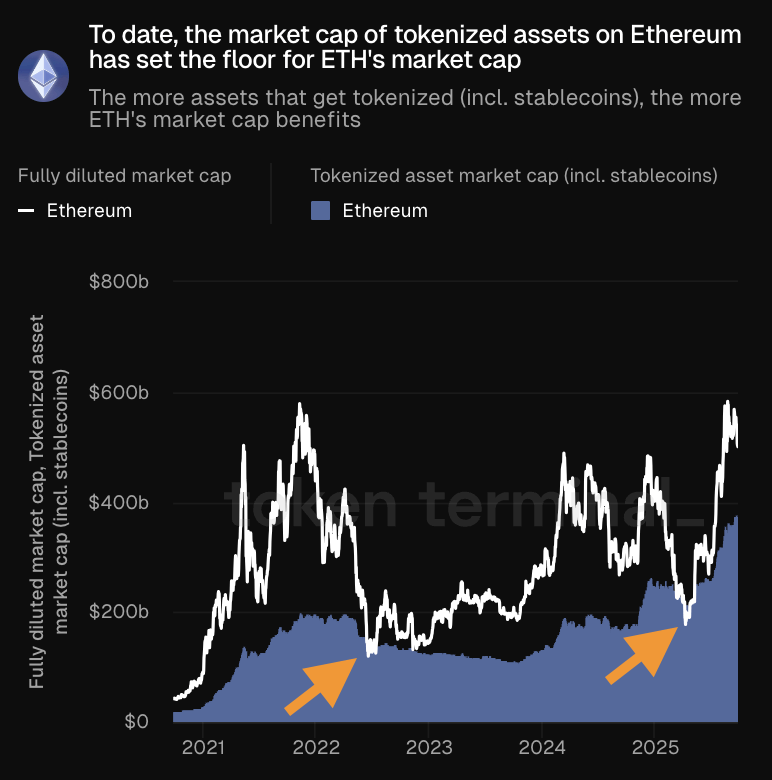
Even during downturns, like in 2022, the value of tokenized assets held on-chain remained stable, preventing Ethereum’s fully diluted market capitalization from experiencing a more significant decline.
As more real-world assets are integrated into blockchain networks, this floor continues to rise, ensuring Ethereum’s long-term stability despite potential price fluctuations.
In conclusion, the stablecoin surge isn’t an isolated event. It’s accelerating capital efficiency, strengthening the link between crypto and mainstream finance, and reinforcing the underlying infrastructure of both Bitcoin and Ethereum.