
The market for stablecoins is increasingly important within the broader digital asset landscape.
After facing skepticism, regulatory hurdles, and media scrutiny for several years, stablecoins are now viewed as essential, not just experimental. They are becoming a cornerstone of the future of programmable finance. Research indicates that changes in regulations, increased adoption by institutions, and innovative uses are pushing stablecoins to the forefront. It’s a pivotal moment for crypto, and stablecoins are leading the charge.
This analysis addresses key questions about stablecoins. We’ll explain what they are and why they matter, explore their role in the crypto ecosystem, and discuss the impact of recent policy shifts. Specifically, we will look at the implications of The GENIUS Act and the Clarity for Payment Stablecoins Act for the cryptocurrency sector, the U.S. Treasury, and the associated risks.
This discussion is informed by an interview conducted by John Furrier with Tom Lee from Fundstrat Global Advisors at the NYSE CUBE studio as part of the CUBE + NYSE Wired Crypto Trailblazer series, which you can watch here. Tom Lee, known for his insightful analysis on CNBC and other platforms, previously served as JPMorgan Chase & Co.’s chief equity strategist and currently chairs Bitmine Immersion Technologies, a blockchain and digital asset management company. Insights from this interview are integrated throughout this report.
Here’s a summary of the key topics:
- What are stablecoins?
They are digital currencies designed to maintain a stable value, typically pegged to a fiat currency like the U.S. dollar. This stability allows for safer, lower-volatility transactions within the cryptocurrency world. - Why are they relevant?
Stablecoins serve as the fundamental infrastructure for crypto finance, supporting payments, trading activities, and yield generation, which in turn drive real revenue and wider adoption. - Where do they fit in the crypto value chain?
Stablecoins are at the intersection of decentralized finance (DeFi), conventional finance, and programmable money, with a significant presence on platforms like Ethereum. - Policy divergence: Biden vs. Trump/Sacks; Gensler vs. Paul Atkins
The previous administration under Biden and Gensler favored stringent SEC oversight, which was often perceived as opaque. Crypto industry leaders reported that sharing information with the SEC under Gensler frequently led to enforcement actions. Conversely, the Trump administration, with David Sacks as Crypto and AI Czar, promotes a more innovation-friendly approach and supports legislation to clarify regulations, significantly shifting the overall sentiment. - Massive regulatory shift – What’s changed?
Increased clarity and bipartisan agreement are fostering institutional participation and reducing the perception of crypto as fraudulent, thus enhancing its legitimacy. - What is The Genius Act?
It establishes uniform rules for stablecoin issuers, emphasizing transparent reserves and interoperability. - The Clarity for Payment Stablecoins Act – What is the Clarity Act?
This bipartisan legislation, having cleared committee, offers legal pathways for banks and fintech firms to issue stablecoins. Its passage is crucial as it enables traditional financial institutions to participate. This act could be a major catalyst for crypto adoption. - How are stablecoins backed?
Most major stablecoins are backed by short-term U.S. Treasuries, which generate yield, although the interest is not typically passed on to stablecoin holders. - What are the Implications for treasuries?
The demand for stablecoins is creating a significant new source of demand for U.S. Treasuries, expanding the global influence of the U.S. dollar and increasing the attractiveness of Treasuries as key assets backing stablecoins. Tokenization of real-world assets (RWAs) like securities, art, and real estate, is also gaining traction, promising easier asset sales. - Risks and critiques
Regulators are rightly concerned about consumer protection, adequate oversight (especially for international providers), potential runs on stablecoins, regulatory loopholes at the state level, reserve quality, and systemic risks from market concentration.
While the enthusiasm is considerable, history shows that reduced oversight can lead to misconduct and market instability.
Let’s delve deeper into each of these areas.
What are stablecoins?
Stablecoins are digital currencies designed to mirror the value of fiat currencies, particularly the U.S. dollar. Unlike the volatility seen in cryptocurrencies like Bitcoin, Ethereum, or Solana, stablecoins maintain a stable price through reserves held in fiat currencies, other cryptocurrencies, or algorithmic methods. They facilitate real-time trading, payments, and on-chain financial services within crypto markets.
Tom Lee suggests that stablecoins, combined with recent positive shifts in public policy, represent a turning point for crypto, akin to the “ChatGPT moment,” driving institutional acceptance and creating new revenue streams for banks and platforms.
[Watch Tom Lee’s explanation on the ChatGPT moment for stablecoins]
The stablecoin business has become the ChatGPT moment for crypto. It’s widely been adopted by consumers and merchants. And now banks want to offer stablecoins. Most of that’s taking place on Ethereum. – Tom Lee on theCUBE + NYSE Wired
Why Ethereum?
For those less familiar, Bitcoin is often seen as a store of value, or digital gold, primarily for buying and holding. However, it has limited utility in enabling new technologies or supporting emerging markets like decentralized applications (dApps) or facilitating transactions through smart contracts.
Bitcoin lacks programmability, while Ethereum does not. Solidity is the main programming language for creating smart contracts on the Ethereum blockchain. As an object-oriented language designed for the Ethereum Virtual Machine (EVM), its syntax resembles C++, Python, and JavaScript, making it accessible to developers.
Generative AI will further simplify programming on Ethereum. Ethereum’s founders, like Vitalik Buterin and Anthony Di Iorio, envisioned a programmable blockchain platform capable of executing smart contracts to build decentralized applications, a vision that is now gaining significant traction.
Why are stablecoins relevant?
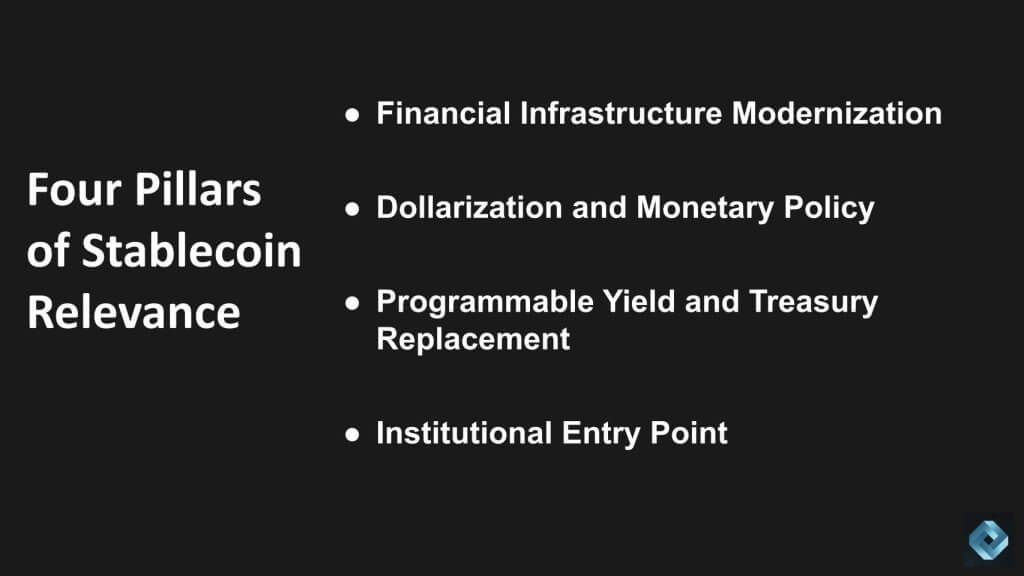
Stablecoins bridge traditional and decentralized finance. Their relevance is driven by four factors:
Let’s explore these further:
- Financial infrastructure modernization – Stablecoins streamline cross-border payments, offering 24/7/365 settlement with reduced fees.
- Dollarization and monetary policy – Stablecoins are amplifying the U.S. dollar’s global influence.
- Programmable yield and Treasury replacement – Ethereum-based staking offers alternatives to traditional fixed-income investments, allowing users to earn rewards for securing the Ethereum network.
- Institutional entry point – Banks and asset managers are launching regulated stablecoin products, transforming perceptions of crypto safety.
[Hear Tom Lee discuss the economics of stablecoins and staking]
Stablecoins are a hugely profitable business. Circle is showing it, because they don’t pay interest and they’re earning 4% on their reserves.… Coinbase is very profitable…. Ethereum treasury companies are very profitable.” – Tom Lee
Where do stablecoins fit in the crypto world?
Stablecoins provide essential liquidity within the crypto ecosystem. They are critical for decentralized finance (DeFi), centralized exchange (CEX) activities, and new applications such as tokenized assets, with Ethereum playing a central role in stablecoin deployment and smart contract innovation.
[Hear Tom Lee explain the original premise of Ethereum and its current role]
Ethereum is programmable. It is really robust… Wall Street is coming in and saying, ‘I want to tokenize a dollar.’ That’s the stablecoin. – Tom Lee
Public policy and the change from enforcement to engagement: Trump, Sacks and Atkins shift the regulatory posture
The shift from the previous administration to the Trump-Sacks-Atkins leadership signals a move from enforcement to encouraging innovation in U.S. crypto policy.
Under President Biden, the former SEC Chair Gary Gensler pursued an aggressive enforcement agenda, asserting that many digital assets should be regulated as securities. This approach led to regulatory uncertainty and stifled crypto innovation in the U.S.
By contrast, the appointments of David Sacks as the AI and Crypto Czar and Paul Atkins as SEC Chair under the Trump administration represent a move toward more market-friendly regulations. The anticipated outcomes include:
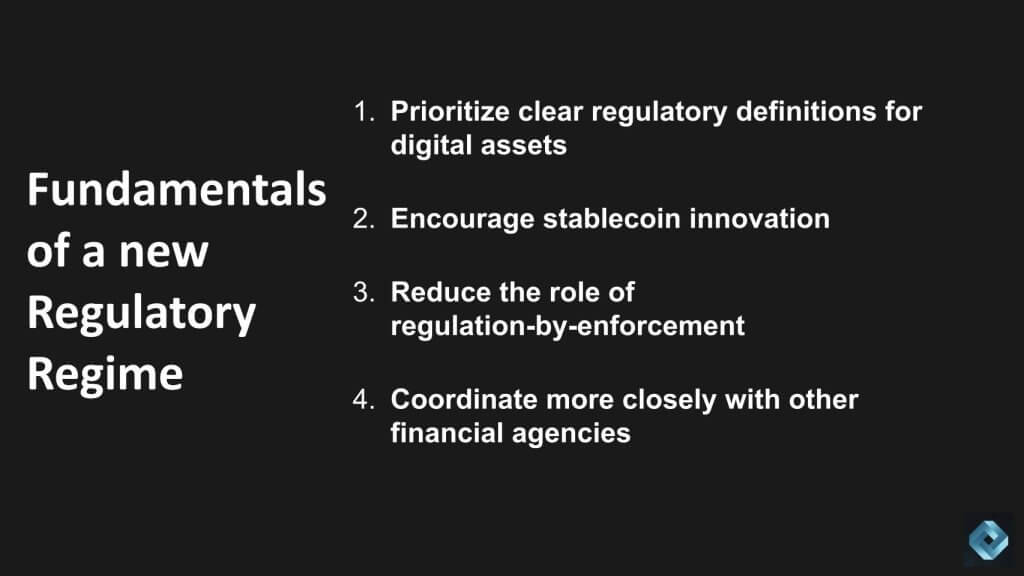
The priorities of the new administration are:
- Establishing clear definitions for digital assets to distinguish between commodities, securities, and stablecoins.
- Encouraging stablecoin innovation, including models for public-private cooperation to promote compliance and transparent reserves.
- Reducing regulation-by-enforcement and instead promoting clear guidelines to encourage responsible growth.
- Enhancing coordination among financial agencies to align digital asset strategies.
This shift is expected to encourage financial institutions, fintechs, and crypto firms to operate under clear, predictable rules. It also aligns the U.S. with other countries that have implemented forward-thinking crypto frameworks. Stablecoins, backed by the world’s reserve currency, could strengthen the USD and Treasury markets.
This is why Tom Lee calls stablecoins and the recent legislation the “ChatGPT moment for crypto.”
As we move into the later half of 2025, the regulatory obstacles that previously constrained U.S. crypto leadership are diminishing, paving the way for greater legitimacy, capital formation, and a competitive edge for the dollar.
The regulatory evolution: How it has shaped attitudes
Attitudes toward crypto are undergoing a significant transformation. What once seemed unconventional is now becoming commonplace, with Wall Street increasingly investing in and building infrastructure around crypto assets.
This legitimization extends beyond regulations to cultural acceptance. The listing of crypto firms on the NYSE, as noted by Lee, signals a powerful acceptance by traditional finance.
[Here’s Tom Lee’s perspective on the credibility of crypto and why the NYSE]
What is the GENIUS Act?
The Guiding and Establishing National Innovation for U.S. Stablecoins (GENIUS) Act provides a comprehensive framework for regulating stablecoins, aiming to clarify the market, protect consumers, and support the U.S. dollar’s role as a reserve currency. The bill was enacted into law in July 2025.
The GENIUS Act is important because of its comprehensive approach to stablecoin regulations.
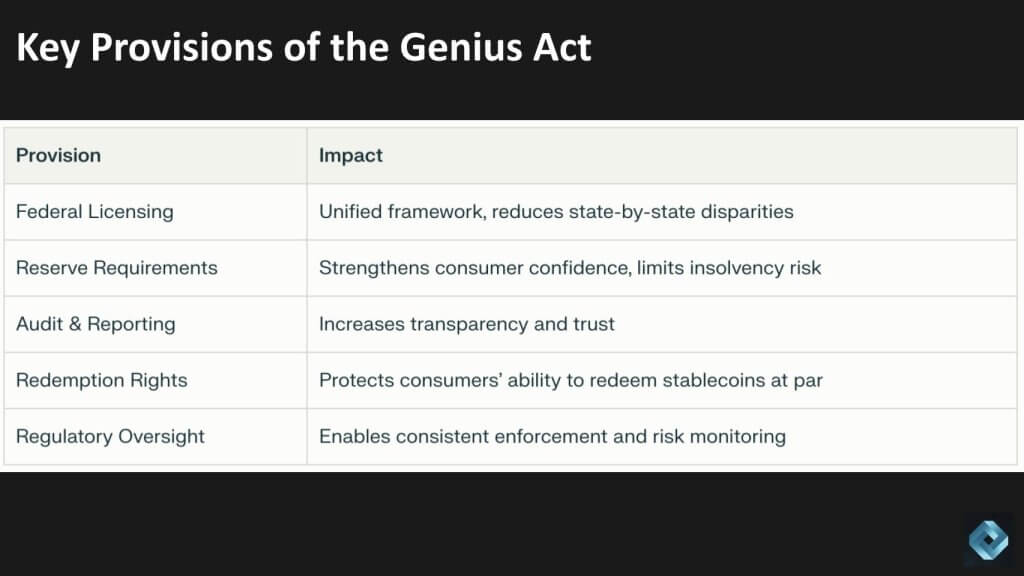
Key provisions include:
Unified Federal Regulation: The Act establishes the first comprehensive federal regulation for stablecoins, addressing the lack of consistent rules across states and reducing regulatory uncertainty.
Consumer Protection: By mandating reserve requirements and clear redemption policies, the act aims to mitigate risks like issuer insolvency and consumer losses.
Innovation: The act permits both banks and qualified non-banks to issue stablecoins, promoting competition and innovation while ensuring market integrity.
Systemic Risk Mitigation: By subjecting issuers to ongoing supervision and ensuring transparent, secure assets, the act addresses systemic risks in payment systems and decentralized finance.
What is the status of the CLARITY Act?
The Clarity for Payment Stablecoins Act has passed the House Financial Services Committee with bipartisan support. It defines payment stablecoins, sets reserve requirements and audit standards, and provides registration paths. Crucially, this bill distinguishes stablecoins from securities, creating a legal framework for banks and fintechs to issue them.
The act’s passage is expected to accelerate institutional adoption and reduce regulatory uncertainty, making it a foundational element of crypto policy.
The GENIUS Act and CLARITY Act differ as follows:
GENIUS Act: It is focused on the regulation of payment stablecoins.
CLARITY Act: This legislation creates a broader market structure for digital assets beyond stablecoins, clarifying their regulatory treatment and supervisory roles.
How are stablecoins backed?
Stablecoins like USDC are backed by short-term U.S. Treasuries and cash equivalents. Issuers collect deposits, invest in T-bills yielding approximately 4% to 5%, and retain the interest.
As Tom Lee noted, “Circle doesn’t pay interest and they’re earning 4% on their reserves.”
This generates substantial cash flow, making stablecoins similar to money market funds but with blockchain-native benefits such as seamless money transfers, absence of trusted third parties, lower fees, and blockchain immutability.
What does this mean for US Treasuries?
Stablecoins are becoming significant buyers of U.S. Treasuries. Their increasing adoption boosts demand for T-bills, supporting market liquidity and expanding the dollar’s global influence, particularly in emerging markets.
[Tom Lee explains this dynamic using Bermudian dollars as an example]
This reinforces U.S. economic strength through digital financial infrastructure, creating a beneficial geopolitical effect.
The GENIUS Act’s implications for the U.S. Treasury market are significant because it mandates that stablecoin issuers back their tokens with high-quality, liquid assets, mainly U.S. Treasuries and cash equivalents.
Increased Demand: Stablecoin issuers must maintain reserves in cash or short-term U.S. Treasury securities. As the stablecoin market grows, these issuers will become major purchasers of Treasuries.
Reinforced Dollar Hegemony: By enhancing the attractiveness of U.S. dollar stablecoins globally, the law supports the continued importance of U.S. Treasuries as a safe asset, boosting demand for dollars and Treasuries.
ETR data for fintech
Enterprise Technology Research (ETR) data shows various fintech platforms, with platform spending velocity on the Y-axis and market penetration on the X-axis.
Stripe’s leadership illustrates a key point.

Stripe’s strength signals institutional validation for crypto rails
ETR data from July 2025 shows Stripe leading with the highest Net Score and broadest shared account footprint among fintech vendors, surpassing legacy platforms.
This confirms the merger of the crypto economy with mainstream fintech infrastructure, with firms like Stripe playing a primary role.
- Stripe’s momentum reflects enterprise demand for programmable payments, embedded finance, and crypto onramps and offramps.
- Its integration with stablecoin networks aligns with regulatory changes under the new administration.
- Stripe’s leadership highlights its early advantage in offering compliant crypto services to institutional clients.
This validates Tom Lee’s view that stablecoins are the “ChatGPT moment” for crypto, with banks and fintechs racing to offer Ethereum-based stablecoin solutions.
There are always risks — so investor beware
Despite the positive changes in crypto policy, it’s essential to consider the potential risks.
Relaxed regulations can lead to financial instability, as illustrated by past crises:
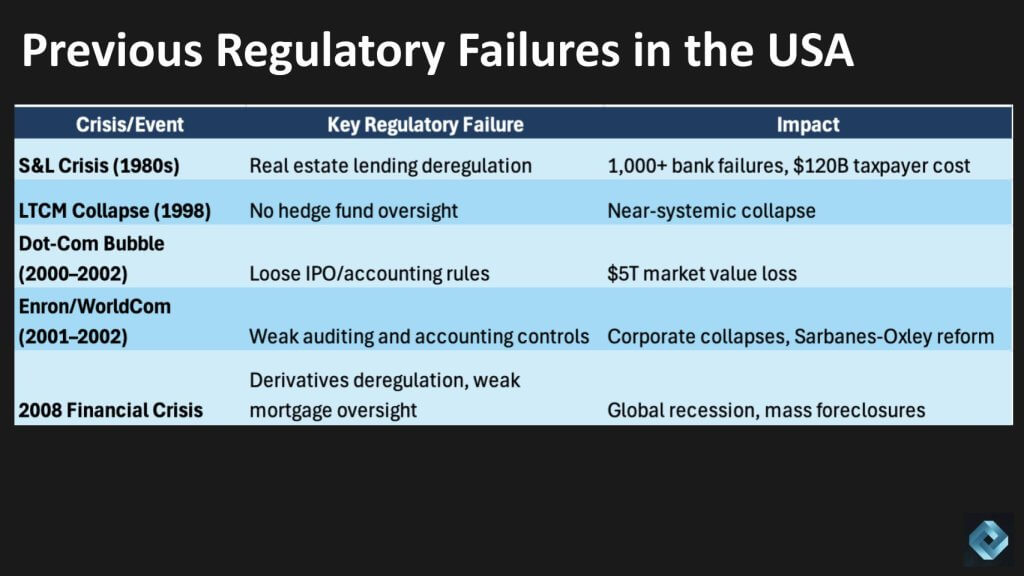
Examples include the S&L crisis, the collapse of Long Term Capital Management, the dotcom bubble, the Enron and Worldcom scandals, and the 2008 financial crisis.
Despite the tailwinds, the stablecoin ecosystem faces risks:
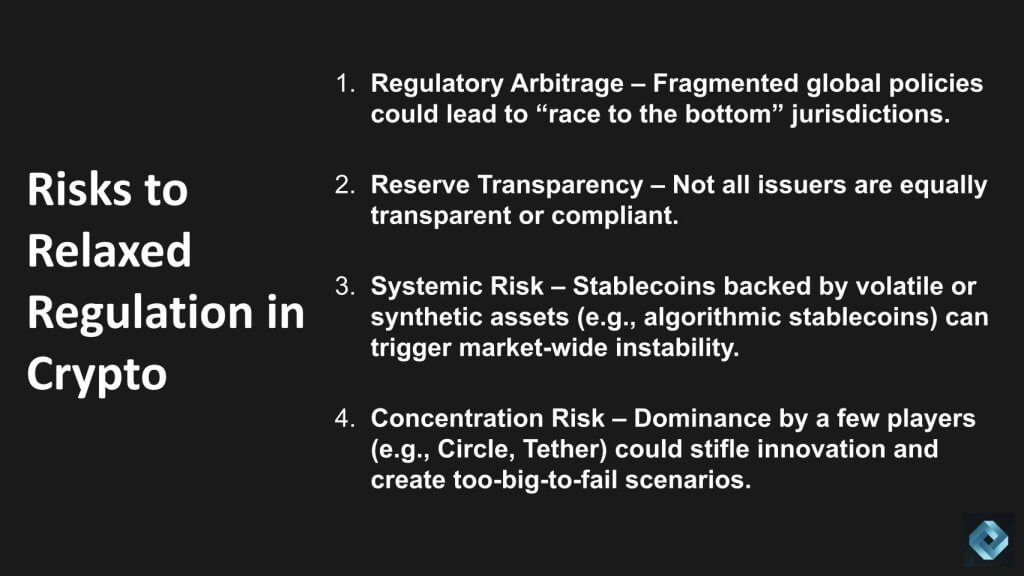
- Regulatory arbitrage: Fragmented global policies could lead to a race to the bottom, where companies move to jurisdictions with weaker rules, leading to less transparency and higher risks.
- Reserve Transparency: Not all issuers are equally transparent or compliant, creating opportunities for misconduct.
- Systemic Risk: Stablecoins backed by volatile or synthetic assets can trigger market-wide instability.
- Concentration Risk: Dominance by a few players could stifle innovation and create too-big-to-fail scenarios.
As Tom Lee emphasized, clear backing is crucial.
As he also noted, ironically, many existing fiat-pegged currencies operate with less transparency than modern stablecoins, making these stablecoins more stable than many existing currencies.
Closing thoughts
Despite the risks, stablecoins are transitioning from experimental crypto tools to mainstream instruments of economic policy and programmable finance. The regulatory environment is clarifying, and lawmakers, investors, and financial institutions are increasingly focused on stablecoins.
Crypto has experienced many significant moments, but this one feels different. As Tom Lee would say, this one has a yield.
Disclaimer: All statements made regarding companies or securities are strictly beliefs, points of view and opinions held by SiliconANGLE Media, Enterprise Technology Research, other guests on theCUBE and guest writers. Such statements are not recommendations by these individuals to buy, sell or hold any security. The content presented does not constitute investment advice and should not be used as the basis for any investment decision. You and only you are responsible for your investment decisions.
Disclosure: Many of the companies cited in Breaking Analysis are sponsors of theCUBE and/or clients of theCUBE Research. None of these firms or other companies have any editorial control over or advanced viewing of what’s published in Breaking Analysis.
Image: theCUBE Research/Reve
Support our open free content by sharing and engaging with our content and community.