According to Bitwise, the relationship between Bitcoin and gold has reached its highest point in six years, indicating that investors are turning to Bitcoin as a safeguard against potential fiscal issues in the U.S.
- The Coinbase premium index indicates that lackluster spot demand in the U.S. suggests a rally to $85,000 will require stronger buying interest.
- With short-term holders seeing unprecedented gains and a bearish divergence in on-balance volume (OBV), profits may be taken soon, leading to a potential price increase.
- At present, Bitcoin’s valuation is influenced by the anticipated Federal Reserve rate hike in September, fluctuating oil prices, and the yen carry trade, which could tighten financial conditions impacting the asset.
Bitcoin (BTC) is facing significant challenges as diminished spot demand, increased profit-taking risks, and revived concerns over the macroeconomic landscape could hinder the cryptocurrency’s ascent toward the $85,000 mark. While Bitcoin is increasingly viewed as a hedge akin to gold, analysts caution that the next phase of its rally may hinge on bolstered buying support and decisions made by the Federal Reserve this September.
Throughout early September, the Coinbase Bitcoin Premium Index remained predominantly negative, indicating that U.S. spot demand hasn’t kept pace with Bitcoin’s price recovery. Although the index saw a brief improvement during a recent rally, this upward movement was not maintained, leading to ongoing declines. This raises questions about whether Bitcoin can sustain its upward trajectory toward $85,000, a target closely monitored by many retail traders on Stocktwits.
According to data from CryptoQuant, the Bitcoin short-term holder (STH) whale group currently holds a staggering $9 billion in unrealized profits, increasing the potential for a near-term sell-off. Historically, these short-term holders have been quick to realize gains when prices begin to falter. Thus, even a minor pullback could prompt profit-taking and introduce additional volatility to Bitcoin’s recovery.
Bitcoin’s Support Wanes
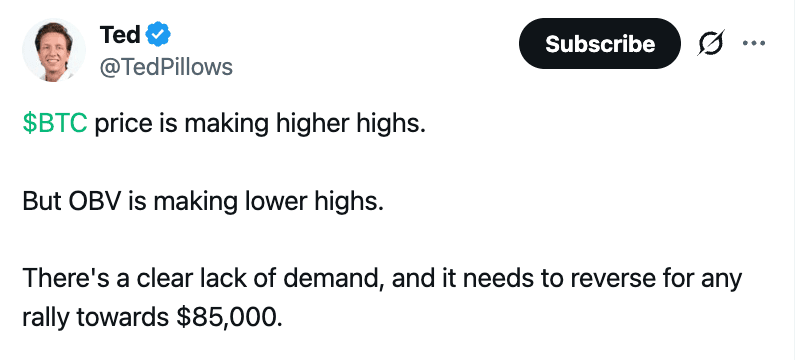
In a separate observation, crypto analyst Ted Pillows highlighted a bearish divergence between Bitcoin’s price movement and on-balance volume (OBV). While the cryptocurrency has been reaching higher price levels, the volume indicator has been falling. This trend suggests that fewer investors are supporting the price increase, which could signal a weakening rally.
Bitcoin has increasingly begun to behave like gold, with their correlation reaching a six-year peak. According to Bitwise, this shift has been spurred by concerns surrounding risk and a renewed interest in tangible assets, aiding Bitcoin’s recovery. The cryptocurrency has surged from the low $60,000s to about $80,000, with many investors viewing it as a hedge against currency devaluation and U.S. fiscal issues.
Currently, Bitcoin’s price hovers around $78,408, representing a decline of over 1% in the last 24 hours. Retail sentiment regarding BTC on Stocktwits is primarily neutral, alongside normal interaction levels noted over the past day.
Fed Decisions and Oil Prices Influence Bitcoin’s Future
Presently, Federal Reserve policies play a significant role in Bitcoin’s price behavior. The market has gauged a roughly 60% chance of a 25-basis-point increase in September, influenced by Kevin Warsh’s commentary on inflationary pressures. However, Fed Governor Christopher Waller has countered recent inflation interpretations, suggesting “encouraging signs” of disinflation and expressing a preference for maintaining rates if August’s inflation numbers affirm the trend.
Such statements have contributed to a decline in U.S. Treasury yields, aiding Bitcoin’s rise above $80,000. The cryptocurrency’s ability to maintain its gains will likely depend on upcoming inflation reports and the Fed’s selections in September.
Additionally, oil prices are a crucial consideration. Brent crude surpassed $97 a barrel even as former President Donald Trump predicted that prices will drop “dramatically” post-Iran conflict. While one outcome could lower inflation expectations and benefit Bitcoin, another supply-driven surge could bolster the argument for tighter monetary policy.
Yen Appreciation and Treasury Yields Heighten Bitcoin Risks
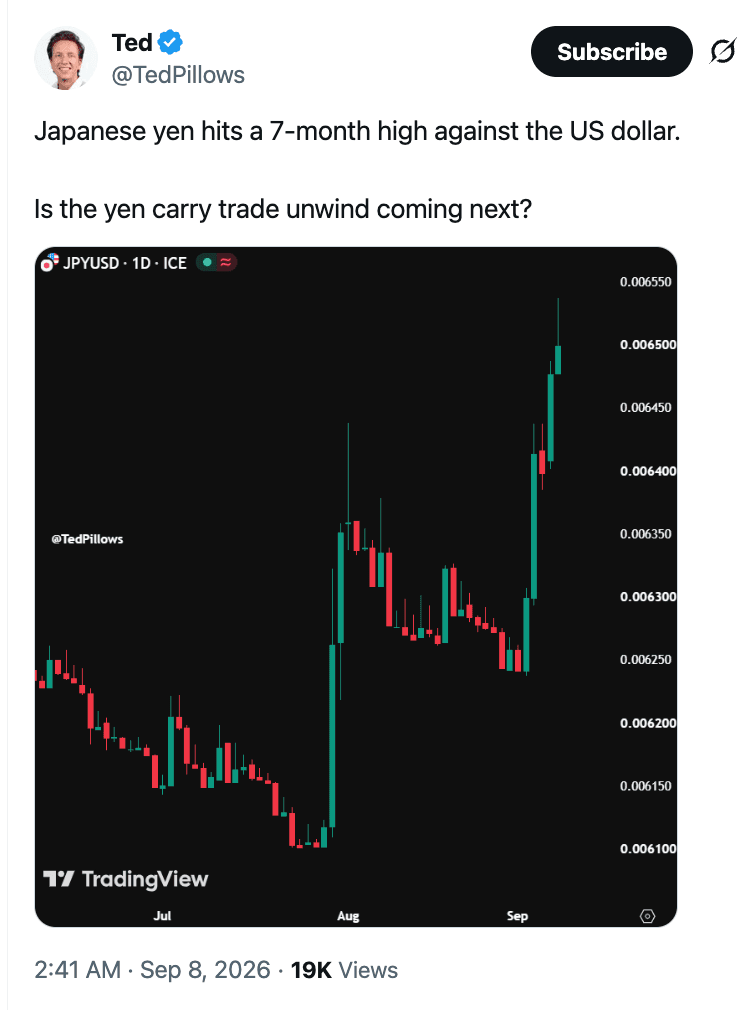
The Japanese yen has appreciated to a seven-month high against the U.S. dollar, triggering speculation regarding the potential unwinding of the yen carry trade. Observations by Pillows suggest that this could add pressure to risk assets if investors reduce their leveraged positions.
A recent report from CoinShares highlights that the bond market serves as another vital influence. Concerns about the scale of government debt and U.S. bond levels have kept annual Treasury yields around a high 4.7%. A further decline in confidence regarding U.S. sovereign debt could elevate alternative stores of value, such as gold and Bitcoin; however, tighter financial conditions may suppress the cryptocurrency.
For more insights: Dow, S&P 500, Nasdaq Futures Decline as Iran Conflict Drives Oil Prices Near $100: TSLA, NVDA, ORCL, INTC, BIDU, BABA Under Scrutiny
For updates and corrections, contact newsroom[at]stocktwits[dot]com.