
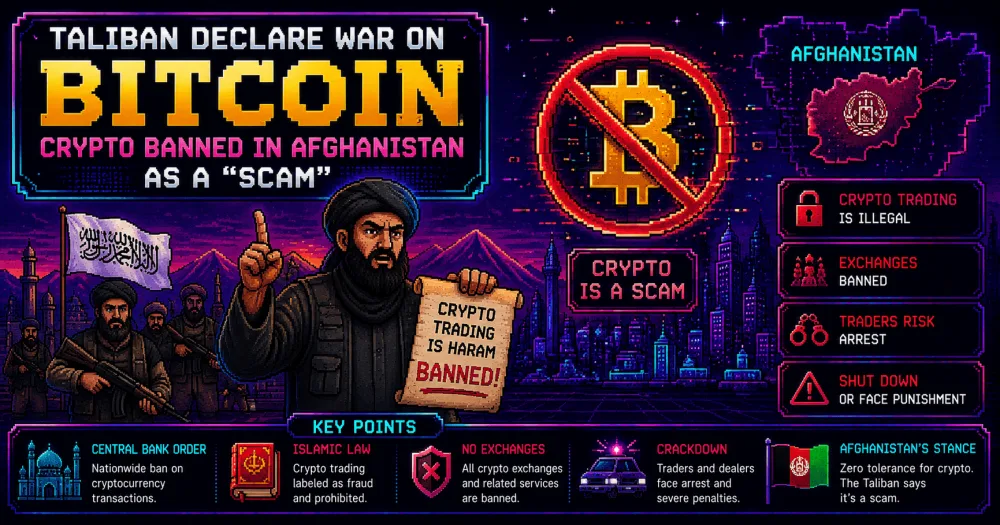
Initially, Afghanistan appeared poised to embrace Bitcoin, but the Taliban’s emergence abruptly changed that narrative.
The Taliban’s prohibition of Bitcoin pushed an emerging cryptocurrency market into secrecy; however, both Bitcoin and stablecoins remained crucial tools in a landscape where traditional banking and remittances collapsed.
Related: Bitcoin vs. Gold: Is the World Finally Ready to Replace Gold with BTC?
Contents
Reasons Behind the Taliban’s Ban on Bitcoin and Cryptocurrency in Afghanistan
Central Bank of Afghanistan Issues Nationwide Ban on Cryptocurrency
Da Afghanistan Bank enacted measures against online trading, reinforcing a broad ban on cryptocurrency and asserting a lack of legal structures to support licensed trading.
This ban extended to both businesses and individual traders, with warnings that noncompliance would result in legal repercussions.
The Taliban’s Claim of Cryptocurrency Being “Fraudulent”
The Taliban criticized digital currency trading as deceptive and harmful to the public, alleging it caused financial losses and incited scams.
Such sentiments played a critical role in justifying the ban on cryptocurrencies, including Bitcoin and other altcoins.
Questioning Bitcoin and Islamic Finance
Justifications for the Taliban’s actions also stemmed from Islamic finance principles, with officials arguing that speculative trading equated to gambling, which is prohibited under sharia law.
While the government investigated the potential for integrating digital assets into Islamic finance, they ultimately opted for an outright prohibition.
Taliban vs. Bitcoin: What Specifics Are Restricted in Afghanistan?
What is the Legal Status of Bitcoin in Afghanistan?
Bitcoin trading operates outside the sanctioned financial framework in Afghanistan, and the central bank has not issued licenses for any cryptocurrency companies.
Is Bitcoin illegal in Afghanistan? Given the Taliban’s stance, all commercial trading and exchange activities face prohibition and severe penalties.
Are Cryptocurrency Exchanges Prohibited in Afghanistan?
Regulators have targeted physical and online crypto exchanges. Local exchanges cannot apply for a legitimate business license, effectively blocking access to the link between fiat and digital currencies—a scenario that hampers businesses’ legal integration.
The Fate of Individuals Engaged in Cryptocurrency Trading
The enforcement actions have included shutdowns, arrests, and threats of legal penalties. The crackdown was more than a mere regulatory warning; open traders and crypto enterprises risk significant legal scrutiny, forcing much trading underground.
Taliban’s Warning: Stop Trading or Face Arrest
Authorities have delivered a straightforward ultimatum to traders: cease operations or confront serious consequences. Police actions in Herat targeted businesses that ignored the ban, leaving local operators to decide between closing down, exiting the market, or risking detention.
Escalating Arrests of Crypto Dealers by the Taliban

Number of Crypto Traders Arrested
The first enforcement sweep in Herat led to thirteen arrests, most of whom were quickly released on bail, with over twenty businesses shuttered by the authorities.
Traders in other regions also faced mounting pressure, as the Taliban’s actions sent a clear warning throughout the nation.
Related: Why Bitcoin Is Compared to Oil: Digital Gold vs Black Gold Explained
Herat’s Emergence as a Key Crypto Center
Before the crackdown, Herat had established itself as Afghanistan’s primary crypto hub, boasting four of the six active brokerages in the country.
Its geographical position close to Iran also facilitated critical trading activities, allowing traders to manage conversions between cash and digital currencies.
Stablecoins: A Crucial Resource for Afghan Users
While Bitcoin garnered significant attention, many Afghan users preferred dollar-pegged stablecoins due to their relative stability compared to more volatile crypto assets.
Stablecoins provided a dependable method for transactions and savings, helping users preserve their purchasing power while facilitating international money transfers.
| Metric | Before the Crackdown | After the Taliban Ban | Insights |
|---|---|---|---|
| Monthly Crypto Inflows | Over $150 million during peak periods | Below $80,000 on average | Crypto activity sharply declined |
| Crypto Brokerages in Herat | Numerous operational businesses | Over 20 closed establishments | Regulatory actions targeted physical venues |
| Crypto Traders Arrested | No major enforcement actions | At least 13 arrests in Herat | Trading carried legal risks |
| Bitcoin Access | Available through local vendors and P2P exchanges | Severely limited | Bitcoin remained technically usable |
| Stablecoin Usage | Common for remittances and savings | Largely moved underground | Users lost an essential dollar alternative |
| Exchange Activity | Growing post-2021 takeover | Essentially banned | The formal crypto market vanished |
| P2P Trading | Readily available | Possible but fraught with risk | Decentralized transactions became harder to suppress |
| Global Bitcoin Network | Unaffected | Unaffected | A national ban didn’t disable Bitcoin |
Bitcoin’s Role Beyond Wealth Accumulation in Afghanistan
Reasons Afghans Turned to Cryptocurrency Post-Takeover
Following the Taliban’s 2021 takeover, a series of sanctions and banking restrictions led to a financial system that proved extremely challenging for the average citizen.
In this context, Afghans began using crypto as a means to make payments when conventional systems failed them.
Using Bitcoin and Stablecoins to Navigate a Defunct Banking System
Cryptocurrencies offered a way to transfer funds that didn’t depend on local banks, allowing users to receive digital currencies directly into their wallets. Stablecoins were useful for remittances and savings, while Bitcoin provided an alternative outside of the mainstream financial arena.
When “Digital Gold” Becomes a Financial Escape Route
The term “digital gold” takes on a new significance for individuals living in a nation with limited banking resources.
The ability to control their assets independently from domestic banking systems affords Bitcoin holders a degree of financial autonomy that many in more developed economies take for granted.
The Taliban’s Discomfort with Financial Competition
The Utility of Crypto for Money Transfers
Cryptocurrency offered a method for people to transfer value without the need for approval from local banking institutions.
This inherent decentralization limited government control over individuals, making it difficult for authorities to monitor financial transactions.
Isolated from the Global Financial System: The Rise of Crypto
Afghanistan found itself increasingly cut off from the international financial system as foreign reserves were frozen and banking connections severed.
Cryptocurrency provided a means for users to receive money independent of traditional banking or remittance channels.
From Essential Financial Tool to Taboo Resource
What was once a lifeline for ordinary citizens quickly transformed into a banned commodity. The rapid shift saw cryptocurrency activity in Afghanistan drop dramatically, with traders who had established businesses suddenly facing regulatory reprisals.
Impact of the Taliban’s Cryptocurrency Ban on Afghanistan
Crypto Market Collapse Following the Crackdown
The decline was stark. Afghanistan had been at the forefront of grassroots crypto adoption prior to the enforcement of the ban. But with increased regulatory actions, activity virtually vanished, making the Afghanistan crypto market a bellwether for the crackdown’s effects.
Related: U.S. vs. Europe: Who Is Winning the Race to Regulate Crypto?
From More Than $150 Million Monthly to Under $80,000
Shortly after the takeover, inflows surged past $150 million. Before that point, monthly averages hovered around $68 million.
Now, average monthly activity has dipped below $80,000—a staggering decline of over 99% from its peak.
Sharp Drop in Crypto Adoption in Afghanistan
The situation reflects more than just a downturn trending towards a bear market: the fear of government enforcement has obliterated the visible trading infrastructure. Exchanges have shut down, traders have vanished, and users have been deprived of access to funds. The Taliban’s crackdown effectively expelled cryptocurrency from the mainstream.
Does Bitcoin Qualify as a “Scam”?
The Taliban’s Stance on Cryptocurrency
Taliban officials have associated cryptocurrency with fraud, speculation, and gambling, disputing its alignment with Islamic finance.
Such perspectives form the basis of their prohibition but do not accurately represent a technical understanding of the digital assets that exist.
Understanding Bitcoin: Reality vs. Misconceptions
Bitcoin is a decentralized digital monetary network with a predetermined supply limit. No corporation issues Bitcoin BTC▲$62,630.00 or assures returns to its users.
While its price may fluctuate significantly, such volatility does not equate to a scam.
While Crypto Scams Exist, Is Bitcoin One of Them?
Although scams are a reality in the crypto world, Bitcoin’s operational model diverges substantially from deceptive investment schemes. Fraud typically occurs at the level of individual projects or through phishing techniques. Bitcoin’s rules are openly available, and its supply isn’t artificially increased.
Is Bitcoin Usable by Afghans After the Taliban Ban?
Accessing Bitcoin in Afghanistan: Is it Possible?
Anyone with internet access and a willing partner can still obtain Bitcoin, although the risk of legal troubles complicates the matter.
So, is Bitcoin usable in Afghanistan? Although the network remains accessible, local trading activities face significant enforcement risks.
The Role of Peer-to-Peer Trading and Hawala
Peer-to-peer trading can provide some insulation from enforcement, as buyers and sellers can facilitate transactions directly and settle in cash.
Additionally, Afghanistan’s hawala system enables informal money transfers, complicating enforcement efforts when combined with cryptocurrency.
Banning Crypto: Simplicity on Paper, Complexity in Reality
Government actions may involve shutting down exchanges, detaining traders, and restricting web access; however, they cannot disable the Bitcoin network internally.
While individuals can still hold and receive Bitcoin, converting it to local currency without raising eyebrows poses challenges.
Implications of the Afghanistan Crypto Ban for Bitcoin
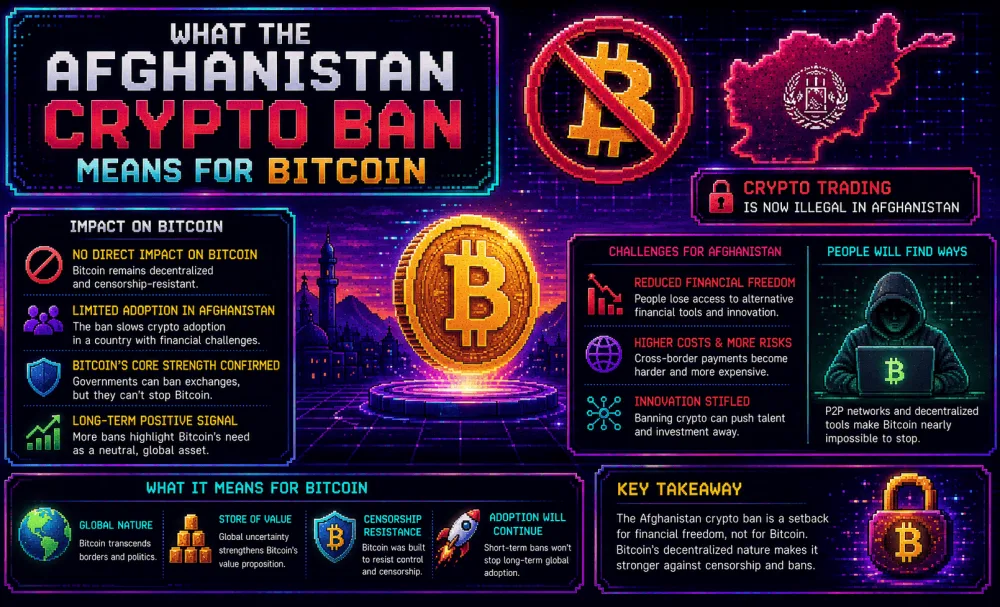
Can Government Bans Effectively Eradicate Crypto?
Governments can undermine local liquidity and render crypto challenging to use; however, Afghanistan exemplifies the limitations of such policies.
Despite the local trading and exchange activities facing severe restrictions, Bitcoin itself remains operational.
Afghanistan Tests Bitcoin’s Censorship Resilience
Afghanistan represents a significant challenge to Bitcoin’s resistance to censorship, as authorities actively seek to eliminate it from the economy.
While they have succeeded in dismantling many accessible market structures, they cannot entirely eliminate self-custodied wallets.
Ironically, a Bitcoin Ban Could Strengthen Its Case
The Taliban’s prohibition of Bitcoin underscores the value of decentralized currency. In times when conventional finance is lacking or less reliable, Bitcoin gains importance.
This ban highlights both the limitations of central authority and the durability of decentralized monetary systems.
Taliban vs. Bitcoin: Who Emerges Victorious?

While the Crypto Market Suffered, Bitcoin Endured
The local cryptocurrency sector has undoubtedly suffered, with trading volumes plummeting and businesses forced to close or face detention.
Nevertheless, Bitcoin itself continues to exist; individuals with access to private keys can still hold BTC, even if public trading has become perilous.
Insights on Crypto Freedom from Afghanistan’s Experience
Achieving financial autonomy requires more than just technology; users also need access to the internet, privacy, liquidity, and means to convert digital assets into cash.
While decentralization does not eliminate all barriers, it does complicate the efforts of authorities aiming for total prohibition.
From “Scam” to Financial Essential: The Complex Bitcoin Narrative in Afghanistan
Bitcoin’s journey in Afghanistan is filled with irony—while it faced bans, it also became invaluable for ordinary people.
Though Bitcoin carries risks, it exemplifies how unstable economies can appreciate features that more developed countries often overlook.
FAQ
What Were the Reasons for the Taliban’s Cryptocurrency Ban?
Officials associated cryptocurrency with fraud, speculation, gambling, and complications for Islamic finance. They also aimed to halt unregulated online trading.
Is Cryptocurrency Prohibited in Afghanistan?
The Taliban has outlawed crypto trading and does not permit exchanges to acquire standard licenses.
Can American or Foreign Platforms Serve Afghan Users?
That largely depends on sanctions, compliance regulations, platform policies, and local laws—many global services face restrictions in high-risk areas.
What has Occurred with Cryptocurrency in Afghanistan?
Visible activity has diminished dramatically following the crackdown, leading to steep declines in trading volumes and the closure of exchanges.
Can the Taliban Successfully Eliminate Bitcoin?
While they can significantly limit local usage, they cannot deactivate the global network or all self-custodied wallets.