


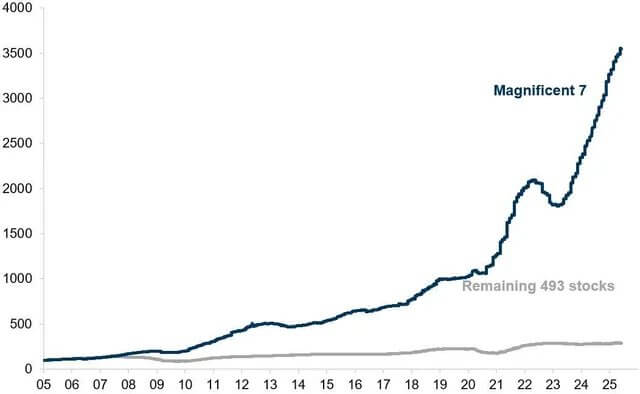
A quick look at the performance of the “Magnificent Seven” stocks reveals a strikingly clear upward trend. However, comparing them to the broader stock market landscape reveals an intriguing divergence. While these seven stocks exhibit significant growth, the remaining 493 generally maintain a stable, relatively unchanged performance. This divide highlights a potential shift in the economic landscape. Balaji Srinivasan, a Bitcoin proponent and founder of The Network State, suggests an explanation:
“My explanation is that the legacy economy is being sunset in favor of the Internet economy.”
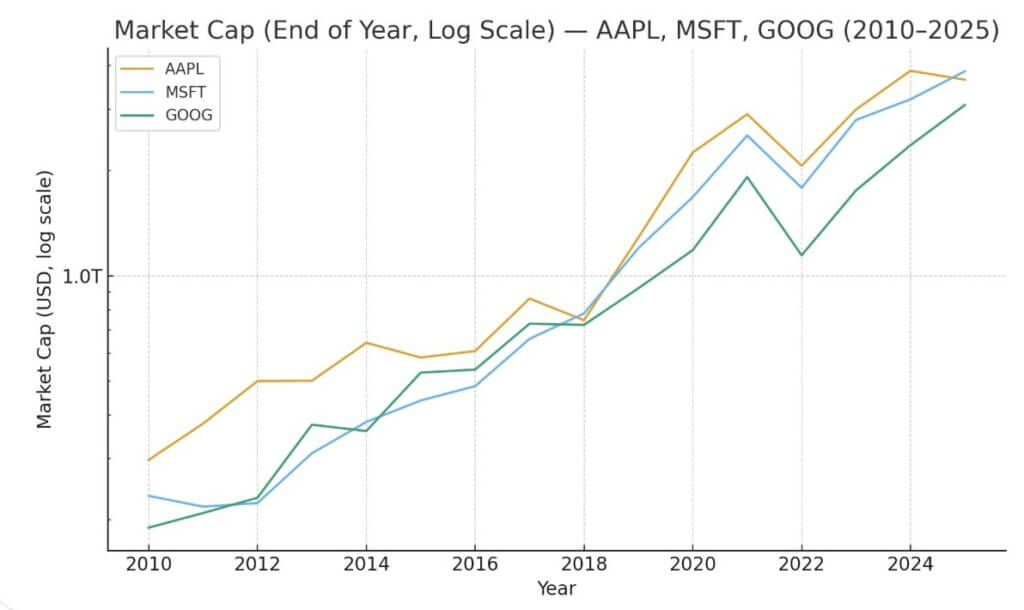
Patrick Collison, CEO of Stripe, has also noted similar trends, specifically observing comparable growth patterns across Google, Apple, and Microsoft. He questioned the commonality given their “ostensibly in totally different businesses,” to which Balaji posited:
“I think those graphs reflect the secular shift towards the Internet. Almost every action that was once done offline is moving online, and routed through tech companies.”
Understanding the Shift to Digital
What underlying dynamics are driving these observations? These correlated trends suggest a fundamental transformation.
This “secular shift” represents a lasting structural change in the economy. Specifically, it refers to the ongoing, decades-long move from physical spaces to online platforms across the global economy.
From ordering groceries to executing financial transactions, conducting social interactions, and facilitating remote work, the accelerated adoption of digital solutions brought on by the COVID-19 pandemic has solidified its position as the primary avenue for both commerce and connection.
Balaji’s Vision: The Internet Expanding Its Reach
Balaji’s response to Collison clarifies what many now recognize: tech companies aren’t merely expanding; they are becoming core elements of everyday life.
Traditional sectors like real estate, banking, and manufacturing are being reshaped, restructured, or entirely superseded by software-based solutions. As Balaji articulated, virtually every activity previously conducted offline is now “routed through tech companies,” with digital innovations offering unprecedented scalability, efficiency, and global accessibility.
This is more than simple technological advancement; it’s a complete reshaping of the landscape. This explains why seemingly unrelated companies are exhibiting similar growth patterns or facing comparable risks of decline: the traditional world is shrinking, and the digital economy is expanding to fill the void.
For investors and entrepreneurs, these trends highlight a clear need: prioritize digital investments or face potential obsolescence. The synchronized growth observed across seemingly disparate industries underscores that internet access and adoption are now critical determinants of economic performance.
Technology firms, leveraging their network effects and digital infrastructures, are assuming a central role in many activities. This reinforces a trend where a select few tend to dominate the market.
For policymakers, this trend should raise concerns: the digital divide will continue to expand unless deliberate efforts are made to bridge it. As more everyday functions are mediated by digital platforms, the disadvantages of being disconnected will increase.
The performance of the “Magnificent Seven” stocks, particularly Google, Microsoft, and Apple, illustrates a future in which software plays a central role in human life. This world is being shaped not just by individual breakthroughs, but by a global, irreversible transition from physical interactions to the digital realm.
The data supports this, and the trend is becoming more prominent.