

Ethereum
celebrated its 10th anniversary on July 30, 2025. From Vitalik Buterin’s groundbreaking concept in late 2013, it has transformed into the leading blockchain for smart contracts globally, underpinning innovations like DeFi, NFTs, and DAOs.
This article revisits the significant events, technological advancements, and market performance that have marked Ethereum’s journey, from its initial launch to the current Ethereum 2.0 ecosystem.
📅 Ethereum’s Evolution: Key Moments by Year and Month
Below is a chronological overview of Ethereum’s major milestones, including network launches, forks, protocol updates, and record price peaks.
2013
Nov 2013:
Vitalik Buterin
publishes the initial Ethereum whitepaper, introducing a decentralized platform with smart contract capabilities.
2014
Jan 2014: Ethereum is formally unveiled at the North American Bitcoin Conference.
Jul–Aug 2014: Ethereum conducts its initial coin offering (ICO), securing over 31,000 BTC (approximately $18 million USD).
2015
July 30, 2015:
Ethereum goes live
with its initial version, known as
Frontier.
During its early days, ETH traded around
$0.75.
2016
Mar 2016: Ethereum implements the
Homestead
upgrade, its first major network enhancement.
Jun 2016: The DAO is exploited, resulting in the theft of 3.6 million ETH.
Jul 2016: Ethereum executes a contentious
hard fork,
resulting in the emergence of
Ethereum Classic (ETC).
ETH’s price reached
$20
before the DAO incident, after which it declined.
2017
Mar 2017: The Enterprise Ethereum Alliance (EEA) launches, with members including Microsoft and JPMorgan.
Jun 2017: Ethereum experiences an
ICO surge,
with projects raising billions through ERC-20 tokens.
Dec 2017: ETH reaches
$826,
its first substantial price increase.
2018
Jan 13, 2018: During the peak of the cryptocurrency bull run, ETH achieves a new all-time high (ATH) of
$1,420.
Throughout 2018: Early DeFi concepts emerge, including platforms like MakerDAO and Compound.
2019
Feb 2019: The
Constantinople
upgrade introduces significant efficiency improvements.
Dec 2019: Development of ETH 2.0 accelerates with the launch of the Beacon Chain test network.
2020
Mar 2020: During the COVID-19 market crash, ETH’s value drops below
$100.
Summer 2020:
DeFi Summer
begins, with platforms like Uniswap, Aave, and Compound experiencing exponential growth.
Dec 1, 2020: The
Ethereum 2.0 Beacon Chain
is launched, marking the initial phase of the ETH Proof-of-Stake transition.
2021
Apr–May 2021: NFTs gain mainstream adoption, with projects like Bored Ape Yacht Club launching.
May 12, 2021: ETH reaches a new ATH of
$4,362.
Aug 5, 2021: The
EIP-1559
proposal is implemented with the
London upgrade,
introducing a base fee burning mechanism.
Nov 10, 2021: ETH reaches its final bull market ATH of
$4,878.
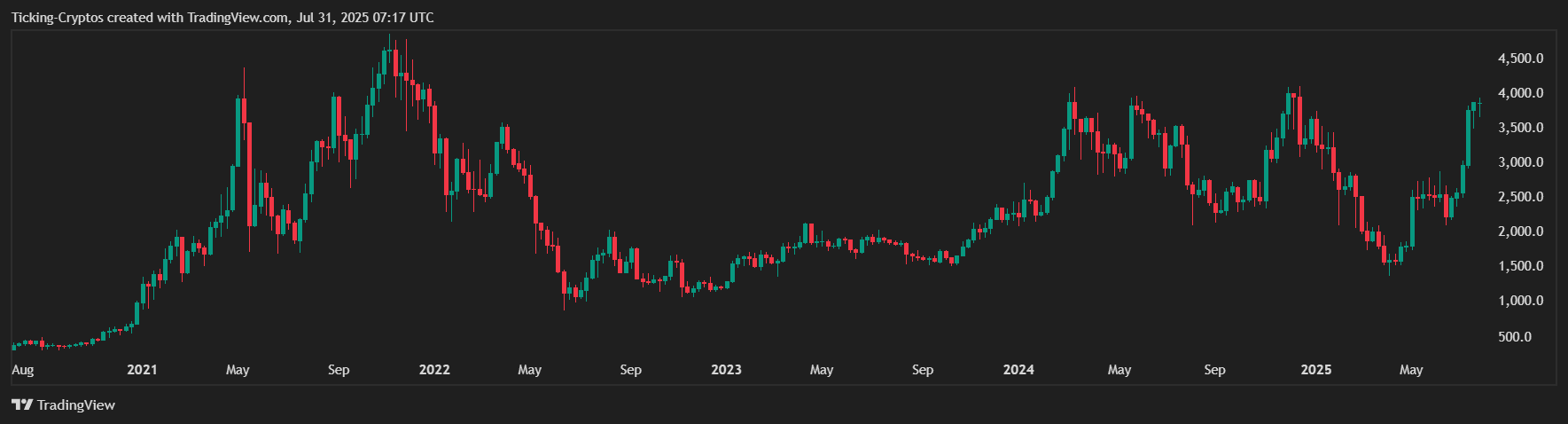
ETH/USD chart showing Ethereum reach its ATH in 2021 –
TradingView
2022
June 2022: Ethereum test networks begin successful merges in anticipation of The Merge.
Sep 15, 2022:
The Merge
is completed, and Ethereum officially transitions from
Proof-of-Work to Proof-of-Stake
.
A significant environmental achievement.
ETH’s price at the time of the merge was approximately
$1,600.
2023
Apr 12, 2023: The
Shanghai Upgrade
enables ETH
unstaking,
completing Phase 1 of Ethereum 2.0.
ETH price: Briefly peaks at
$2,100
after the upgrade.
Rollups and Layer-2 solutions such as Arbitrum, Optimism, and zkSync gain prominence.
2024
Q1 2024: The Ethereum ecosystem drives the modular blockchain trend, with EigenLayer and restaking becoming increasingly popular.
May 2024: Layer-2 activity reaches record levels, while ETH fees stabilize despite high demand.
ETH price: Surpasses
$3,700
amid a wider market upturn.

2025
May 2025: The Ethereum developer community finalizes strategies for integrating
Verkle Trees
and Proto-Danksharding.
Jul 30, 2025:
Ethereum reaches its 10th year,
marking a decade of open-source innovation and reshaping the financial landscape.
ETH is currently trading between
$3,300–3,500,
demonstrating resilience as it anticipates the next bullish phase.
🎉 Ethereum’s Legacy After 10 Years
Ethereum not only endured the volatile crypto cycles but also
led
through constant innovation. It gave rise to smart contracts, decentralized finance, NFTs, and the rollup-focused architecture of Web3.
The network has transitioned from Proof-of-Work to a scalable Proof-of-Stake system, burned millions worth of ETH tokens, reduced its emission rate, and evolved toward a more modular design.
As Ethereum celebrates its 10th anniversary, the next decade could bring
scalable ZK-rollups,
mainstream tokenization,
AI x blockchain integrations,
and a future where
deflationary ETH
becomes standard.