
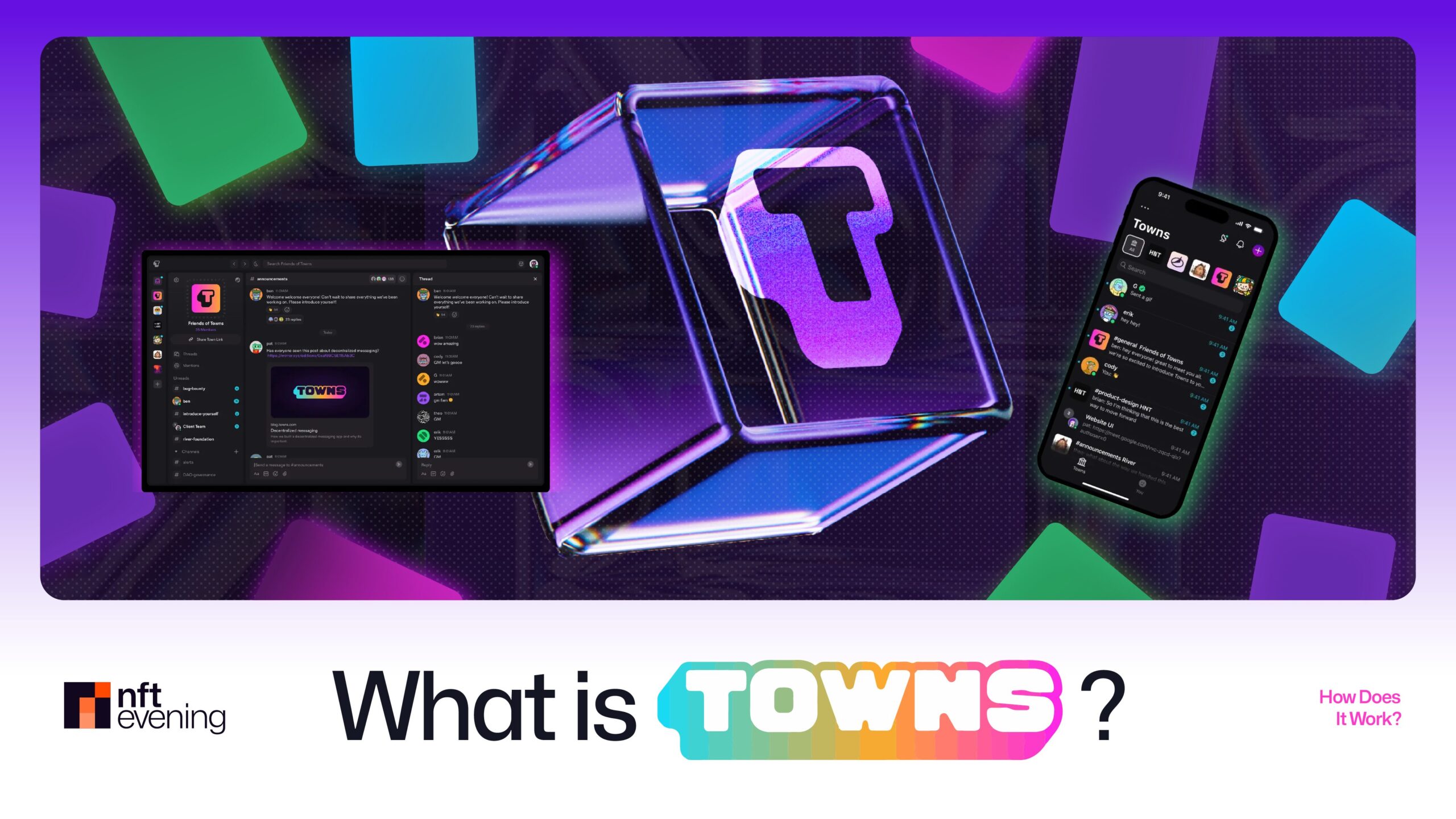
Unlike conventional platforms where algorithms and centralized control govern user interaction, Towns empowers individuals to directly own, manage, and profit from their online communities. Backed by significant venture capital and featuring a modular design alongside its dedicated TOWNS digital asset, the Towns Protocol is set to become a central element for on-chain communication and collaboration in the evolving Web3 landscape.
What Is Towns Protocol?
Towns Protocol is an inclusive messaging infrastructure developed on the Base network. It merges a Layer 2 blockchain compatible with the Ethereum Virtual Machine (EVM) with decentralized, off-chain stream nodes and adaptable smart contracts. Diverging from established platforms, it enables communities and users to build “Spaces” – secure, programmable communication hubs managed by smart contracts on Base.
Key attributes include:
- End-to-End Encryption safeguarding all message exchanges.
- Token-Gated Access facilitated via ERC-20 tokens, NFTs, or blockchain wallet memberships.
- On-Chain Memberships supporting paid subscription models and reputation-based access control.
- On-Chain Social Graphs & Governance tools ensuring transparent moderation and community organization.
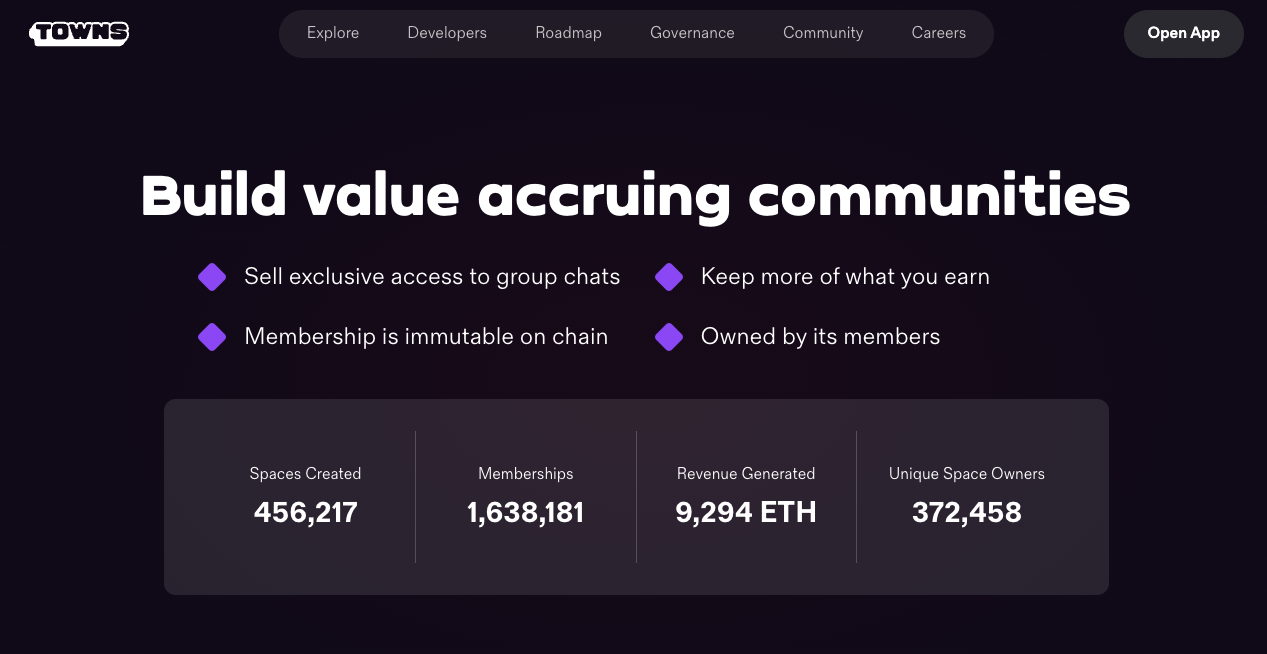
Already capturing attention in the Web3 social sphere, Towns has fostered millions of active “Spaces,” amassed over 1.6M memberships, and generated more than 9,300 ETH in revenue across the protocol. Its architecture enables communities to monetize access and maintain independent governance—features frequently limited to centralized platforms.
How Does Towns Work?
Towns Protocol operates as a decentralized communication framework built on Base Layer 2, facilitating online communities governed by tokens and powered by smart contracts. Fundamentally, Towns allows individuals to create programmable “Spaces”—akin to token-gated Discord servers—where access rights, administrative control, and content moderation are all enforced on-chain. These “Spaces” utilize a blended infrastructure: the on-chain component handles access permissions, subscriptions, and governance through Ethereum smart contracts, while real-time messaging is streamed and archived off-chain to ensure optimal performance. This two-tiered system maintains decentralization and individual ownership without compromising the user experience.
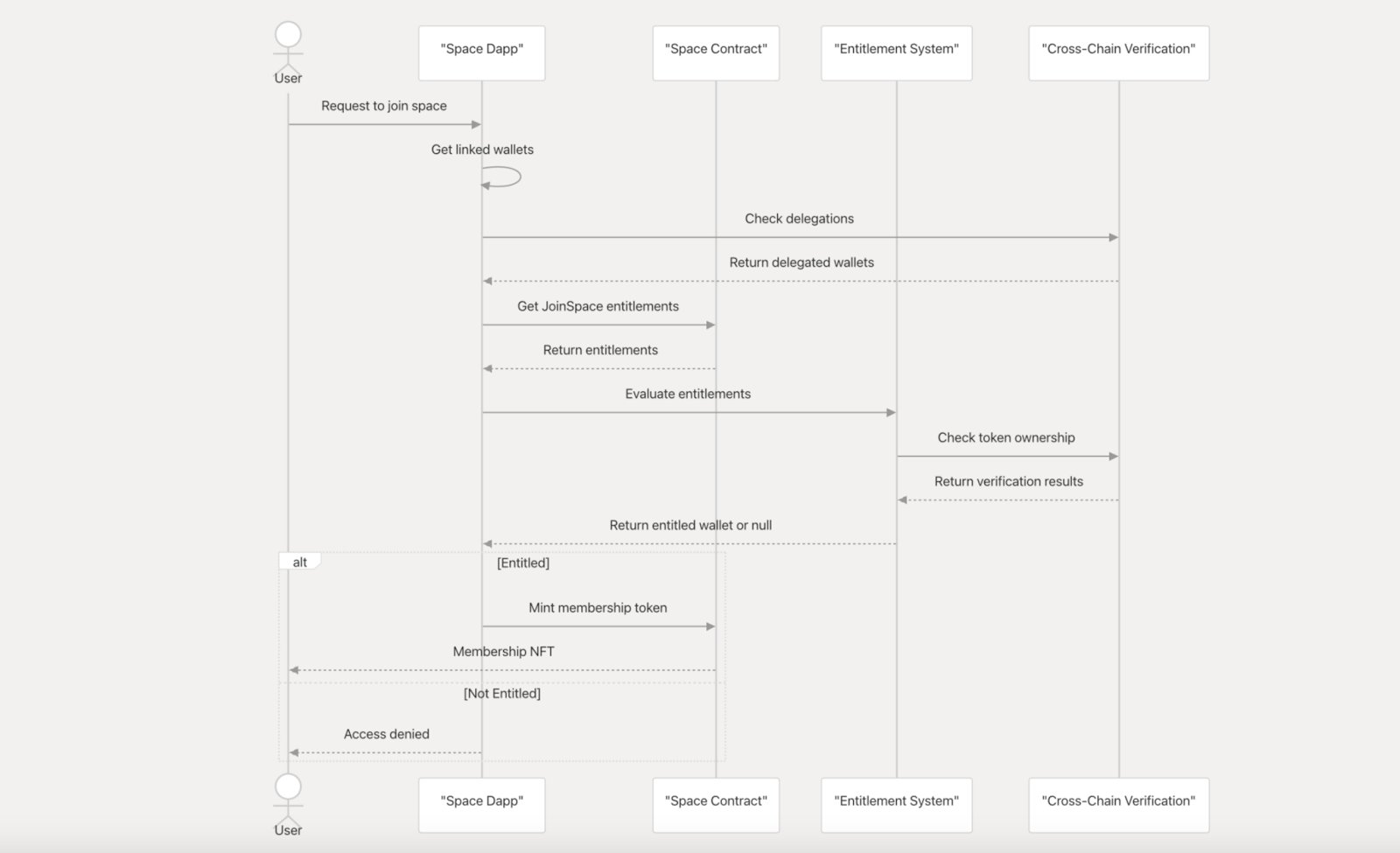
Each Space can require ownership of specific NFTs or tokens for entry, and communities can offer recurring crypto subscriptions, implement voting procedures, or introduce custom moderation policies. The TOWNS token is pivotal, enabling access management, governance voting, staking incentives, and the protocol’s long-term viability. Proceeds from paid Spaces are partly used to repurchase and retire TOWNS tokens, creating a deflationary characteristic within the ecosystem. Additionally, Towns furnishes developers with a comprehensive Software Development Kit (SDK) to integrate programmable chat into any Web3 application, Decentralized Autonomous Organization (DAO), or NFT initiative, thereby serving as a fundamental element of decentralized social infrastructure.
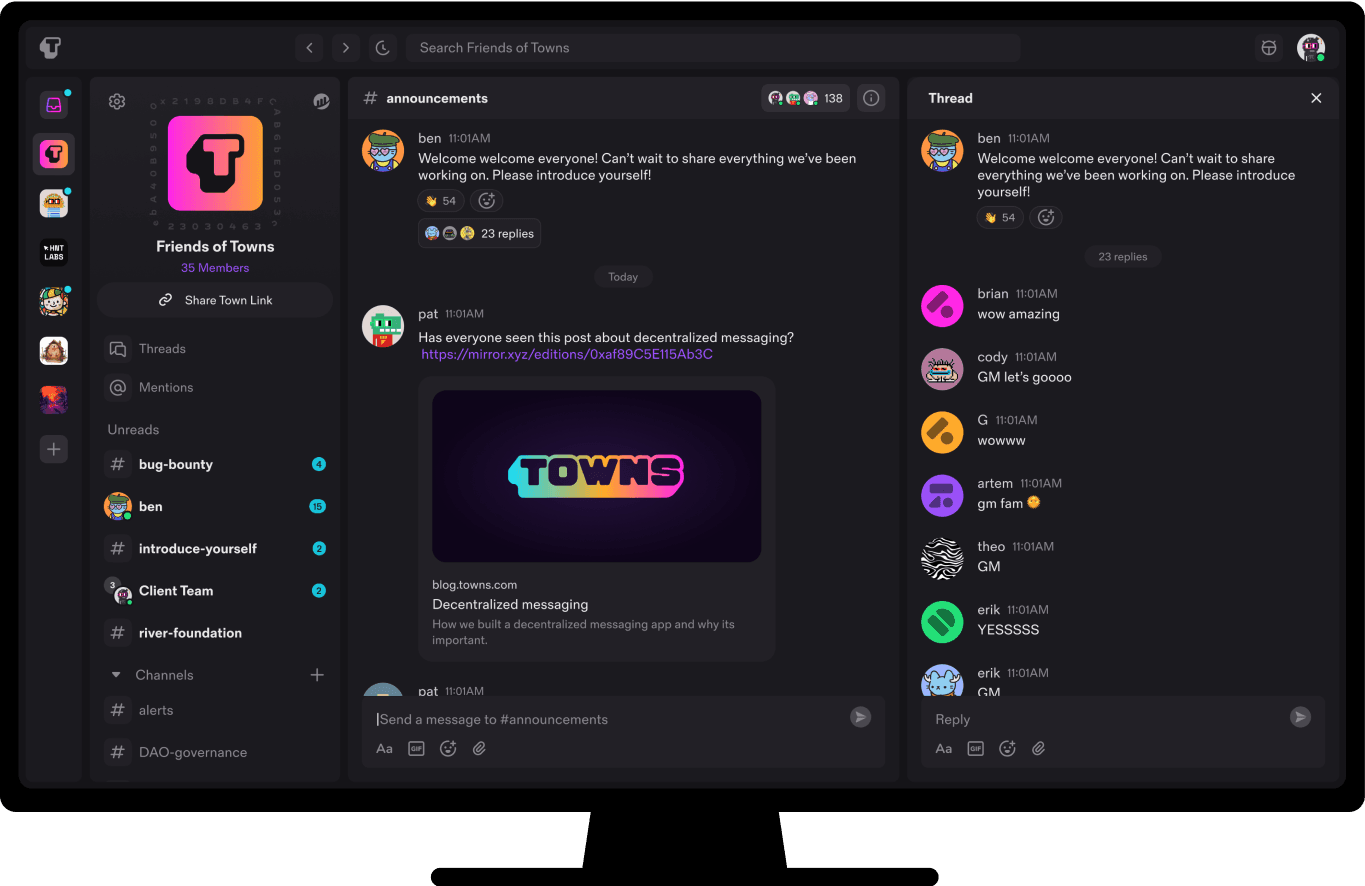
Unlike Web2 platforms like Telegram or Discord, where centralized entities control user data and dictate platform policies, Towns transfers authority to smart contracts—ensuring protection against censorship, preserving user privacy, and fostering community ownership. Featuring end-to-end encryption and rules reinforced through cryptography, Towns presents a Web3-native substitute for group messaging, fully integrated within the blockchain environment.
For more: Towns Airdrop Guide: SocialFi Project Backed by a16z
Key Components of Towns Protocol
Towns Protocol fundamentally comprises three essential elements: Towns Protocol (the foundational smart contract layer), appTowns (the user interface application), and daoTowns (the governance framework). Together, these layers construct a comprehensive, open ecosystem that enables encrypted, real-time communication, on-chain engagements, and decentralized governance.
Towns Protocol (Composable Infrastructure Layer)
The protocol layer consists of Ethereum smart contracts that are adaptable, expandable, and upgradeable. This infrastructure layer allows communities to establish their specific access protocols, content moderation guidelines, privacy configurations, and monetization strategies. Unlike rigid Web2 architectures, these contracts enable dynamic interactions tailored to the particular requirements of each community. From NFTs to DAO voting systems, all components are composable—allowing developers to integrate functionalities without needing to start from scratch.
To further strengthen decentralization, Towns operates through a distributed proof-of-stake network of nodes, ensuring its real-time communication is both resistant to tampering and free from censorship. End-to-end encryption guarantees that no central authority or infrastructure provider can access messages or associated metadata.
appTowns (The Interface Layer)
The appTowns application serves as the protocol’s primary interface—an entirely open-source, privacy-focused platform that brings its technical infrastructure to life. With an intuitive and seamless UI, users can engage in chats, participate in votes, conduct trades, and contribute to community projects—all in one unified space. appTowns directly integrates with Web3 wallets and identity protocols, linking a user’s blockchain address to their activities in a verifiable and secure way.
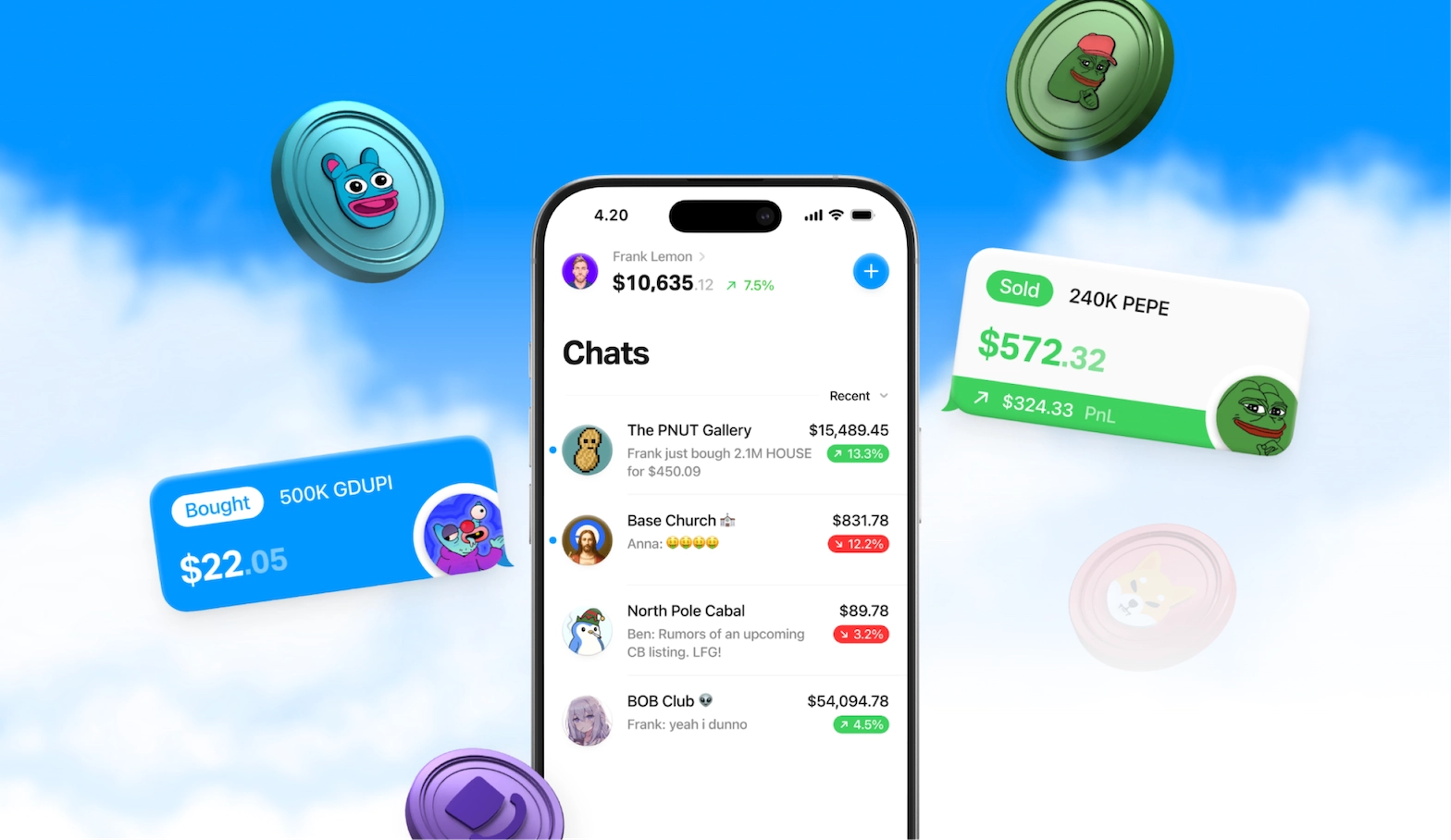
One of the key highlights of appTowns is its strong connection with the broader Ethereum ecosystem. Users can, for example, interact with NFTs, initiate DAO voting processes, or execute cross-chain operations directly from their chat interface. Communities can also incorporate games or decentralized finance tools, fostering a participatory economy within each Town. Envision it as a decentralized, censorship-resistant combination of Discord and Web3 functionalities.
daoTowns (Governance and Community Ownership)
The daoTowns system represents the protocol’s governance aspect. Overseen by the Towns DAO, its governance participants encompass developers, node operators, space administrators, and token holders. The DAO votes on essential updates, treasury allocations, incentive structures, and product strategy.
Instead of relying on centralized leadership, the Towns ecosystem is molded by the communities it supports. DAO participants can propose new features, allocate funds for development tools, and establish strategic alliances. Moreover, their engagement ensures Towns evolves according to user needs, rather than platform profit objectives.
Binance Airdrop and TOWNS Token Launch
Binance has designated TOWNS as the 30th project within its HODLer Airdrops program, retrospectively rewarding users who held and staked BNB via Simple Earn or On-Chain Yields between July 14 and July 17, 2025 (UTC). Qualified users will receive a portion of 305,848,461 TOWNS tokens, roughly representing 3.02% of the genesis supply.
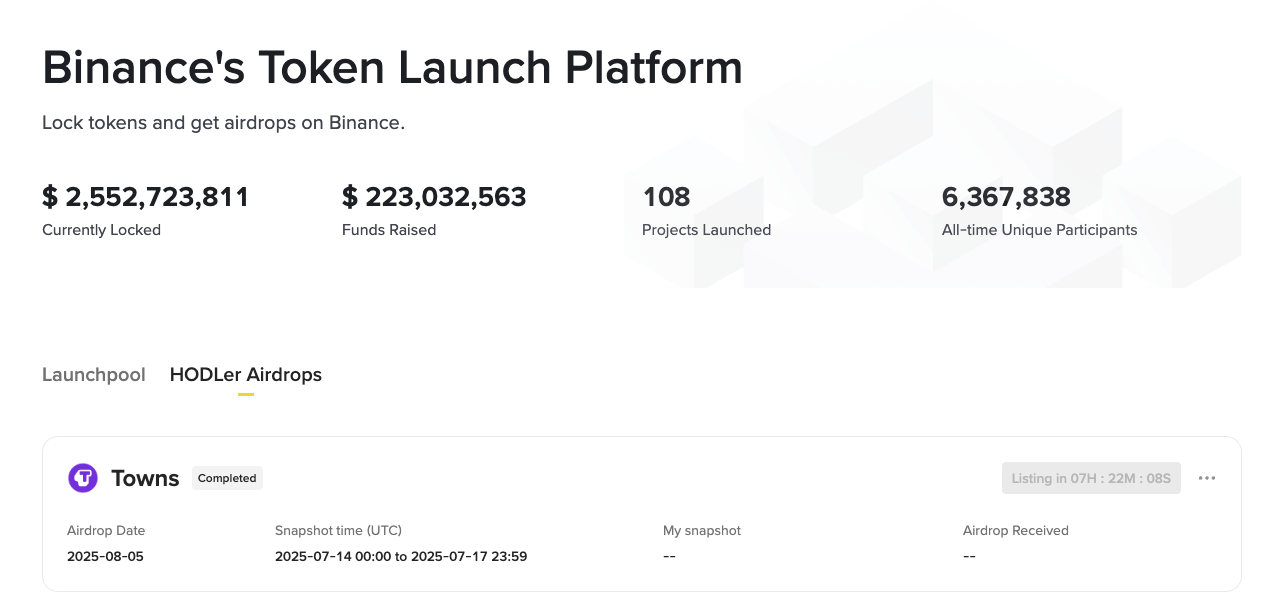
Binance is scheduled to list TOWNS on August 5, 2025, at 14:30 UTC, offering trading pairs such as TOWNS/USDT, USDC, BNB, FDUSD, and TRY. Initial trading will occur on Binance Alpha—a pre-launch environment—before transitioning to Spot markets. The asset will feature a Seed Tag, indicating that it may be a higher-risk, early-stage investment.
For more: Towns (TOWNS) Will be Listed on Binance HODLer Airdrops
TOWNS Tokenomics and Distribution
TOWNS debuted with a genesis supply around 10.13 billion tokens, and a maximum limit of 15.33 billion. At listing, the circulating supply is expected to be approximately 2.11 billion TOWNS (~20.8% of the genesis supply).
$TOWNS tokenomics puts the community first.
57% of tokens fuel airdrops, grants, and other community initiatives.
Team and Seed, Series A/B investors are locked for 1 year by a third party, then vest linearly.
Inflation is offset by a programmatic buy-and-burn. pic.twitter.com/BskbNslROc— Towns Protocol (@TownsProtocol) August 2, 2025
TOWNS token contract:
- BNB Chain: 0x00000000bcA93b25a6694ca3d2109d545988b13B
- Ethereum: 0x000000Fa00b200406de700041CFc6b19BbFB4d13
- Base: 0x00000000A22C618fd6b4D7E9A335C4B96B189a38
The token allocation strategy emphasizes community distribution:
- 57% of tokens are allocated for airdrops, grants, and overall ecosystem growth
- 35% is reserved for the team and initial investors (subject to a one-year lock-up with subsequent vesting)
- 8% is assigned to node operators and delegators to promote a decentralized infrastructure.
Furthermore, individuals who opt to stake TOWNS may receive a 50% bonus allocation, contingent on a 30-day withdrawal lock—designed to encourage sustained involvement and enhance decentralization.
A crucial mechanism involves token buybacks and burns, funded by protocol usage fees. Since its introduction, Towns has generated earnings exceeding $2.1 million, primarily utilized to repurchase and eliminate TOWNS, establishing a self-sustaining relationship between network activity and token demand.
The TOWNS token bolsters the protocol through three key functions:
- Access Control – Participation in specific spaces may require holding or staking TOWNS.
- Governance – Token holders participate in voting on proposals, including protocol enhancements, treasury distributions, and fee adjustments.
- Staking & Burns – TOWNS can be staked to earn incentives or rewards. Protocol revenues (from paid Spaces) are used to buy back and burn TOWNS, gradually reducing the overall supply.
Towns Protocol Team, Investors & Fundraising
Towns was established in 2023 by Ben Rubin (co-founder of Houseparty) and Patrick Fives, who previously held senior technology roles in consumer-focused social applications.

Brian Meek (left), Ben Rubin (Middle) and Patrick Fives (Right)
The protocol has accumulated around $25.5 million in Series A funding (Feb 2023), $10 million in Series B funding (Apr 2025), $1.11 million from Echo’s ICO round with restricted access conditions, and an additional $3.3 million via the ICO round Binance Holder Airdrop event—bringing total financing to almost $46 million.
Towns has raised $46 million to date from a16zcrypto, Coinbase Ventures, Benchmark, Framework, echodotxyz and other strategic angels.
Thank you to our partners who trust the vision that communication should be owned, not controlled. pic.twitter.com/54pz0WDm9z
— Towns Protocol (@TownsProtocol) July 30, 2025
Key investors include:
- Andreessen Horowitz (a16z Crypto)
- Coinbase Ventures
- Benchmark
- Framework Ventures
Towns Protocol signifies an innovative advancement toward communication infrastructure native to Web3, offering communities a secure and decentralized alternative to platforms like Discord or Slack—while embedding economic benefits and governance within its framework. Its tokenomics are structured to reward engaged users, generate scarcity, and provide significant control to creators and participants.
For more: Crypto Venture Capital Funds: Top Crypto VC Firms in 2025
FAQs
What distinguishes Towns Protocol from alternative chat platforms?
Towns provides users with direct ownership of their virtual spaces through the use of smart contracts, decentralized governance, and complete end-to-end encryption—capabilities not available on traditional platforms such as Discord or Telegram.
What types of communities can be built on Towns?
Communities can develop diverse ecosystems ranging from gaming centers and DeFi communities to NFT marketplaces and governance platforms. Towns is designed for modularity and composability, allowing custom rules, integrations, and monetization structures.
What are the applications of the TOWNS token?
The TOWNS token has various functions: it facilitates governance voting, incentivizes node operation, controls access rights, and potentially unlocks premium functionalities within Towns applications. Owning TOWNS grants influence over the protocol’s direction and treasury management.