In 2025, the cryptocurrency world appears promising at first glance. Bitcoin could reach unprecedented levels, and a US president with family deeply involved in crypto could support the sector. Crucially, Congress is expected to pass important crypto legislation.
Top Stories from Bloomberg
However, digging deeper reveals a more concerning reality beyond Bitcoin’s surge. Many alternative cryptocurrencies (altcoins), once considered Bitcoin’s rivals, are experiencing sharp declines. This year alone, they’ve lost over $300 billion in total market value.
This widespread downturn raises fundamental questions about the future of the industry. Early crypto visionaries imagined a dynamic ecosystem with numerous competing coins, each offering unique applications. But Bitcoin’s dominance is fueling predictions that much of the altcoin market will become irrelevant.
“I genuinely believe they’re going to die,” says Nick Philpott, co-founder of Zodia Markets, regarding altcoins. “They’ll simply fade away. Much of this will technically exist but be completely unused.”
CoinMarketCap data indicates that Bitcoin’s share of the overall crypto market has risen by nine percentage points this year, reaching 64%—its highest level since January 2021. Back then, the crypto landscape was largely unregulated, crypto lending thrived with minimal safeguards, and NFTs were just emerging.
Altcoins – a blanket term for digital assets other than Bitcoin and stablecoins – are struggling in stark contrast. A MarketVector index tracking the lower half of the top 100 digital assets initially more than doubled after Donald Trump’s November 5th election victory. However, it has since relinquished all of those gains and is currently down around 50% in 2025.
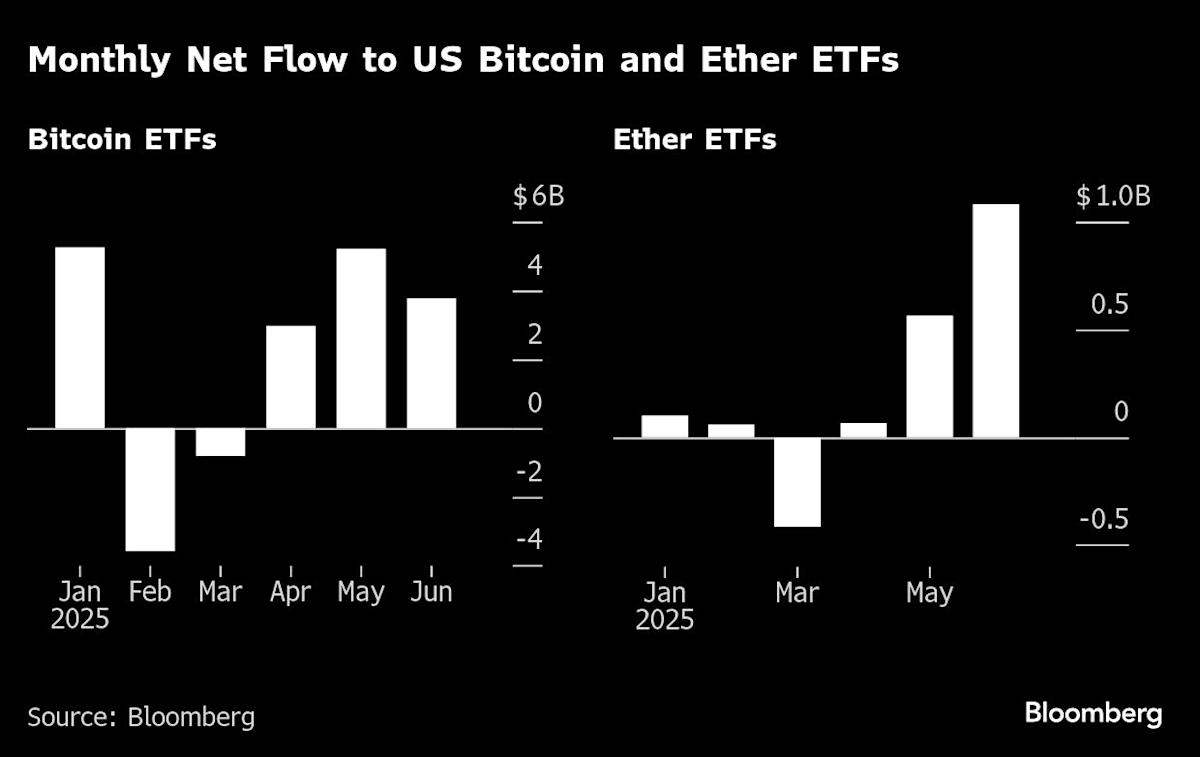
With Bitcoin attracting the majority of investment capital from exchange-traded funds (ETFs), other areas of the crypto market are increasingly neglected. Even Ether, the second-largest cryptocurrency, remains about 50% below its peak value, despite a modest recovery driven by ETF inflows.
“Historically, Bitcoin’s movements have rippled outwards to altcoins,” explains Jake Ostrovskis, an OTC trader at Wintermute. “We haven’t really seen that pattern emerge in this cycle yet.”
The cryptocurrency world is familiar with mass extinction events. The 2022 market collapse, marked by the failures of TerraUSD and FTX, led to the downfall of hundreds of projects. Thousands of coins persist on their respective blockchains, but show little activity, now relegated to being known as “ghost chains.”
This time, crypto’s increasing regulation and institutional involvement differentiate this situation. Stablecoins appear to be the only tokens with a viable pathway to achieving status as real payment methods due to their volatility reduction.
Over the past year, the market value of stablecoins has risen by $47 billion, and several major banks are entering the space. A recent Wall Street Journal article reported that Amazon is exploring the use of stablecoins.
This increasing pressure is causing altcoin projects to seek ways to improve their positions and broaden their investor appeal.
“I’ve spoken with projects considering merging foundations and presenting it for governance approval: ‘Hey, we can now operate under this other authority,’ with that authority being another altcoin community,” notes Kanyi Maqubela, Managing Partner at Kindred Ventures.
Corporate activities also demonstrate the shift. Inspired by Michael Saylor’s strategy, a new class of Bitcoin accumulators has emerged. In April, a SPAC affiliated with Cantor Fitzgerald LP partnered with Tether Holdings SA and SoftBank to launch Twenty One Capital Inc., with a $4 billion Bitcoin allocation. Similarly, the Trump family, also engaged in Bitcoin mining, raised $2.3 billion via Trump Media & Technology Group Corp. to create a Bitcoin treasury.
While similar vehicles have been created to accumulate Ether, Solana, and BNB, they are far smaller.
Glimmers of Hope
Not all altcoins are struggling. Tokens such as Maker and Hyperliquid, linked to flourishing decentralized finance (DeFi) protocols, have seen substantial gains this year.
“There is definitely a segment of the market doing remarkably well, typically companies with genuine businesses and revenue, which are being used to buy back tokens,” states Jeff Dorman, CIO of Arca.
The prospect of more favorable regulations exists. The possibility of SEC approval for ETFs backed by coins such as Solana is fueling hopes for wider acceptance. Another potential stimulus is the Digital Asset Market Clarity (CLARITY) Act, informally called crypto’s market structure bill. The CLARITY Act aims to establish a comprehensive regulatory structure, outlining responsibilities between the Commodity Futures Trading Commission (CFTC) and SEC.
“The Clarity Act could potentially do for altcoins what ETFs did for Bitcoin and Ethereum: providing the regulatory legitimacy needed to unlock real institutional capital,” said Ira Auerbach, an executive at Offchain Labs.
According to Maqubela, the core issue is utility. He compares Bitcoin to gold and Ether to copper—the former has a fixed supply and the latter is the foundation for much of crypto’s function—and states most altcoins are in a vague middle ground, supported by empty promises.
“Many are likely to dwindle to zero due to speculative drives, lacking Bitcoin’s mimetic value and failing to achieve real scale in utility attempts,” he concludes.
Most Read from Bloomberg Businessweek
©2025 Bloomberg L.P.