The return of Donald Trump to the White House is poised to reshape the digital currency sphere, especially the future of Bitcoin. With shifts anticipated in regulatory focus, market attitudes, and broad economic approaches, investors and those following crypto closely are preparing for what could be a period of major change. Let’s delve into how a Trump presidency might impact Bitcoin.
Trump’s Evolving Views on Bitcoin
Historically, Trump’s perspective on Bitcoin has moved from initial skepticism to a more measured outlook. While he once voiced concerns about Bitcoin as a rival to the U.S. dollar, his recent pronouncements suggest a more complex understanding. At the Nashville Bitcoin Conference, Trump raised the possibility of establishing a national Bitcoin reserve—a move that could give Bitcoin greater legitimacy as a global asset. His administration’s generally pro-business stance could lead to less regulatory barriers, potentially creating a more supportive environment for innovations in the cryptocurrency world.
This potential shift in stance has been mirrored by recent market activity; Trump’s win led to a boom in memecoins during November 2024, signaling increased investor confidence. His appointments of individuals known to be supportive of crypto to key positions have further bolstered optimism about Bitcoin’s prospects under a more crypto-friendly regulatory framework.
Regulatory Clarity: A Complex Situation
A Trump administration could usher in substantial regulatory modifications. The selection of individuals like Paul Atkins, as the new SEC Chair, who is known for favoring deregulation, could signal the end of the era of “regulation through enforcement.” This could be a positive development for Bitcoin by providing clearer guidelines for institutional investors. However, increased acceptance and broader use could also bring increased oversight. Potential tax overhauls and new reporting obligations for crypto transactions could introduce added complexity for individual investors.
Several ongoing developments in the courts and legislatures could encourage the mainstream use of crypto. The U.S. Appeals Court’s decision to overturn the OFAC sanctions related to Tornado Cash establishes a legal precedent for the treatment of unchangeable smart contracts, classifying them as not directly controlled, owned, and not “property” based on OFAC’s definitions. Legislatively, rules such as SAB 121—which limits banks from holding crypto assets off their official records—are likely to be rescinded soon. Moreover, revised stablecoin regulations under Sen. Hagerty’s Clarity for Payment Stablecoins Act could facilitate the creation of more privacy-focused versions, potentially allowing state-chartered banks to issue stablecoins without needing Federal Reserve approval.
Furthermore, the executive branch’s supportive stance toward crypto under Trump’s direction offers opportunities for expansion. Key figures such as Secretary of the Treasury Scott Bessent have publicly commented that “everything is on the table with Bitcoin,” while other high-ranking cabinet members actively possess crypto assets, indicating alignment with the industry’s growth prospects. Approvals for Ethereum and Solana ETPs in 2025 could enhance liquidity and attract institutional investment to decentralized applications.
Moreover, the Trump administration might issue executive orders specifically related to cryptocurrency as early as his first day in office. These directives are likely to include initiatives to:
- Create a well-defined national framework for regulating cryptocurrency, promoting uniformity across federal and state levels.
- Introduce tax incentives for businesses that utilize blockchain technology and for mining operations, fostering innovation and growth within the country.
- Order a review of the current oversight structures of the SEC and CFTC to simplify the approval process for financial products based on cryptocurrencies, such as ETPs.
- Establish partnerships between the public and private sectors to boost blockchain research and development, with a focus on strengthening the United States’ competitive position in the global digital economy.
By enacting these executive orders, the Trump administration hopes to establish the United States as a leader in cryptocurrency and blockchain advancement, sending a clear signal of support to both institutional investors and those in the crypto industry.
Economic Policies and How They Could Affect Bitcoin
Trump’s economic plans—which often feature government stimulus and modifications to trade agreements—could have an indirect impact on Bitcoin. As government spending increases, worries about inflation and the devaluation of the dollar could lead investors to consider Bitcoin as a safeguard. Historical patterns show that Bitcoin’s price has been correlated with periods of political and economic instability, suggesting that such dynamics could lead to a price increase.
Additionally, Trump’s support for domestic energy production aligns well with the interests of Bitcoin miners. By promoting the use of fossil fuels and nuclear energy, his administration could reduce the costs for mining operations located in the U.S., potentially strengthening America’s position as a leading location for global mining. Furthermore, improved regulatory clarity, which could increase institutional interest, may further drive Bitcoin adoption.
The Idea of a National Bitcoin Reserve
One of the more interesting possibilities under a Trump presidency is the establishment of a national Bitcoin reserve. This idea, supported by influential figures such as Senator Cynthia Lummis, involves the U.S. Treasury acquiring Bitcoin to strengthen its financial position. Proponents argue that this could solidify Bitcoin’s role as a crucial reserve asset, similar to gold. While ambitious, such a plan would face logistical and political difficulties, including how global markets might react and potential accusations of manipulating the dollar.
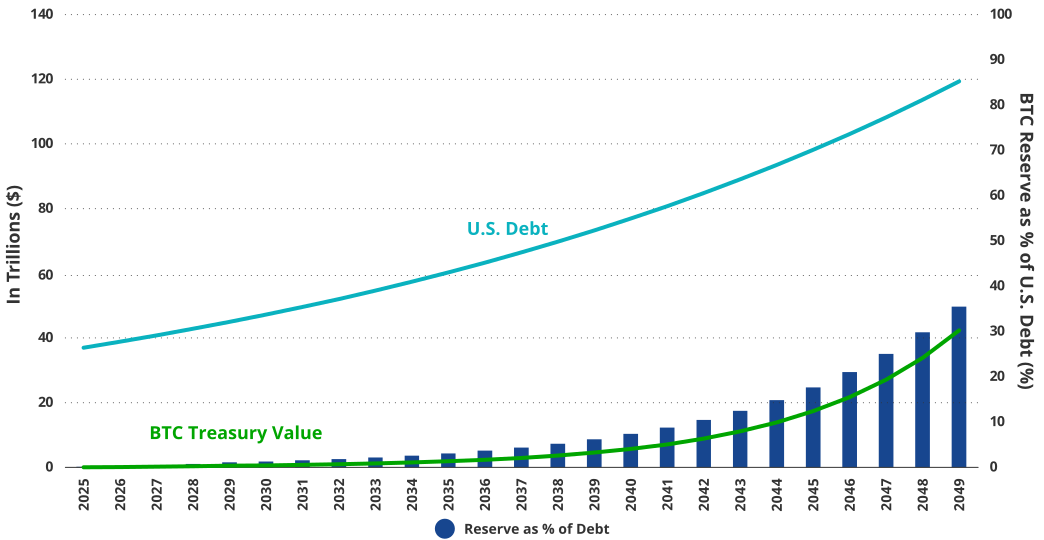
It’s important to consider that a U.S. Bitcoin reserve could significantly offset the national debt. Based on projections, if the U.S. acquires 1 million BTC by 2029 and Bitcoin increases in value at a compound annual growth rate (CAGR) of 25%, Bitcoin could account for 35.5% of the national debt by 2049. This projection assumes Bitcoin is acquired at $200,000 per coin and that debt growth slows from its recent CAGR of 7% to 5%. Stating this assumption ensures the methodology is clear.
In an even more optimistic scenario, where Bitcoin reaches a value of $42 million per coin by 2049, a U.S. Bitcoin reserve could represent 36% of the projected $119 trillion national debt. Such a reserve would also make up 18% of all global financial assets, demonstrating Bitcoin’s growing significance in global finance. The graph below illustrates the trajectory of the U.S. national debt compared to the projected value of a Bitcoin reserve, highlighting the potential financial benefits of this strategy.
Bitcoin Reserve Value Vs. U.S. National Debt in 2049
Est. U.S. Debt vs BTC Reserve Growth