
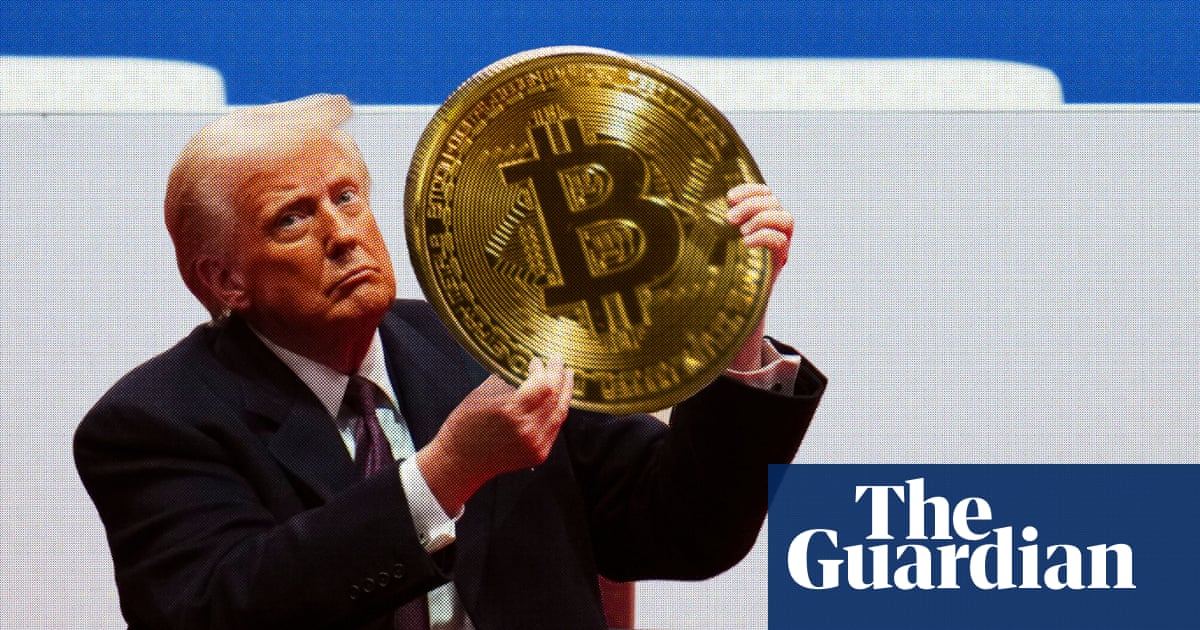
With former President Donald Trump appointing individuals with strong ties to digital currencies to key regulatory roles and advocating for the United States to become a global leader in crypto, the industry, already known for its volatility and controversies, appears set for a period of reduced regulatory scrutiny and accelerated expansion. This prospect is raising concerns among ethics watchdogs and former legal professionals, who caution about potential risks to investors and the increased possibility of illicit activities.
Trump’s supportive stance toward cryptocurrency has coincided with efforts to attract crypto firms to increase their financial contributions to his political campaign as he seeks to regain the White House. Despite once labeling Bitcoin a “scam” in 2021, Trump announced plans last fall to launch a crypto-related business, World Liberty Financial, with his sons, a venture from which they stand to profit.
Further highlighting his growing involvement in the speculative crypto market, Trump unveiled another crypto project just days before his inauguration – a personal meme coin called $Trump. This move, perceived as a blatant act of self-enrichment, was met with significant criticism from ethics observers, economists, and even some within the crypto industry itself.
According to Cornell economics professor Eswar Prasad, “The Trump meme coin represents the point where Trump’s tendencies to profit meet his administration’s acceptance of cryptocurrencies, accompanied by a lack of regard for government regulation.”
Prasad further anticipates that a Trump administration will likely lead to “regulatory agencies and key officials lending legitimacy to crypto assets, despite the inherently speculative nature of these investments and the dangers of exposing inexperienced retail investors to their instability.”
The crypto industry’s political influence has surged, fueled by substantial financial contributions to Trump’s campaign and inauguration events, including a dedicated “crypto ball,” alongside intensified lobbying efforts aimed at shaping the new administration’s and Congress’s priorities.
Indicating a potential shift toward lighter regulation, industry leaders welcomed Trump’s recent appointment of Paul Atkins, founder of a pro-cryptocurrency organization and former SEC commissioner, to chair the Securities and Exchange Commission.
Moreover, Trump signed an executive order last Thursday aimed at fostering the growth of cryptocurrency. The order calls for the creation of a working group to explore the possibility of establishing a national crypto reserve and to propose new regulations for digital assets, fulfilling his commitment to overhaul crypto policies.
Trump has also gained praise from crypto companies for selecting David Sacks, a prominent Silicon Valley venture capitalist and PayPal co-founder with close ties to Elon Musk, to serve as the inaugural crypto and AI czar within his administration.
At the crypto ball, Sacks declared that “the reign of terror against crypto is ending.” That same evening, Trump used his Truth Social platform to launch $Trump, a meme coin with no inherent value but whose price surged before Trump’s inauguration, substantially increasing his net worth on paper.
Trump’s apparent merging of his political efforts to promote crypto through deregulation with his personal pursuit of wealth in the crypto market has drawn sharp criticism from watchdogs and experts.
Former Federal Election Commission general counsel Larry Noble, currently a law professor at American University, stated, “Most individuals with a basic understanding of ethical principles, let alone the specific rules governing government ethics, would find Trump’s decision to launch a cryptocurrency token just as he is about to be inaugurated as president to be outrageous.”
Noble added, “The anonymity associated with cryptocurrency transactions will likely enable anyone seeking favorable treatment from Trump’s administration, including both domestic businesses and foreign entities, to contribute to Trump’s wealth by simply purchasing his token.”
Other critics have offered equally critical assessments of Trump’s crypto strategy, in which entities affiliated with the Trump organization reportedly hold an 80% stake.
Richard Painter, former chief ethics counsel for George W. Bush and a current law professor at the University of Minnesota, commented, “The coin’s value could be impacted by his actions or policies while in office, particularly considering Trump’s stated intention to be more crypto-friendly, which will likely further inflate the coin’s value, at least temporarily.”
Senator Elizabeth Warren of Massachusetts expressed a broader concern, telling the Guardian, “Trump should be focused on lowering costs for Americans, not scamming them out of their savings to inflate the value of crypto tokens for his personal and familial gain.”
Trump’s wife, Melania, also launched her own meme coin, $Melania, shortly after her husband’s.
Some experts are increasingly worried about the broader economic ramifications of proposals to create a Bitcoin reserve for the U.S., an idea that Trump has indicated he might support and that some industry leaders favor.
“Establishing a Bitcoin reserve would grant cryptocurrency official recognition and result in the U.S. government assuming the risks associated with its price volatility,” Prasad warned.
Prasad further stated, “This is neither a strategic nor a sensible concept; instead, it benefits Bitcoin holders while burdening U.S. taxpayers and exposing the government to financial risks. The U.S. government would become a primary driver of Bitcoin’s price both upwards and downwards.”
Such criticisms appear unlikely to slow the pro-crypto momentum within the Trump administration, which is fueled by industry lobbyists with strong ties to Trump and tens of millions of dollars in campaign spending that benefited both congressional allies and Trump himself.
Leading crypto companies have amplified their influence efforts in recent weeks by contributing millions of dollars to Trump’s inauguration and hiring prominent lobbyists with strong connections to Trump and who served as top fundraisers for him.
Among others, the crypto firm Ripple pledged $5 million in its own cryptocurrency to the inauguration, making it one of the event’s largest donors. Ripple’s external lobbying team includes Michael Best Strategies, whose board is chaired by Trump’s former Chief of Staff Reince Priebus.
Following Trump’s election, Ripple also hired influential lobbyist Brian Ballard, who has been a key fundraiser for Trump since 2016. Ballard Strategies, his lobbying firm, also represents Robinhood, a leading trading platform in the crypto industry, which contributed $2 million to the inauguration.
Trump’s enthusiastic courting of crypto leaders was evident at a Bitcoin conference last summer, where he vowed to remove SEC chair Gary Gensler, who was disliked by industry leaders for his stringent regulatory approach. Trump also pledged to make the U.S. “the Bitcoin capital of the world.”
Trump’s personal interest in alternative currencies was highlighted last September when he announced on Elon Musk’s X platform that his family, including Eric and Don Jr., were helping to launch World Liberty Financial, a crypto venture from which they could financially benefit, though they would not manage it directly.
World Liberty was a prominent participant at a lavish two-day Bitcoin event in Abu Dhabi last month, featuring a keynote address by Eric Trump. The conference also included Trump’s special envoy to the Middle East, Steve Witkoff, who helped found World Liberty, which now lists Chinese-born entrepreneur Justin Sun as its top investor. Sun, who also attended the Abu Dhabi event and has reportedly invested $75 million into World Liberty, previously headed another crypto firm called Tron, which has faced regulatory scrutiny. In 2023, the SEC filed charges of fraud and securities law violations against Sun and three of his wholly owned companies, including the Tron Foundation Limited.
after newsletter promotion
At the Abu Dhabi event, Eric Trump asserted that his father would be the “most pro-crypto president in the history of America.”
Despite Trump’s vocal support for crypto and his personal financial interests in the sector, there are growing concerns about crypto abuses, which worry critics.
Among the concerns are various criminal uses of cryptocurrency, including by certain foreign actors with links to North Korea.
Last month, a study by Chainanalysis, a prominent blockchain analytics firm, revealed that North Korean hackers stole $1.34 billion in cryptocurrency in 2024, a record amount and double the amount stolen in 2023.
The report concluded that analysts from the U.S. and other countries believe the stolen funds were being used to “finance its weapons of mass destruction and ballistic missile programs.”
Within the U.S., significant crypto fraud schemes have also raised alarms.
Sam Bankman-Fried, founder of the now-bankrupt FTX crypto exchange, was sentenced to 25 years in prison this past March by a New York judge for defrauding customers of $8 billion.
More broadly, the FBI disclosed in an annual report last September that fraud associated with crypto businesses soared in 2023, resulting in $5.6 billion in losses for Americans, a 45% increase from the previous year.
These abuses have led crypto critics to advocate for stricter, not weaker, regulations on cryptocurrency to prevent fraud and the potential for broader economic disruption.
“There is a substantial risk that our next financial crisis could stem from inflated crypto currency values (i.e., a bubble), much like the previous crisis, which originated from securities-based swap agreements and mortgage-backed securities that were loosely regulated prior to 2008,” Painter cautioned.
Warren emphasized that Congress must collaborate in a “bipartisan manner to establish sensible rules for crypto that foster competition and innovation while implementing real safeguards to protect our national security and shield consumers, investors, and our broader financial system from potential shocks.”
Other leading Democrats express concern that meme coins could undermine campaign finance regulations.
Representative Jamie Raskin of Maryland stated, “The crypto meme coin could signify the end of campaign finance law as we understand it. This provides an opportunity for an interested donor to place millions or billions of dollars at the disposal of a politician. If a foreign or domestic entity wishes to secretly funnel money to the president, they can do so through this avenue.”
Former prosecutors are also raising alarms about crypto-related criminal schemes.
Stefan Cassella, a former federal prosecutor and head of the firm Asset Forfeiture Law, explained, “The crypto world is simply the latest arena where fraudsters and grifters have learned to operate. It is a shiny new object that people are eager to obtain, hoping it will make them rich.”
“Cryptocurrency has created a world of ephemeral assets, characterized by a complexity that few understand and a vocabulary that few have mastered, leading to opportunities for criminals and challenges for law enforcement that were nonexistent in prior eras.”
Other former prosecutors are also deeply concerned about the proliferation of crypto fraud.
According to Paul Pelletier, former acting chief of the fraud section at the Department of Justice, “Crypto crime represents a new reality in global economic crime – an anonymized digital pathway for both committing and concealing the proceeds of organized criminal activity.”
“Sophisticated criminal actors recognize that law enforcement is not presently capable of effectively monitoring or curbing this activity. As a result, malicious state actors like North Korea exploit these weaknesses to steal billions from unsuspecting victims worldwide.”
“It is essential for U.S. law enforcement and regulators to proactively develop sophisticated surveillance systems to deter this emerging and growing threat. Regrettably, they appear to be moving in the opposite direction.”