
National digital reporter and business reporter
Getty Images
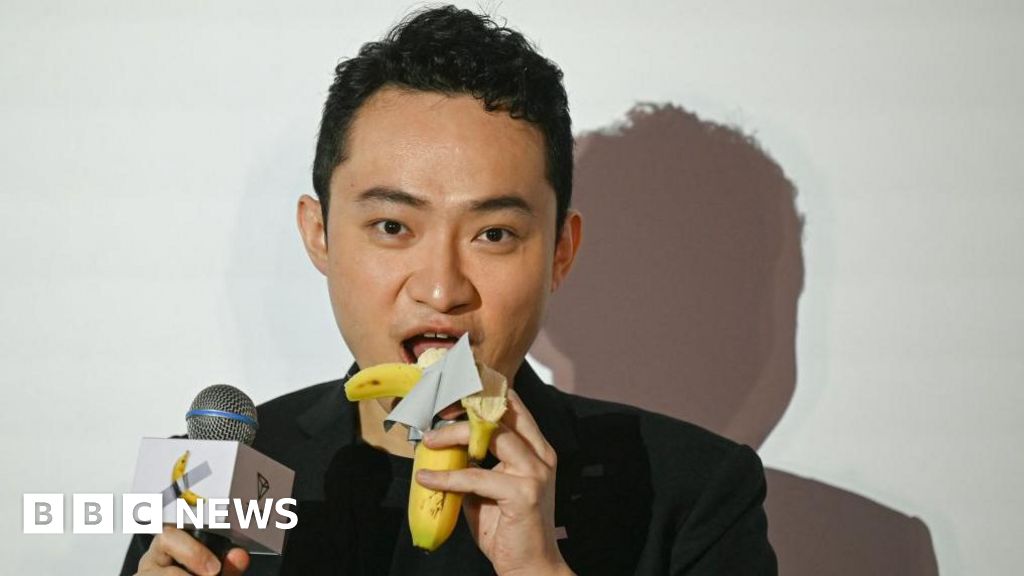
Shortly after acquiring and publicly devouring a banana valued at $6.2 million as part of an art-related performance, Justin Sun, a Chinese entrepreneur involved in cryptocurrency, made another notable purchase. He invested $30 million ($23.5 million) in a cryptocurrency venture known as World Liberty Financial.
Since its launch in October, the company had struggled to gain traction, with investors appearing hesitant about its future and associated conditions.
However, the enterprise possessed an attribute that held potential allure: the chance to engage with a business collaborating with and promoted by Donald Trump.
Sun’s financial injection elevated the company beyond the level required for the former president to begin accruing profits from the arrangement. Trump and his family are now positioned to receive an estimated $20 million—and potentially a significantly larger amount.
Sun, who is currently facing allegations of fraud in the United States linked to his own cryptocurrency dealings, did not provide answers when questioned regarding the reason for his interest in the tokens, which are not eligible for trading.
The sequence of events has sparked concerns among experts focused on government ethics, who view it as a sign that Trump’s expanding business endeavors have made it increasingly straightforward for individuals aiming to exert influence on American policy to funnel funds in his direction.
“The conflicts have increased significantly because of how large his business is,” commented Richard Painter, who previously served as the chief ethics lawyer for the White House during the George W. Bush administration.

Getty Images
In a communication with the BBC, Trump’s representatives dismissed these concerns.
Karoline Leavitt, a spokesperson for Trump, stated that during his initial term, “President Trump distanced himself from his multi-billion-dollar real estate holdings to pursue public office and declined his government salary.”
She further added, “Unlike the vast majority of politicians, President Trump did not enter politics to seek personal gain—he is engaged in this fight because of his love for the people of this nation and his desire to restore America’s greatness.”
However, Trump has taken limited action to address the potential for, or the perception of, corruption as he gears up for a potential return to the White House.
Emerging Opportunities
Trump has previously faced questions concerning potential conflicts of interest.
During his initial tenure as president, the Trump International Hotel in Washington, D.C., became a central symbol of this issue, serving as a favored location for lobbyists, foreign envoys, and allies to lodge and spend money.
Detractors contended that the hotel enabled Trump to indirectly profit from his position. He was subject to accusations and legal challenges asserting that he violated the U.S. Constitution’s prohibition against presidents receiving foreign emoluments—or reaping financial benefits from their office.
However, specialists suggest that the expansion of his business empire, which now encompasses a publicly traded social media platform, a cryptocurrency company, and connections to a golf league supported by Saudi Arabia, allows those seeking to gain influence to channel funds more discreetly and in considerably larger amounts.
Michael Ohlrogge, a law professor at New York University who has conducted research on Trump Media, which operates Truth Social and currently accounts for the majority of Trump’s $6 billion wealth, noted that “The scale has grown, and the ease has increased. You can only reserve a certain number of hotel rooms.”
Ohlrogge suggested that on Truth Social, for instance, a foreign government or entity could purchase advertisements aimed at persuading investors that the platform is gaining traction, leading to a surge in its stock price.
While Trump Media boasts a market value exceeding $7 billion, there has been limited evidence of such activity to date. The company has reported less than $5 million in advertising revenue for the current year.
However, given the “amplifying” effect of the stock market, Ohlrogge posited that a relatively modest investment could result in substantial gains for Trump, who owns more than half of the company’s shares.
“His Pro-Crypto Stance”
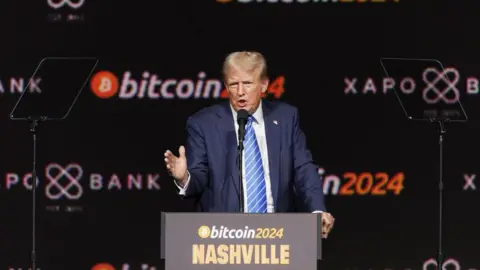
The entanglement between Trump’s business interests and his governmental duties is perhaps most pronounced in the cryptocurrency sector, where he has amplified his personal engagement while simultaneously pledging to champion it during his time in the White House.
His plans include reducing regulations and concepts such as a national Bitcoin reserve, where the government would accumulate the cryptocurrency.
“The regulation of crypto is one of the most important issues to be determined over the next few years,” according to Virginia Canter, chief ethics counsel at the nonpartisan Citizens for Responsibility and Ethics in Washington. “Now, he’s an active player in the crypto market. The way crypto is regulated [could] affect his personal wealth, impacting the position he takes.”
Nik Bhatia, the founder of Bitcoin Layer, a company promoting investments in Bitcoin, cautioned against attributing Trump’s stance on crypto solely to his financial interests.
“I don’t think these moves are motivated by self-interest – I think they represent the electorate,” he said.
However, he did concede: “I think there probably is a conflict of interest in that his pro-crypto stance will benefit his company.”
Getty Images
Trump recently announced his intention to nominate Paul Atkins, a known lobbyist for the crypto industry, to lead the Securities and Exchange Commission (SEC).
It is widely anticipated that Atkins will curtail enforcement activities at the agency, which oversees publicly traded companies such as Trump Media for potential violations like fraud and insider trading. Under President Joe Biden, the SEC had intensified its scrutiny of the crypto industry.
Mr. Sun, the investor in World Liberty Financial, found himself under SEC scrutiny last year when the agency charged him and his company with failing to properly register with the government while selling digital assets, along with other allegations.
John Coffee, a professor at Columbia Law School and an expert in securities law, suggests that the agency could potentially drop the case under new leadership.
He stated, “The defining characteristic of Mr. Atkins is his aversion to enforcement and his desire to significantly restrict the range of cases the SEC will pursue.”
In announcing his investment last month, Mr. Sun made no mention of the SEC complaint – which he has dismissed as lacking merit – but he did cite Trump’s perspective on crypto.
“The U.S. is becoming the blockchain hub, and Bitcoin owes it to @realDonaldTrump!” he posted on X. “TRON is committed to making America great again and leading innovation. Let’s go!”
Reduced Safeguards
U.S. law offers limited restrictions on conflicts of interest, as presidents are not bound by the same regulations that apply to other government employees and cabinet members.
Although the U.S. Constitution theoretically prohibits presidents from accepting gifts from foreign governments while in office, the Supreme Court has already dismissed two prior lawsuits from Trump’s first term that raised concerns about potential conflicts of interest.
Last summer, in a case involving Trump, the court also ruled that presidents have extensive immunity from criminal prosecution while in office.
Trump has previously argued that his business actually suffered as a result of his time in the White House, as partners, concerned about controversy, severed ties, and he faced investigations and lawsuits.
As he prepares to enter the White House for a second time, Trump has yet to release an ethics plan, as is customary, and has shown little indication that he intends to address these concerns.
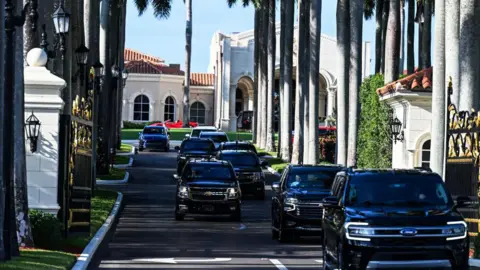
He has pledged to retain his stake in Trump Media, continues to promote Trump-branded merchandise, and lends his name to ventures like World Liberty Financial. His Mar-a-Lago club remains a destination where wealthy individuals willing to pay for membership can gain access to the president with minimal transparency.
Ethics experts are concerned that Trump has opened a door that will be difficult to close.
Mr. Painter said, “Trump’s got the message that he can do whatever he wants, because he won. Future presidents are going to look at this and think, ‘We can do whatever we want.'”