
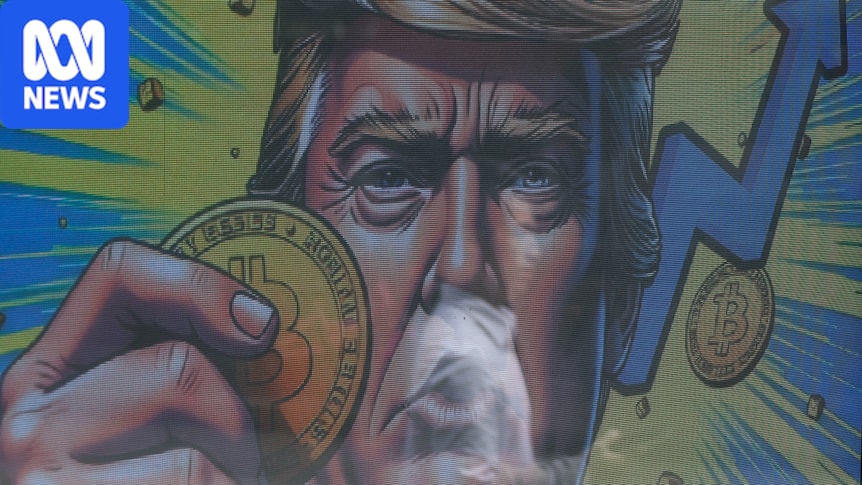
Former US President Donald Trump, who could have greatly benefited from the booming world of cryptocurrency, has instead turned it into a significant advantage for himself.
Initially skeptical, Trump later rallied the crypto community in support of his 2024 presidential campaign, having previously referred to cryptocurrency as “a scam” during his first term.
He vowed that the United States would become the leading hub for cryptocurrency.
Donald Trump embraced cryptocurrency during his 2024 campaign. (Reuters: Kevin Wurm)
To make this vision a reality, he committed to relaxing regulations, appointing a crypto-friendly leader to the US Securities and Exchange Commission, and promoting the widespread adoption of Bitcoin.
He has followed through on these promises while accumulating significant wealth in the process.
Recent filings have revealed that Trump and his family have profited $US1.4 billion ($2.02 billion) from crypto activities since he returned to the presidency.
Loading…
Yet, Trump remains somewhat distrustful. When engaging in cryptocurrency, his family has opted for immediate cash transactions or fees on transactions rather than holding cryptocurrencies as assets.
This strategy has insulated them from the often tumultuous market swings that have led their supporters to incur significant losses.
In addition to their connections with World Liberty Financial—a crypto firm operated by his sons Donald Jr. and Eric—he gained $US636 million from launching a meme coin.

Donald Trump Jr and Eric Trump are co-founders of World Liberty Financial. (Reuters: Brendan McDermid)
Identified as $TRUMP, this coin lacks any real value, and its worth has plummeted, resulting in $US3.8 billion in losses for approximately one million investors.
However, losses in the crypto sphere are not limited to Trump-related activities.
Across the entire sector, investors are facing significant financial setbacks.
Having gained everything they desired—broad acceptance and validation—Bitcoin enthusiasts now find themselves with an asset that lacks practical utility and a dubious future.
Once viewed as a disruptive force, it now appears to be just another speculative asset, its status as a gambling tool also in jeopardy.

Bitcoin has approximately halved in value since its peak. (Reuters: Dado Ruvic, file)
When “never” means something else
Recently, Michael Saylor found himself with some positive news.
After securing funds, the stock price of his company Strategy, which is the largest corporate holder of Bitcoin, surged. To commemorate this, Saylor shared his latest outlook for cryptocurrency.

Michael Saylor famously advised, “never sell your Bitcoin.” (Reuters: Marco Bello)
Saylor is feeling the pressure; his company’s stock has plummeted by 78% over the last year, even after last week’s increase linked to Bitcoin’s dramatic price drops.
In a remarkable turnaround, the individual who once proclaimed “never sell your Bitcoin” has found himself doing just that.
Last month, he began offloading small amounts, and just last week, he authorized a plan to sell up to $US1.25 billion of his reserve if necessary.
Having survived the dotcom bubble of the ’90s, Saylor transitioned from software to cryptocurrency in 2020, benefitting from the Bitcoin boom until October of last year.
His singular focus on Bitcoin propelled Strategy’s market value way beyond the actual worth of its cryptocurrency holdings.
Saylor capitalized on that inflated value to acquire even more Bitcoin, financing it with the sale of Strategy shares that offered a 12% guaranteed dividend.
This strategy worked wonderfully during price increases.
However, when Bitcoin prices faced a severe downturn last October, meeting those guaranteed dividends turned into a significant challenge.
His company reported $US27 billion in losses over two quarters ending in March, with further losses anticipated for the June quarter.
Now, he is unloading Bitcoin and shares to cover those promised dividends.
It’s a strategy for survival.
Power-hungry AI transforms miners into data centers
A couple of years ago, the collapse of FTX and other crypto exchanges made headlines worldwide.
Recently, however, issues have surfaced among some of the leading financiers in the crypto market.
In March, BlockFills, a prominent US liquidity provider, filed for bankruptcy.
Meanwhile, the crypto world is facing a more tangible challenge: electricity.

AI advancements are increasing the demands on data centers. (Supplied: Google)
Bitcoin relies on “miners” to maintain its blockchain. These miners are compensated in two ways: they earn transaction fees and receive new Bitcoin for verifying transactions.
However, mining necessitates solving intricate mathematical problems that demand extensive computational resources and vast amounts of electricity.
As the availability of new Bitcoin declines and mining grows increasingly complex, the costs and power consumption escalate dramatically.
Given that Bitcoin is currently priced at $US63,000, which is less than half its peak value from October, the profitability of mining has become marginal due to skyrocketing costs and low returns.
Fluctuating Bitcoin prices frequently lead miners to operate at a loss, with soaring electricity costs overshadowing any potential gains.
Enter artificial intelligence, sparking a rush among major tech companies to establish data centers across the United States.
Bitcoin mining sites in regions like Texas and the Midwest, which have robust power grids and extensive computer networks capable of handling large volumes of data, are nearly operational with minimal modifications.
Many miners have opted for AI operations, favoring improved margins and more dependable returns.
A notable newcomer to Bitcoin mining is Eric Trump.
Last September, his American Bitcoin company attracted considerable investor attention upon its public debut. Despite only having $US270 million in Bitcoin, its stock soared, reaching a market valuation of $US13.2 billion.
The company claimed it could mine at significantly lower costs than its competitors, promising substantial profits.
However, as Bitcoin’s price dropped, this competitive edge diminished, leading to a significant decline in stock price.
From its peak of $US142, the stock now languishes at about $US7.48, leaving many of Trump’s investors in a precarious position.
Even gamblers are pulling back
Bitcoin emerged during a time of crisis.
As the year 2009 began, the world was in turmoil, with the global financial system hanging by a thread.
Banks refused to lend to one another, and the global economy was nearly at a standstill.
Loading
This crisis resulted in widespread unemployment and left countless lives shattered.
It’s no wonder that amid the chaos, the idea of a new financial system, one immune to manipulation by governments or central banks, was so appealing.
However, 17 years later, Bitcoin and many similar cryptocurrencies have largely failed to deliver on their promises.
Rarely utilized in transactions, these currencies offer no safeguard against inflation, and their extreme volatility renders them ineffective for wealth preservation.
In contrast, stablecoins, pegged to the US dollar’s value, have emerged as the only reliable crypto assets for transactions.
Even cryptocurrency proponents gauge their worth in traditional fiat currencies—the very systems they sought to bypass.
Bitcoin and its counterparts have largely devolved into tools for speculation, and even that allure is fading.
In the realm of speculation, prediction markets are currently trending. The leading platforms, such as Polymarket, built on crypto technology, and Kalshi, which operates as a financial derivative, allow bets on a myriad of topics.
You can place wagers on anything, even on bets themselves, and these platforms remain largely unregulated since they fall into the category of financial products rather than gambling.
Who is still placing bets on Bitcoin’s future?