

Key takeaways
-
The UAE stands out as an extremely attractive location for cryptocurrency investors, particularly because it has no individual income or capital gains levies, along with recently enacted VAT waivers on cryptocurrency transactions.
-
Dubai’s VARA and Abu Dhabi’s FSRA are setting the standard with legal structures for both retail and institutional clients, while RAK, Sharjah, and other locations are developing specialized zones and guidelines to foster Web3 innovation.
-
Specialized zones such as DMCC, ADGM, and DIFC offer ready-to-use business settings. The UAE is a convenient location for cryptocurrency firms due to its fast internet, 5G, and cloud computing capabilities.
-
The Golden Visa program, combined with safety, worldwide connectivity, and smart city living, provides cryptocurrency millionaires with a secure, high-end home base in addition to financial independence.
The United Arab Emirates (UAE) has recently risen to prominence as a desirable location for affluent cryptocurrency investors. Across all seven emirates, including well-known cities like Dubai and Abu Dhabi, as well as up-and-coming centers like Ras Al Khaimah and Sharjah, the UAE provides a desirable combination of no taxes, defined rules, advanced infrastructure, encouraging government assistance, and an unmatched standard of living.
In particular, a rising number of cryptocurrency investors with substantial net worth are deciding to call Dubai and Abu Dhabi home. This pattern is noteworthy; the UAE is now the world’s most popular location for migrating millionaires, with an estimated 9,800 millionaires expected to move there in 2025 alone.
The nation’s attractiveness is a result of carefully considered government choices, such as regulatory changes, favorable tax policies, and even long-term residency options such as the Golden Visa. In simpler terms, this migration of cryptocurrency professionals to the UAE is being driven by a mix of business-friendly policies and a desirable quality of life.
This article will delve into five essential regulations and reasons behind this trend in more detail below.
1. Tax-free crypto profits: Zero taxes on income and gains
The UAE’s policy of no taxes on cryptocurrency profits—including no income tax and no capital gains tax—is a major factor in attracting cryptocurrency investors from across the globe. Cryptocurrency millionaires residing in the UAE are free from taxes on their cryptocurrency holdings, as the nation does not levy taxes on individual income or capital gains.
This indicates that Bitcoin billionaires, NFT giants, and startup founders can take out or reinvest their digital assets without having to pay taxes, which is very different from the high-tax jurisdictions in Europe and North America.
Even with the 9% federal corporate tax that the UAE implemented in 2023, people’s cryptocurrency assets are still not subject to taxation and cryptocurrency gains are entirely legal. Importantly, the government has taken another step by exempting the majority of cryptocurrency transactions from the 5% value-added tax (VAT).
The UAE’s Federal Tax Authority stated in late 2024 that cryptocurrency transfers and conversions would be exempt from VAT beginning on November 15, 2024 (with retroactive application to transactions dating back to 2018). This VAT exemption applies to services for trading and exchanging cryptocurrencies, treating them similarly to other financial services.
The result is a virtually tax-free environment for participants in the cryptocurrency market, whether they are engaged in Bitcoin mining, exchange trading, or realizing profits from token investments. According to industry insiders, the UAE’s combination of defined regulations and no capital gains tax has led to the creation of the “ideal environment for cryptocurrency growth.”
Did you know?
Over 74% of UAE residents aged 25-34 are interested in crypto, and 21% plan to enter the market within the next 12 months.
2. Regulatory clarity: World-leading crypto frameworks in Dubai, Abu Dhabi and beyond
For cryptocurrency entrepreneurs, clarity and certainty in regulation are essential, and the UAE delivers with cutting-edge frameworks.
Dubai: Retail-focused clarity
-
Dubai took the lead in 2022 by establishing the Virtual Assets Regulatory Authority (VARA), the first regulator in the world devoted solely to virtual assets.
-
Backed by Dubai’s new virtual asset legislation, VARA offers unambiguous licensing procedures for exchanges, cryptocurrency platforms, and token issuers, instilling trust in businesses looking to set up shop.
-
Major cryptocurrency exchanges like Binance and Crypto.com have been granted VARA licenses, which shows how appealing Dubai is under well-defined regulations.
Abu Dhabi: Institutional-grade compliance
-
In the meantime, Abu Dhabi was a pioneer in cryptocurrency oversight thanks to the Financial Services Regulatory Authority (FSRA) of Abu Dhabi Global Market (ADGM).
-
As early as 2018, the FSRA introduced a comprehensive regulatory framework for virtual assets that covered everything from exchange licensing to custody rules and was the first of its kind in the Gulf Cooperation Council region.
-
Institutional players have been drawn in by the regulatory clarity in the ADGM; by the end of 2023, major international corporations like Copper, Paxos, and eToro had grown into Abu Dhabi under the FSRA’s supervision.
-
Abu Dhabi’s strategy typically focuses on cryptocurrency activities with high capital and institutional backing, complementing Dubai’s more retail-oriented market.
It is important to note that the UAE is making an effort to harmonize cryptocurrency regulations at the federal level. Dubai’s VARA and the UAE’s Securities and Commodities Authority (SCA) reached a mutual recognition agreement, allowing VARA-licensed businesses to conduct business throughout the UAE. This implies that a cryptocurrency exchange with a license from Dubai’s free zone is able to serve customers in other emirates, which further integrates the national market.
Ras Al Khaimah: Specialized Web3 jurisdiction
-
Ras Al Khaimah (RAK) made headlines by launching the RAK Digital Assets Oasis (RAK DAO), which is being promoted as the first free zone in the world to be exclusively for businesses dealing in digital assets.
-
RAK DAO, a specialized zone established by law in 2023, possesses financial and legislative independence to create cryptocurrency-friendly regulations under the new Department of the Future. It serves Web3 and virtual asset service providers, including NFT platforms and metaverse builders, by providing them with a custom-made, common-law system. With this bold move, RAK hopes to draw in blockchain businesses and establish itself as a forward-thinking jurisdiction.
Sharjah, Ajman, UAQ, Fujairah: Emerging frontiers
-
In a similar vein, Sharjah has expressed interest in blockchain applications.
-
Umm Al Quwain and Ajman are investigating fintech and digital economy projects, indicating that every emirate is embracing innovation.
While Dubai and Abu Dhabi have established the regulatory gold standard, the overarching theme is clarity, defined regulations, specialized regulators, and forward-thinking legislation. This gives cryptocurrency investors and businesses the confidence to relocate to the UAE, understanding their legal standing.
Did you know?
Telegram founder Pavel Durov has called Dubai home since 2017 and is now a UAE citizen. Once named the richest expat in the UAE, he ranked as the world’s 120th richest person in 2024.
3. Cutting-edge infrastructure: Crypto zones, hubs and innovation ecosystems
The UAE’s appeal to cryptocurrencies is supported by a supportive infrastructure. Across the emirates, a network of free zones, hubs, and accelerators are specifically designed for fintech and digital assets.
Dubai
-
In Dubai, the Dubai Multi Commodities Centre (DMCC) has built a well-known Crypto Centre, a comprehensive ecosystem that hosted over 650 blockchain and digital asset businesses as of the middle of 2025. Cryptocurrency startups will find co-working spaces, incubators, and a supportive community within this hub, along with access to DMCC’s business services.
The Dubai International Financial Centre (DIFC), which is traditionally focused on finance, now also accommodates a thriving fintech and cryptocurrency scene through its Innovation Hub and the DFSA’s regulatory sandbox for digital tokens.
Abu Dhabi
-
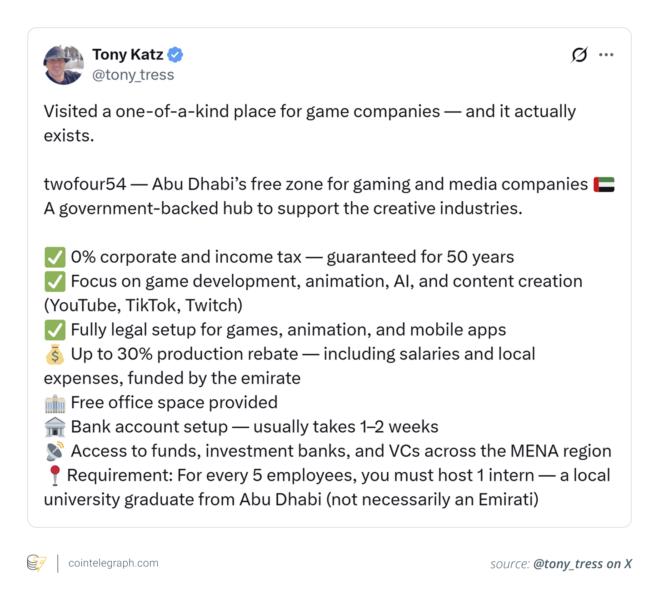
The ADGM on Al Maryah Island in Abu Dhabi has developed into a cryptocurrency and blockchain innovation hub in its own right. The ADGM operates under English common law and has a strong fintech ecosystem (Hub71) that launched a $2 billion+ initiative in 2023 to fund Web3 and blockchain startups.
-
Over 5,000 Special Purpose Vehicles (SPVs) have been established in ADGM for wealth and business structuring, which is a significant increase from just 46 SPVs in 2016. This demonstrates how many family offices, investment funds, and cryptocurrency project founders are utilizing Abu Dhabi’s infrastructure to store assets and launch new ventures.
-
Even Binance’s former CEO, Changpeng “CZ” Zhao, and other billionaires from around the world have created holding companies in ADGM, taking advantage of its strong legal framework and cryptocurrency-friendly regulations.
Sharjah and beyond
-
Sharjah, known for its academic prowess, is contributing to infrastructure by nurturing human capital and innovation. The emirate is home to the Sharjah Research, Technology and Innovation Park and recently launched a blockchain academy in partnership with layer-1 blockchain Sui at the American University of Sharjah. Sharjah is building a pipeline of blockchain talent and startups through initiatives like these, complementing the physical infrastructure with intellectual infrastructure.
-
Fujairah, further east, is developing tech-friendly free zones (such as Fujairah Creative City) and investigating blockchain applications in industries like supply chain and finance in an effort to diversify its economy with digital ventures.
-
Ajman and Umm Al Quwain, while smaller, also provide reasonably priced free zone licenses and encouraging business environments for cryptocurrency-related startups, ensuring that entrepreneurs have choices beyond the major cities.
Significantly, the UAE’s top-notch digital infrastructure, widespread high-speed internet, 5G networks, and cloud data centers serve as the foundation for any cryptocurrency or blockchain activity. Cryptocurrency investors discover a plug-and-play infrastructure that is prepared to support their endeavors, whether they are in Dubai’s active cryptocurrency co-working spaces or RAK’s new digital assets zone.
4. National blockchain and metaverse ambitions of visionary government
The UAE’s ascent to the status of a cryptocurrency hub is no coincidence; rather, it is the result of a calculated, far-sighted government vision. The country’s leaders have incorporated blockchain and digital assets into its broader national innovation strategies.
Strategic national goals
-
As early as 2018, the UAE unveiled Blockchain Strategy 2021, with the goal of transferring 50% of government transactions onto blockchain platforms by 2021. This push not only streamlined public services but also signaled to the world that the UAE was serious about adopting crypto’s underlying technology at scale.
-
Building on that momentum, Dubai launched an ambitious Dubai Metaverse Strategy in 2022, with the goal of making the emirate one of the global top 10 metaverse economies. The strategy targets adding 4 billion UAE dirhams ($1.1 billion) to the economy in five years and creating 40,000 virtual jobs by 2030.
-
Initiatives under this plan include attracting 1,000 blockchain and metaverse companies (Dubai already had 1,000 firms in this space by 2022) and integrating metaverse tech into tourism, education and government services. In practice, this means Dubai’s government is actively experimenting with NFTs, virtual real estate and immersive digital services, fostering a climate where crypto-related ideas are welcomed rather than shunned.
Federal support
-
At the federal level, the UAE has a National AI Strategy and a Digital Economy Strategy, under which blockchain and crypto are key components for diversifying beyond oil.
-
High-level ministers (such as the minister of state for artificial intelligence, digital economy and remote work) champion crypto and metaverse projects, ensuring policy support at the top.
Regional alignment
Each emirate is finding its niche under this vision.
-
Abu Dhabi, for instance, through Hub71 and ADGM, focuses on big-ticket Web3 investments and institutional adoption (including a government-backed $2-billion fund for Web3 startups).
-
Dubai focuses on retail crypto adoption, blockchain in everyday services and emerging tech like tokenized assets and AI integration in finance.
-
Ras Al Khaimah’s creation of the RAK Digital Assets Oasis aligns with the national vision to become a “global crypto capital,” enabling RAK to specialize in nurturing early-stage Web3 innovators in a sandbox-like environment.
-
Even Sharjah’s emphasis on education (like the American University of Sharjah Blockchain Academy) echoes the strategic goal of building human infrastructure for a blockchain-based economy.
The government’s pro-crypto vision is also evident in international partnerships; for example, Dubai’s leadership has inked agreements with global crypto firms (like a recent deal with Crypto.com to develop blockchain solutions for real estate transactions) to pilot new use cases.
All these efforts, including blockchain strategies, metaverse roadmaps and tech parks, create a clear message: The UAE sees crypto and digital assets as integral to its future. This vision and openness reassure crypto entrepreneurs that by relocating to the UAE, they are aligning with a country that wants their industry to thrive.
Did you know?
The TON Foundation’s offer of UAE golden visas to Toncoin stakers was quickly denied by local regulators,
exposing a legal misstep
. Despite support from influencers, including Telegram’s Pavel Durov, the plan clashed with strict UAE crypto marketing laws, highlighting the need for proper legal reviews.
5. Residency opportunities: Golden visas and an elite global lifestyle
In addition to the official regulations, the UAE offers an appealing quality of life and residency benefits that are highly appealing to affluent people, including cryptocurrency millionaires.
Key highlights include:
-
The UAE’s Golden Visa program, which is a long-term 10-year residency visa, has significantly changed the game for investors, business owners, and talented individuals.
-
Cryptocurrency founders who meet the requirements (for example, by investing in UAE businesses or real estate, or by achieving success in the tech sector) can obtain a Golden Visa, which guarantees themselves and their families ten years of residency without the need for a local sponsor.
-
Its stability and simplicity are what make the Golden Visa so appealing: it enables expatriates to easily settle in the UAE, create bank accounts, purchase property, and even sponsor family members. In 2024, the government significantly broadened the visa categories, introducing new sponsor-free residency paths for everyone from digital content producers to even owners of luxury yachts.
-
This inclusive strategy conveys the message that innovators of all kinds are welcome. A cryptocurrency hedge fund manager or blockchain developer can relocate to Dubai or Abu Dhabi knowing that they can obtain long-term residency as easily as a more conventional investor.
The UAE’s lifestyle benefits are equally alluring. Dubai and Abu Dhabi are consistently ranked among the safest cities in the world because of their low crime rates and strong political stability—a “safe haven status” that wealthy families greatly value. Modern infrastructure amenities are abundant, including top-notch hospitals, foreign schools and universities, upscale retail centers and restaurants, and dynamic arts and culture scenes.
For cryptocurrency millionaires accustomed to traveling abroad, the UAE’s strategic location is a major benefit: Dubai and Abu Dhabi are significant aviation hubs with nonstop flights connecting Europe, Asia, and Africa in under eight hours. This global connection allows investors to manage businesses across continents while maintaining a home base in the emirates.
Furthermore, the quality of life is enhanced by cutting-edge smart city programs. For instance, UAE cities are investing in smart governance (you can pay government fees in cryptocurrency for select services and digital amenities, such as high-speed 5G, widespread cryptocurrency ATMs, and even real estate deals via blockchain).
The daily way of life, which ranges from sunny weather and opulent real estate to five-star entertainment and outdoor activities, is frequently compared to a never-ending vacation. Such benefits have not gone unnoticed by the cryptocurrency elite: a large number of cryptocurrency conferences (like Token 2049), blockchain summits, and networking events now take place in Dubai each year, strengthening the sense of a thriving community.
Importantly, the UAE also provides comfort on the legal and financial front: a strong banking infrastructure with private banking services designed for high-net-worth individuals and new family-friendly legal reforms (such as secular options for marriage/inheritance) that provide expatriate families with more certainty.
The crypto future is being built in the emirates
The UAE offers cryptocurrency millionaires not only a place to conduct business, but also a high-end, practical lifestyle and a safe home. It is a unique combination of tax-free cryptocurrency profits during the day and opulent living at night that is difficult to find elsewhere.
Each emirate, from Dubai’s bold metaverse goals to Abu Dhabi’s institutional-grade infrastructure and Ras Al Khaimah’s Web3-first regulatory sandbox, plays a distinct role in establishing the UAE as a comprehensive cryptocurrency haven. The UAE is not only accommodating cryptocurrency; it is actively influencing its global future with forward-thinking governance, cutting-edge infrastructure, and a welcoming environment for innovators.
In 2025 and beyond, the UAE is sending a clear message to cryptocurrency entrepreneurs: bring your ideas, bring your capital, and build your future here. It is a call that is being heard all over the world, and it is one that is still drawing the blockchain elite to this cryptocurrency-friendly oasis in the desert.
This article does not provide financial advice or recommendations. Investing and trading are inherently risky, and readers should do their own research before making any decisions.