

In San Antonio, Texas, artist Gilbert Martinez found himself on hold with Mastercard’s customer support, a glass of water momentarily forgotten as he wrestled with their phone system. His mission: to voice his concern over reports that Mastercard is pressuring digital game distributors like Steam and Itch.io to restrict the sale of certain adult-themed games. After what he estimated to be an 18-minute initial call, he realized his complaint was filed with the incorrect department.
Undeterred, Martinez made two more calls, each time receiving assurances that his concerns were being documented. He utilizes Mastercard’s payment system via PayPal to acquire games from Valve’s platform. Speaking with Kotaku, he noted, “The customer service representative indicated that those in leadership positions are aware and are actively seeking a solution. The representative maintained a courteous demeanor, as expected when dealing with a customer. I made every effort to remain polite throughout the entire conversation.”
Martinez is among a growing group of individuals protesting the actions of Steam and Itch.io in removing thousands of games due to pressure from payment processors. Collective Shout, an organization based in Australia focused on combating pornography, has claimed responsibility for the recent censorship wave, citing their campaign urging people to contact Visa and Mastercard. They accused these companies of profiting from games depicting “rape, incest, and child sexual abuse.” In response, some gamers are organizing counter-campaigns, hoping to influence Visa and Mastercard in the opposite direction.
Martinez told Kotaku, “This surge in censorship, masked as a measure to ‘protect children,’ evokes memories of the Satanic Panic, unjustly targeting individuals who have done no harm, except to enjoy themselves. We are already seeing the detrimental effects of these unnecessary restrictions on people’s personal and financial well-being. Instead of forcing their demands on others, parents concerned about protecting their children should focus on parenting them.”
Vile: Exhumed, an indie horror game, is among the titles that Valve has removed from Steam. Released the prior year by Cara Cadaver of Final Girl Games, the game places players within a fictional ’90s computer terminal, uncovering a disturbing obsession with a horror film actress, using this framework to explore online misogyny and toxic parasocial relationships. On July 28, Cadaver posted on Bluesky, “It was banned for ‘sexual content with depictions of real people,’ which, if you have played it, you know is all implied, making this all feel even worse.”
Valve has yet to issue a statement regarding these events.
Vile: Exhumed perfectly exemplifies the concerns raised by critics of the sex game purge. They feared guidelines aimed at curbing pornographic games with themes of sexual violence would inevitably affect serious artistic works addressing difficult and uncomfortable topics. The question remains: who decides what constitutes harmful material and what is art? For a while, it seemed to be Steam and Itch.io. However, these recent actions reveal that Visa and Mastercard are the de facto decision-makers, influenced by those who can generate the most negative publicity.
“We are definitely seeing a shift in how calls are handled, from ‘Sorry, what are you talking about?’ to ‘Are you ALSO calling about itch/steam?’ and now some callers even experiencing outright harassment,” reported a 2D artist known as Void, who has been instrumental in organizing a Discord server for a counter call-in campaign. While the full extent of these counter-initiatives and their potential impact on the companies remains uncertain, there is evidence suggesting growing momentum. For instance, callers are now spending less time clarifying what Steam, Itch.io, or “NSFW” games are to the representatives on the phone.
RJAIN, a Bluesky user, informed Kotaku, “Initially, I focused on Mastercard, but I ended up dedicating a significant amount of time to Visa. Two days ago, I had a conversation with Visa lasting over an hour, followed by a later call lasting over two and a half hours. During these calls, I spoke with a supervisor who appeared calm and understanding. Yesterday, the calls were different. The representatives seemed frustrated and exhausted. They refused to connect me with a supervisor and repeatedly stated that it is now their protocol to disconnect calls from anyone complaining about this issue.”
Bluesky user snowlupinwood, an LGBT furry author whose work was affected on Itch.io, reported calls being transferred between various managers, culminating in a 30-minute exchange with a manager reading from a script. Subsequent calls resulted in quick disconnections. Another individual claiming to have called at least 30 times noted that the interactions have shifted since the initial purges on Itch.io and Steam.
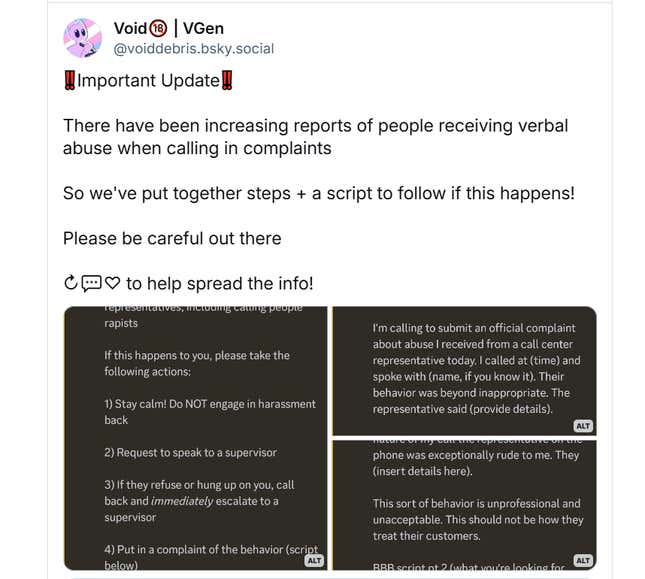
Bluesky user sakurakyun shared with Kotaku, “Now, the moment I mention censorship, they instruct me to email. Some even hung up after pretending to transfer me to a supervisor. Others cut me off and began their ‘ending speech,’ informing me they can no longer assist and to email. Some have even mocked me, saying they recognize my number and asking if I’ve called before. I am concerned about my next call, but I will continue calling until something changes. I am not afraid of being yelled at; I have worked in customer service for nearly five years.”
Visa and Mastercard have yet to respond to requests for comment.
Reports indicate that some interactions have remained courteous, while others have been placed on indefinite hold. “It’s clearly making a difference,” RJAIN stated. “They are adjusting their call-handling procedures and sound weary of the issue. There are often wait times when I call.” The ACLU, which has previously criticized the use of credit card companies to censor online adult content, also addressed the situation on Tuesday, although they have not announced any specific actions they might take on behalf of affected creators.
Industry trade groups have also voiced their opinions. The International Game Developers Association (IGDA) released a statement asserting that “censorship like this is materially harmful to game developers” and advocating for a dialogue between “platforms, payment processors, and industry leaders with developers and advocacy groups.” They added, “We welcome collaboration and transparency. This issue goes beyond adult content. It concerns developer rights, artistic expression, and the sustainability of diverse creative work within the gaming industry.”
For now, it seems that this dialogue is largely occurring within Visa’s and Mastercard’s call centers, assuming they allow it.
.