

The month of October was anticipated to be exceptionally profitable for the cryptocurrency arena. However, the reverse happened as market values plummeted. An extraordinary upward thrust had propelled Bitcoin to a value above $126,000, but enthusiasm dwindled fast as values declined sharply. It had initially seemed to be the beginning of an unstoppable uptrend, but it has evolved into a test of endurance.
So, what precisely occurred? And the bigger issue is: Is the Altcoin season still coming, or has the market lost its momentum?
The Abrupt Change: The Cause of the Decline
The crypto market pullback recently experienced during October can be attributed to a blend of on-chain and macro events. After Bitcoin attained a fresh record high of about $124,000, investors started securing revenues. This triggered a tide of liquidations across leveraged holdings. The adjustment happened concurrently with a slight increase in U.S. Treasury yields and a more robust dollar, which applied pressure to risk assets, encompassing cryptocurrencies.
Meanwhile, altcoins were lagging as funds returned to Bitcoin, elevating its dominance above 55%. On-chain data demonstrates declining trading volumes and cautious accumulation, indicating that traders are awaiting better direction. Despite the volatility of the short-term, analysts consider this phase to be a healthy market reset, potentially creating the groundwork for renewed momentum once macro headwinds subside and capital flows back to high-beta assets, like altcoins.
Bitcoin and Markets Are Relaxing, Not Collapsing
From a technical viewpoint, the Bitcoin value is still maintaining its ground. The $118,000–$120,000 range has operated as a safety net, mitigating the current selling pressure. Momentum indicators are cooling off—a classic sign that knowledgeable investors might be discreetly re-accumulating.
Momentum indicators like the RSI and MACD are cooling off, signaling a potential re-accumulation phase ahead of the next upward move. On-chain data supports this viewpoint, with exchange reserves decreasing as long-term holders continue amassing. Altcoins, however, convey a different narrative. The majority are trading 15–25% below their recent peaks, reflecting weak liquidity and investor carefulness.
Altcoin Season: Delayed, Not Forgotten
Historically, the Altcoin Season tends to happen following Bitcoin’s value stabilization after a major uptrend. In the present cycle, capital rotation appears to be slower, with institutions giving precedence to BTC and ETH exposure. Nevertheless, several mid-cap projects have exhibited flexibility amid the broader downturn, particularly within the AI, RWA, and privacy sectors. The Altcoin Market Cap Index has flattened, signifying that a true Altcoin Season may only commence once Bitcoin’s dominance begins to decline, which is currently slow.
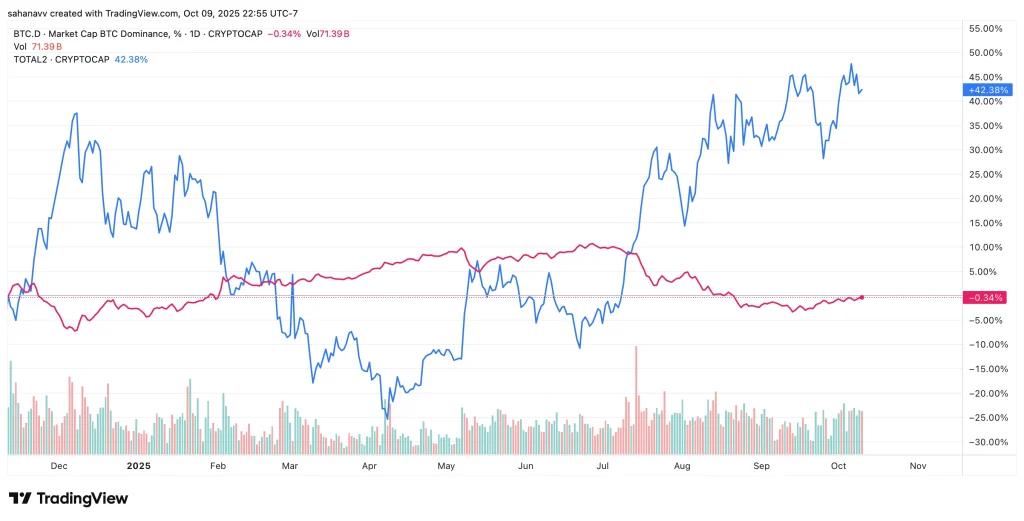
If historical patterns repeat, this reduction could be the steady accumulation that happens before Altcoin Season breaks out. In previous bull cycles, altcoins didn’t stand out until Bitcoin settled down—and that’s where we are today. Specific sectors are displaying sparks of life. AI tokens, DeFi protocols, and privacy coins are staying strong even as the broader market declines. These might be the initial leaders of the upcoming rally—a sign that Altcoin Season could be taking shape beneath the surface as traders focus on Bitcoin’s variations.
Bitcoin’s consolidation near record heights indicates that the market is readying itself for its subsequent major move. With positive sentiment progressively returning and institutional demand displaying strength, the stage appears set for a potential breakout. However, traders should remain mindful, as failed breakouts in such zones often trigger quick adjustments. If momentum aligns with enhanced accumulation and macro support, Bitcoin could regain its upward direction, making the $137,000 mark a realistic objective in the upcoming weeks and possibly presenting the long-awaited Altcoin Season.