


Despite already declaring its largest cryptocurrency seizure to date, the United States could potentially lay claim to an additional $2 billion in Bitcoin connected to the now-defunct LuBian mining operation.
On October 15th, blockchain researcher Sani indicated that approximately 16,237 BTC, currently valued at around $1.8 billion, are still being moved across various digital addresses linked to LuBian.
These addresses include:
- bc1qvrwzs8unvu35kcred2z5ujjef36s5jgf3y6tp8: 13,107 BTC
- bc1q42ltpxsc6s8fne0jz474tvuvyq2sqw26ud80xy: 2,129 BTC
- bc1q4c9q0nva573jgs7vxu9hf0qyfqqtzy8awn77s0: 1,000 BTC
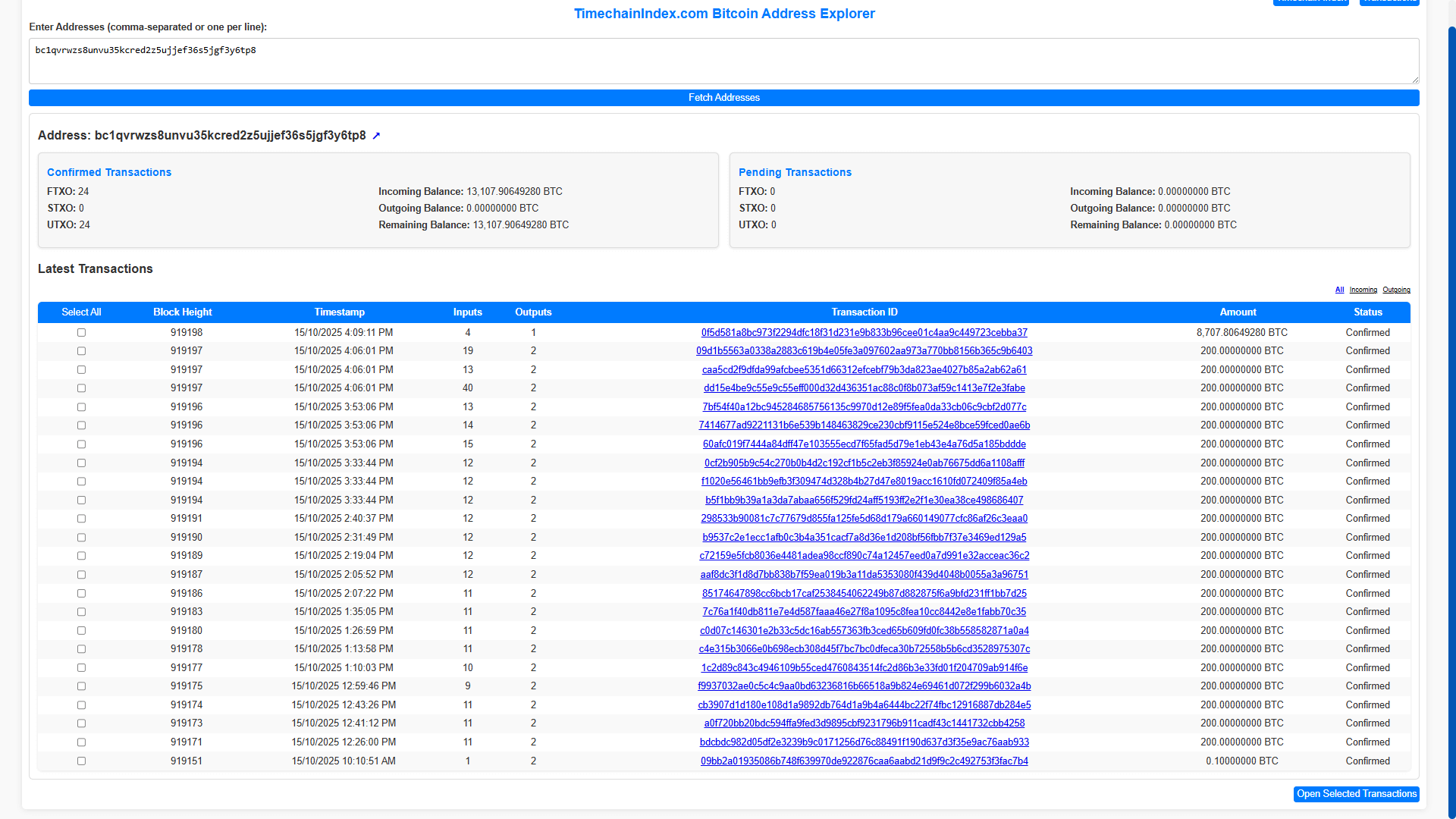
Interestingly, these specific digital wallets were not included among the 25 addresses listed in the U.S. forfeiture documents, which detail approximately 127,000 BTC that the government seeks to confiscate.
This difference, however, doesn’t automatically suggest that federal agents overlooked any assets. Certain addresses might remain confidential under court order, while others could belong to intermediaries involved in the money laundering scheme.
Nevertheless, these ongoing Bitcoin transactions indicate that investigators have not yet completely mapped out the operational structure of the network.
Strategic Bitcoin Reserve
Should the U.S. government successfully recover the additional 16,237 BTC, in addition to the already seized 127,000 BTC, its total Bitcoin holdings would reach roughly 343,000 BTC. This amount would represent approximately 1.6% of Bitcoin’s total supply.
These holdings would establish the U.S. government as the leading nation-state holder of the premier cryptocurrency.
Furthermore, this accumulation would position the U.S. just behind MicroStrategy, led by Michael Saylor, whose corporate treasury holds approximately 640,000 BTC, representing over 3% of Bitcoin’s total supply.
In parallel, the LuBian case signifies the initial practical test for the Strategic Bitcoin Reserve (SBR), an initiative established under President Donald Trump’s March 2025 executive order to manage confiscated digital assets.
Senator Cynthia Lummis commented that the seized Bitcoin demonstrates the necessity for the U.S. Congress to “enact clear digital asset market structure legislation to guarantee that law enforcement can take decisive action against wrongdoers while simultaneously protecting innovation.”
She further stated:
“Codifying the methods for storing seized bitcoin, returning it to victims, and safeguarding it for future generations. Transforming criminal proceeds into assets that strengthen America’s Strategic Bitcoin Reserve illustrates how sound policy can convert wrongdoing into enduring national value.”
The Collapse of LuBian
LuBian, once ranked among the top six Bitcoin mining entities globally, controlled roughly 6% of the global hash power through mining operations in China and Iran.
Its decline began in late 2020 when a vulnerability in its key generation algorithm allowed attackers to steal 127,426 BTC, valued at $3.5 billion at the time, from its digital wallets. Arkham Intelligence initially reported this theft in August 2025.
In a desperate attempt to recover the stolen funds, LuBian sent hundreds of on-chain messages urging the hacker to return the coins and offering a reward for their return.
Blockchain analytics firm Elliptic later estimated that the company spent over $40,000 sending these embedded appeals before ceasing network activity in early 2021.
On October 14th, U.S. authorities unsealed an indictment connecting the stolen assets to a fraud network linked to the Prince Group, a Cambodian conglomerate headed by Chen Zhi.
According to the authorities, Chen’s associates channeled proceeds from “pig butchering” scams, which are large-scale online investment frauds, into cryptocurrency mining operations like LuBian.