


USDe, a rising stablecoin, has witnessed an impressive surge in its market capitalization. Starting at roughly $5.33 billion on July 17, it escalated to over $9.3 billion by August 4. This nearly 75% increase propelled USDe to become the third-largest stablecoin, surpassed only by USDT and USDC.
This swift ascent has placed Ethena’s creation amongst the leading digital currencies of its type, while simultaneously generating inquiries about the long-term viability of a crypto-based asset in a sector typically governed by assets backed by traditional currency.
The notable market cap jump signifies more than just increased investor interest. In under a month, more than $3.1 billion worth of new USDe tokens entered circulation. This surge aligns with favorable funding rates within the perpetual futures arena, coupled with a heightened focus surrounding Ethena’s ENA token repurchase initiative.
Rapid ascent of USDe
The speed at which USDe has grown is especially noticeable in the world of stablecoins. Similar growth was seen with USDC, which surpassed $10 billion in valuation around March 2021. Now sitting at nearly $9.25 billion, USDe has reached a similar level.
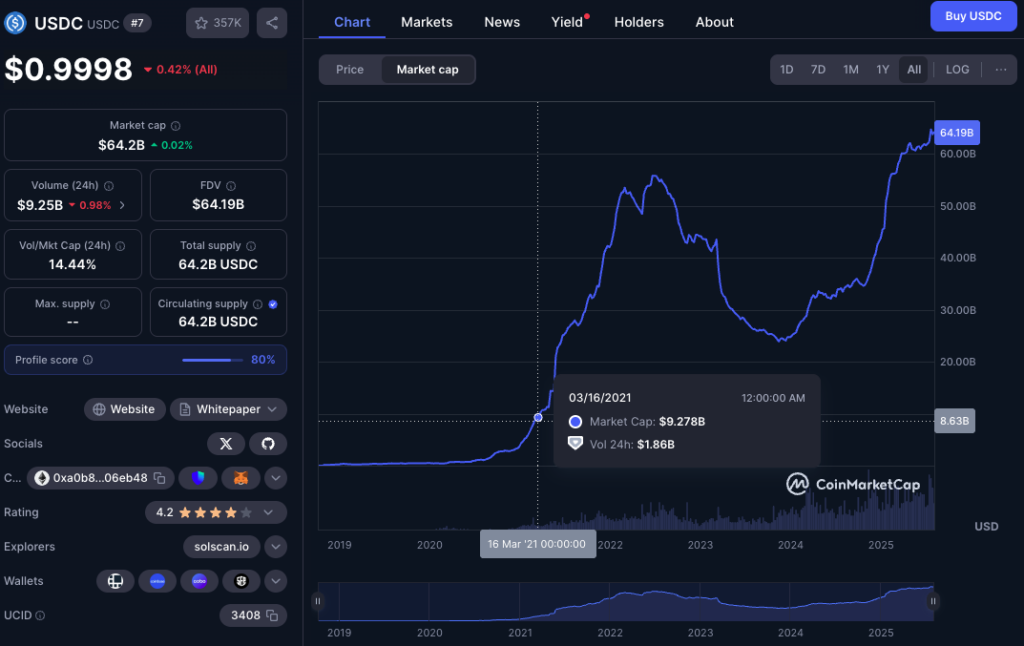
USDe distinguishes itself from USDT and USDC, as it is entirely decentralized using a synthetic framework. This means that unlike its established counterparts, USDe is built on a delta-neutral mechanism that pairs long spot positions in digital currencies, like Bitcoin, Ethereum, and Solana, with offsetting short positions in perpetual futures.
This approach gives rise to basis or funding yield, which is then provided to stakers who convert USDe to sUSDe. Ethena has proposed this as a way to create solid returns while avoiding traditional monetary authorities. The project founder, Guy Young, explained that USDe is meant to have different risk aspects compared to stablecoins based on standard currency.
The basis trade that backs USDe’s income has been successful in growing or changing market conditions, where continuous funding increases favor short sellers. This factor was a major aspect of USDe’s growth in July.
Still, how long this income can last is not certain. Incentives that went over 60% each year are now below 5% as more investors have joined the activity.
Ethena has stated that “funding risk” is a key concern, clarifying that its strategy is very affected by any market changes. This could happen if funding turns negative, or if a counterparty becomes unstable on a large exchange.
USDe leaves established stablecoins in the dust
Market information emphasizes the extent of USDe’s latest climb. Data from CoinMarketCap and DefiLlama shows that USDe now takes the number three spot in terms of market cap, following USDT at about $164 billion and USDC at around $64 billion.

This growth has also put USDe ahead of other stablecoins such as USDS (previously DAI), and shows how the positions in decentralized stablecoin rankings are changing.
While still behind USDC by $50 billion, the present size of USDe is half of the USDC market cap when it dropped in November 2023 to $24 billion.
If USDe keeps an 8.4% monthly growth rate, and if USDC remains the same, USDe could exceed USDC in two years.
The model’s effect has gathered attention from experts. Young specified how the growth of USDe coincidentally causes demand for USDT: “Every time Ethena brings shorts to the market, Tether demand is generated. A $1 increase in USDe causes about a $0.70 increase in USDT when USDe is fully backed by continuous positions.” This market relationship indicates that USDe’s growth may indirectly help the entities it is working to disrupt, and explains the complex workings of its systemic operations.
USDe’s current progress demonstrates a non-fiat-backed stablecoin’s capacity for accomplishing substantial scale. Its quick increase underscores both the advantages and limits of crypto-native yield platforms.
It does, however, make some remember the algorithmic stablecoin Luna UST, which climbed to a market cap of over $60 billion before losing its peg and failing to zero.
While current dynamics have brought it to the front, there is still doubt if it can retain its speed in view of compressed funding, custodial risk, and regulations.
For now, Ethena’s digital dollar is a contender among giants, and its future depends strongly on the changing mechanics it uses.