
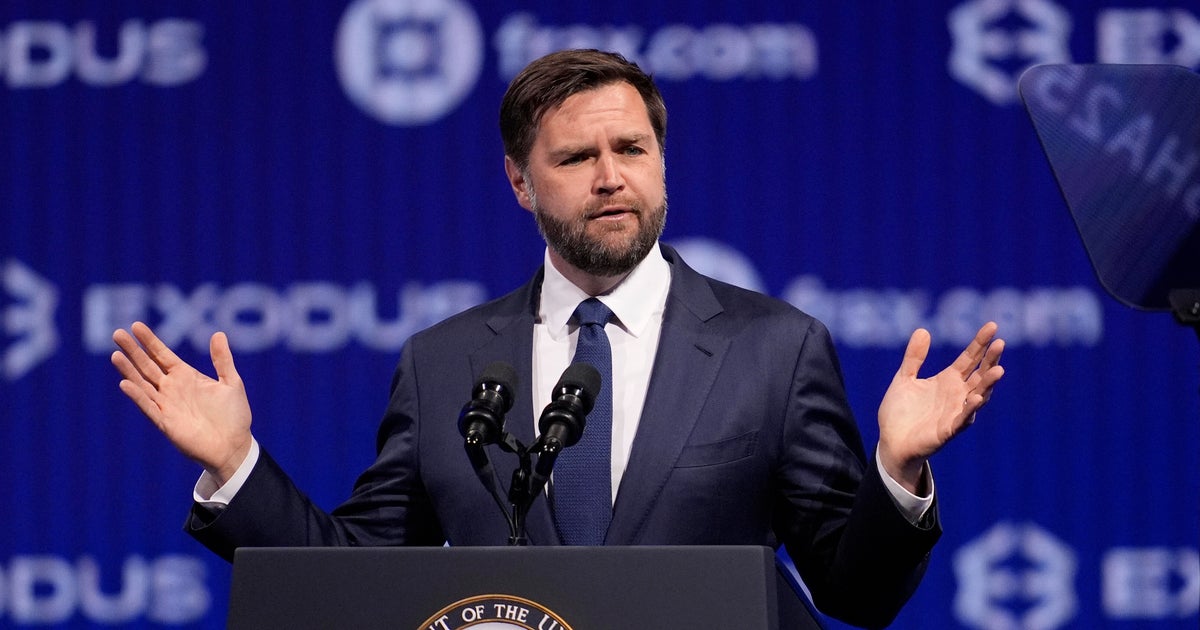
Speaking at the Bitcoin 2025 Conference on Wednesday, Vice President JD Vance highlighted the close relationship between the Trump administration and the cryptocurrency sector. This industry, once considered unconventional, has found increasing support from President Trump and his allies in recent months.
“I’m here to declare unequivocally that with President Trump, the crypto world finally gains a strong advocate and partner in the White House,” Vance stated to attendees in Las Vegas.
The Trump administration has actively engaged with cryptocurrency, aiming to reduce regulatory obstacles, encourage sector expansion, and integrate it into the traditional financial system. Vance, a long-time supporter of cryptocurrencies, held Bitcoin assets valued between $250,000 and $500,000, according to a financial disclosure from August 2024.
“We want Americans to understand that crypto and digital assets, particularly Bitcoin, are integral to the mainstream economy and are here for the long haul,” Vance emphasized on Wednesday.
Vance commented that he hadn’t been to a conference with “this much excitement” in quite a while, adding, “but I assure you I’m not just saying that to promote my own memecoins.” During his address, Vance provided few specific policy details. However, he asserted that decentralized finance, facilitated by crypto, has “revolutionized” how Americans conduct transactions and functions as a “protective measure” against flawed policies.
“Crypto acts as a safeguard against poor decision-making in Washington, regardless of the party in power,” he stated. “It’s a defense against soaring inflation, which has diminished the real savings of Americans over the past four years. And as you all know, it’s a shield against a private sector that’s increasingly inclined to discriminate against consumers based on their fundamental beliefs, including their political views.”
John Locher / AP
Vance urged Congress to approve the GENIUS Act, which is designed to establish a regulatory structure for stablecoins. Stablecoins are a form of cryptocurrency pegged to an underlying asset, such as the U.S. dollar.
“This administration does not believe that stablecoins pose a threat to the integrity of the U.S. dollar; quite the opposite,” Vance stated. “In fact, we view them as a force multiplier for our economic strength.”
Acknowledging the increased civic engagement in 2024, Vance called for a continued effort to influence policy.
“If you don’t participate in the political process, politics will overlook this industry,” Vance warned. “… While Bitcoin exists in the digital realm, none of us do. The decisions made in politics and bureaucracy will impact even the most innovative and valuable technologies if we don’t act. Therefore, I urge you to maintain the momentum of your political involvement from 2024 and extend it to 2026 and beyond.”
The Las Vegas conference is also featuring several other prominent Trump supporters. Donald Trump Jr. and Eric Trump, both with investments in crypto ventures, are scheduled to speak on a panel discussing “the rise of new bitcoin business models.” Chris LaCivita, who co-managed Mr. Trump’s 2024 campaign, and David Sacks, a venture capitalist serving as the White House’s crypto czar, were speakers on Tuesday.
Vance holds the distinction of being the highest-ranking sitting politician to address the Bitcoin Conference, which bills itself as “the world’s largest gathering of bitcoiners” and regularly attracts legislators supportive of cryptocurrency. Last year, Mr. Trump, then a presidential candidate, was the key speaker.
Vance headlined a fundraising event hosted by MAGA Inc. on Tuesday night in Las Vegas, where tickets were priced at $1 million each, according to CBS News sources. The Washington Post initially reported the fundraiser.
Vlad Tenev, CEO of Robinhood, a widely used trading platform for stocks and crypto, conveyed to CBS News at the conference that the Trump administration’s approach to the crypto industry is a welcome change.
“Under the previous administration, the industry was essentially under indiscriminate attack,” Tenev said.
“Now, there’s an opportunity to be proactive… And we have an administration that’s receptive to the technology,” he added.
Bitcoin, and cryptocurrency in general, has gained traction and attracted allies from both parties, despite concerns about its volatility. Bitcoin’s price, the most widely used cryptocurrency worldwide, has surged nearly 60% in the past year.
Mr. Trump was previously skeptical of crypto, calling Bitcoin a “scam” with a value “based on thin air.” However, in his second term, he has actively promoted crypto and pledged to reverse stringent regulations implemented during the Biden administration.
Mr. Trump and his family also have financial interests in crypto, which comprise $2.9 billion of his net worth, according to a recent report. Trump Media and Technology Group, the parent company of Truth Social, announced on Tuesday plans to raise $2.5 billion to invest in Bitcoin.
Furthermore, businesses associated with the president launched a Trump-branded “meme coin” earlier this year, and Mr. Trump hosted the digital currency’s top investors at his Virginia golf club last week. The president and his sons are connected to the crypto exchange World Liberty Financial. Eric Trump co-founded a Bitcoin mining enterprise that is seeking to become publicly traded.
These actions have faced criticism from Democrats and some ethics experts who contend that Mr. Trump’s crypto ventures present a conflict of interest and that investing in them could provide a quick path to accessing the president.
Tenev shared his perspective on Trump’s personal investment in crypto.
“It is, of course, a potential conflict,” Tenev acknowledged, but added, “Whether their motivation is primarily personal gain… I’m unsure if there’s enough factual basis to support that.”
The GENIUS Act, initially a bipartisan Senate bill aimed at regulating stablecoins, lost support after Democratic lawmakers advocated for restrictions on elected officials buying or selling crypto – with some Democrats specifically referencing Mr. Trump’s crypto investments. Senators ultimately voted to advance the bill earlier this month.
The White House has firmly dismissed any conflict-of-interest concerns, asserting that Mr. Trump’s assets are held in a trust managed by his children.
Jo Ling Kent and
contributed to this report.