

The VeChain price forecast for September 2026 remains optimistic, positioning above $0.007027, the EMA200 level that has held steady since $VET surpassed a long-term descending trendline in August.
Analysis of VeChain’s Price: Is $VET Confirming Its Break from the Trendline?
$VET is trading close to $0.007880, marking a decrease of 2.31% today, following a retreat from an intraday peak of $0.008162. This dip comes after a significant rally that began from August’s low near $0.0044, breaking through a descending trendline that extended from January’s high of around $0.0095.
The current price remains above all EMAs, with the 20-day at $0.006673, the 50-day at $0.005892, the 100-day at $0.005769, and the 200-day at $0.007027. This last EMA is critical, determining whether today’s pullback remains minor. The weekly Bull Market Support Band rests significantly lower, between $0.005683 and $0.006172, establishing a broader macro support level.
Support and Resistance Levels for $VET in September 2026
Latest VeChain Updates: Cointelegraph Introduces Validators on the Network
A notable enhancement to the VeChain validator ecosystem has been made. @CTDG_DevHub is now operational with two validators, providing $VET holders with an additional method to stake and reinforce the network.
Welcome aboard. https://t.co/vIYgz53o2d
— VeChain (@vechainofficial) September 7, 2026
Cointelegraph’s validator branch, CTDG, has launched two validators on the VeChain network, as confirmed by the official VeChain account. Validators help maintain network security and create new blocks, earning rewards. Operating one requires holding a substantial amount of $VET, but smaller investors can delegate their tokens to an existing validator, sharing rewards—approximately 70% to delegators and 30% to the validator—via the VeChain StarGate platform.
Related: Ethereum Price Prediction: Will ETH Surpass $2,600 Amidst Ongoing Institutional Interest?
This development was made possible after the Hayabusa upgrade on VeChain opened 101 validator positions to eligible operators. Cointelegraph has established validators on Solana, Polkadot, and Injective, so its inclusion in VeChain’s validator lineup adds a recognized media name to the network.
VeChain Insights: Highlighting Ethereum’s EIP-8141 and Its Related Concepts
With hindsight, protocol design appears more compelling.
Ethereum’s EIP-8141 emphasizes transaction batching, gas abstraction, and programmable account functionality within the protocol.
VeChainThor integrated several of these concepts as first-class transaction functionalities years ago.
The inquiry is…
— VeChain (@vechainofficial) September 8, 2026
VeChain’s official account shared a technical analysis comparing its transaction framework with Ethereum’s EIP-8141 proposal. The main argument is that features Ethereum is currently developing already exist on the VeChain blockchain and have been established for years.
Below is the comparison provided by VeChain:
Simply put: VeChain enables a single transaction to encompass multiple actions (referred to as Clauses), permits a third party to cover gas fees (VIP-191), and allows a transaction to time out or rely on the successful completion of another. Ethereum’s EIP-8141 aims to achieve similar capabilities but under different terminology.
Related: Cardano Price Prediction: Is ADA Set to Break Its Range Ahead of This Week’s CPI Report?
VeChain acknowledged one limitation in its structure. EIP-8141 would allow a wallet’s inherent rules to determine the validity of a transaction, opening avenues for custom signature methods or smart-account logic. Currently, VeChain determines validity via a standard method, relying on a single cryptographic signer. This report posited the situation as two entities independently addressing similar challenges rather than one imitating the other.
Seasonal Trends for VeChain in September
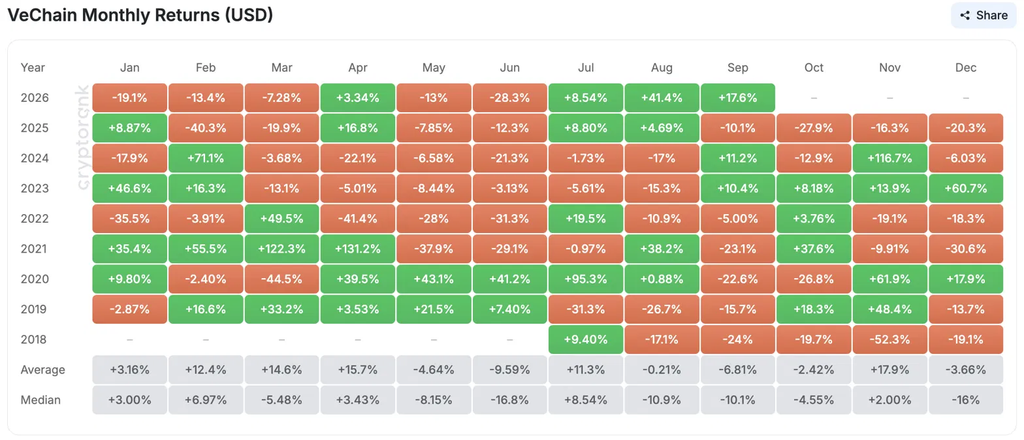
Historically, September has not been favorable for $VET, closing in the red in five of the past eight years, with a median return of -10.1%. However, this year’s performance, with a 17.6% increase along with a 41.4% rise in August, significantly deviates from past trends.
Week-by-Week VET Forecast for September 2026
VeChain Price Insights for September 2026: Potential Upsides and Downsides
Optimistic Scenario, Target: $0.0095
If $VET remains above the 200-day EMA at $0.007027 and surpasses today’s peak near $0.0082, achieving a daily closing above $0.0085 may pave the way to the January high at $0.0095, which would completely invalidate the long-term downtrend.
Pessimistic Scenario, Support Level: $0.006172 (Upper Band of the Weekly BMSB)
Should $VET fall below the 200-day EMA at $0.007027, it risks a decline towards the 20-day EMA at $0.006673. Dropping further would expose the weekly Bull Market Support Band around $0.006172, reversing the trendline breakout.
Expert Observations
VeChain shared its comparative analysis with Ethereum the same week it broke a prolonged downtrend, and the timing is significant. Projects previously overlooked often present their strongest technical arguments at moments when price surges capture attention. The assertion holds true; VeChain did implement many features before Ethereum proposed them. However, the timing suggests a strategy to convert a price rally into a narrative that endures beyond the short-term surge. The sustainability of this narrative will determine if $VET maintains its breakout once the broader altcoin momentum subsides.
Related: Venice Token Price Prediction: VVV Rises 50% as Buyers Aim for $30
Frequently Asked Questions
If $VET sustains above $0.007027 and surpasses $0.0082, it could reach $0.0095. Conversely, dropping below $0.007027 could lead to a decline towards the weekly Bull Market Support Band near $0.006172.
The rally’s magnitude is not attributed to a single VeChain-specific event. Noteworthy developments include Cointelegraph initiating validators on the network and a technical analysis contrasting VeChain’s transaction mechanism with Ethereum’s EIP-8141, neither of which act as definitive demand catalysts on their own.
No, $VET has experienced losses in five of the last eight Septembers, with an average return of -10.1%, making the current year’s performance an anomaly against its historical trends.
Holders of $VET can delegate their holdings to Cointelegraph’s validator, CTDG, and earn a share of staking rewards, distributed approximately 70% to delegators and 30% to the validator through VeChain’s StarGate platform.