
On September 9, U.S. exchange-traded funds (ETFs) linked to Ethereum, $XRP, and Solana saw an influx of nearly $59 million, whereas Bitcoin-related products faced withdrawals totaling $120.24 million. This shift highlights a trend of reallocating capital within the regulated crypto sector.
However, the overall market showed little indication of this transformation. The Altcoin Season Index from BlockchainCenter registered a score of 37, significantly under the 75 mark, suggesting that less than 25% of the leading eligible tokens are outperforming Bitcoin over a 90-day span.
This phenomenon is becoming a hallmark of the growing crypto ETF landscape. While there are more options for diversifying away from Bitcoin, investor funds tend to be concentrated in a select few major assets, instead of being distributed across a wider range of tokens.
A Limited Rotation Within a Niche ETF Sector
The trading session on September 9 illustrated how institutional interest in altcoins can emerge without triggering a broader crypto movement.
Ethereum funds attracted $34.75 million, while investments in $XRP garnered $12.29 million, and Solana received $11.73 million. In contrast, Bitcoin funds experienced their second consecutive day of withdrawals.
Although these figures do not definitively show that investors sold Bitcoin ETFs to reinvest in these three alternatives, they clearly indicate a contrasting trend in demand across the leading regulated crypto categories.
This trend extends beyond just one trading day.
In the 30 days leading up to September 9, Bitcoin ETFs still dominated with a total of $3.42 billion in net inflows, compared to $1.76 billion for Ether. Meanwhile, Solana and $XRP saw inflows of $200.88 million and $185.32 million, respectively.
Overall, these four assets collectively made up approximately $5.57 billion out of around $5.64 billion in net inflows reported across various spot crypto ETF categories tracked by SoSoValue.
Other products attracted significantly less capital.
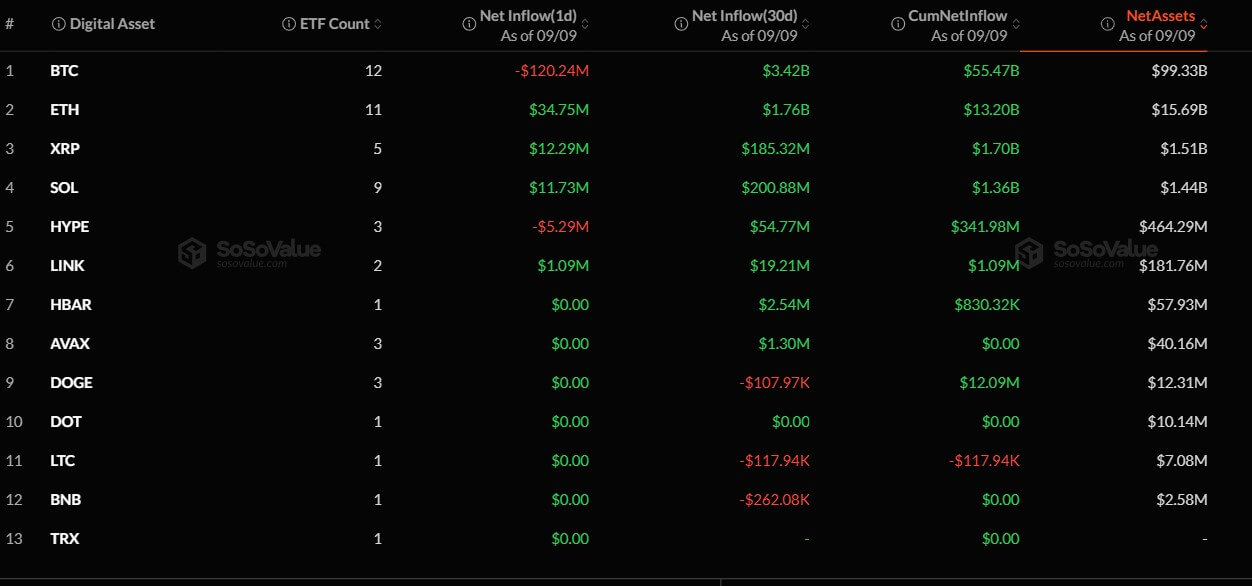
Hyperliquid funds drew in $54.77 million during the same timeframe, with Chainlink attracting $19.21 million. Hedera saw $2.54 million, and Avalanche garnered $1.3 million, while Dogecoin, Litecoin, and $BNB experienced minor net outflows. Polkadot remained stagnant with no net flow.
When examining assets under management, the disparity is even more pronounced. Bitcoin and $ETH products currently hold $99.33 billion and $15.69 billion, respectively, while $XRP and Solana have each reached roughly $1.5 billion.
The next largest category, Hyperliquid, accounts for about $464 million. Chainlink falls short at approximately $182 million, and all other categories hold less than $60 million.
This hierarchy allows investors to shift away from Bitcoin while still having a limited set of regulated options, without delving deeply into the broader crypto ecosystem.
Historically, traders typically anticipated that early Bitcoin gains would flow into $ETH, followed by large-cap tokens and eventually smaller speculative assets. However, ETFs introduce a different pathway: institutional portfolios can adjust their allocations among Bitcoin, Ethereum, $XRP, and Solana while largely leaving the rest of the token market untouched.
Funding for Altseason Must Extend Further
Current market data indicates that this transition has yet to materialize fully.
BlockchainCenter defines “altseason” as a period in which 75% of the top 50 eligible cryptocurrencies exceed Bitcoin’s performance over 90 days. With a reading of 37 on September 9, less than the needed proportion enjoyed such success.
CoinGecko’s data also indicates Bitcoin maintained 56.64% of the total crypto market capitalization, slightly up from 56.02% three months prior and down only slightly from 56.54% a year ago. Its market share has thus remained relatively stable, despite an increase in regulated access to a growing array of alternative tokens.
This highlights the importance of differentiating between ETF altcoin rotations and a true altseason.
Ethereum, $XRP, and Solana may attract hundreds of millions in funding without significantly impacting the prices of Dogecoin, Avalanche, Polkadot, or many other tokens whose ties to institutional portfolios are minimal.
The increasing number of approved products does not ensure that a cohesive market will emerge. On September 9, Hedera, Avalanche, Dogecoin, Polkadot, Litecoin, and $BNB all recorded zero net flows, even with Bitcoin funds leaving the market and three larger altcoins receiving capital.
As such, the next challenge for fund issuers lies less in introducing additional crypto assets into ETF structures and more in convincing investors to diversify beyond their current preferences.
A sustained period of Bitcoin withdrawals would serve as a clear test. If $ETH, $XRP, and Solana continue to draw in that demand while smaller ETF categories remain largely inactive, Wall Street could witness frequent rotations in altcoins, yet the widespread altseason that crypto traders anticipate may still be elusive.