
Senator Elizabeth Warren has voiced strong objections to the current administration’s approach to cryptocurrency, particularly a recently enacted stablecoin regulation bill. She warns that the legislation, which she characterizes as “industry-authored,” will ultimately be detrimental to the average American citizen.
Ensuring Proper Cryptocurrency Legislation is Crucial
In a recent interview with Vanity Fair, Senator Warren, a Democrat, expressed her disapproval of the Guiding and Establishing National Innovation for US Stablecoins (GENIUS) Act. President Trump signed this bill into law just a week prior, coinciding with the House of Representatives’ “Crypto Week.”
The GENIUS Act, initially proposed by Republican Senator Bill Hagerty in February, seeks to establish a regulatory environment where stablecoins operate under the jurisdiction of the Federal Reserve. This framework aims to cultivate a “secure and growth-oriented” structure, fostering advancement within the U.S. digital asset sector.
When questioned about the bipartisan support for the legislation, Senator Warren suggested a recurring pattern of prioritizing industry interests over the needs of the American public, who are calling for economic fairness and affordability.
The Senator, known for her skepticism towards crypto, emphasized the necessity of robust digital asset laws, but cautioned against passing bills that appear to be “written by the industry itself.” She asserted, “If we are to implement a comprehensive regulatory structure for crypto, we must ensure it’s done correctly.”
According to Senator Warren, the considerable “influence” of the crypto industry in Washington, D.C. is not unexpected, given the city’s political landscape. As Bitcoinist previously reported, significant sums have been spent by Super Political Action Committees (PACs) in recent years.
A report indicated that Fairshake, a prominent Super PAC, and its affiliates allocated around $136 million to support approximately 60 pro-crypto candidates during the 2024 election cycle and are strategically positioned for the 2026 midterm elections with over $100 million in available resources.
Senator Warren stated that lobbying expenditures from the crypto sector have “exceeded any previous levels witnessed in Washington,” enabling the industry to essentially draft “its own legislation.”
Drawing a parallel, Senator Warren compared the GENIUS Act to the Commodity Futures Modernization Act of 2000. She argued that when Washington caters to specific industries, the benefits concentrate among a select few, while the broader population “bears the consequences.”
This scenario is familiar. When an industry drafts its own regulations, the outcome often favors the industry itself. This occurred with the derivatives industry, which presented legislation for regulation that ultimately provided weak oversight and a false sense of government backing. The result was the financial crisis of 2008, which led to the loss of homes for ten million American families, along with jobs and savings for many more.
Senator Warren Criticizes Administration’s Stance on Crypto
Senator Warren reiterated her concerns regarding the Trump administration’s apparent shift towards policies perceived as beneficial to the crypto industry, allegedly for personal gain. She stated that the President is “exploiting the presidency to personally benefit from crypto activities, and he is doing so openly.”
She had previously expressed worries concerning President Trump’s involvement in crypto ventures, asserting that these activities could potentially pave the way for “crypto-related corruption.” In May, she urged Congress to reject the GENIUS Act, despite bipartisan efforts aimed at addressing concerns raised by Senate Democrats and amending the legislation.
During the interview, Senator Warren also criticized the President for appointing individuals with industry ties to “oversee crypto policy,” dismantling the Department of Justice’s (DOJ) specialized enforcement unit, and urging the Securities and Exchange Commission (SEC) to move away from its previous “regulation through enforcement” strategy.
She concluded, “People voted for Trump with the expectation of lower costs from day one, not to transform the White House into a crypto cash cow.”
Despite Senator Warren’s reservations, some within the crypto sector believe that the regulatory changes, including the GENIUS Act, will positively impact the American digital asset industry. Fred Thiel, CEO of MARA Holdings, recently commented that the newly passed legislation demonstrates U.S. leadership on a global scale and will “foster trust” within the sector, while enabling the market to “operate with greater freedom.”
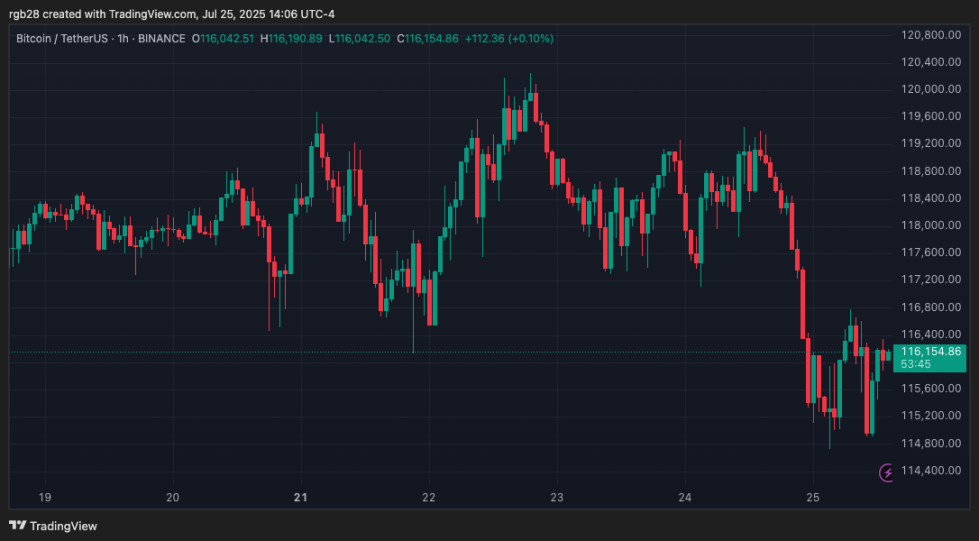
Bitcoin (BTC) is trading at $116,154 on the one-week chart. Source: BTCUSDT on TradingView
Featured Image from Unsplash.com, Chart from TradingView.com

Editorial Process for bitcoinist focuses on delivering in-depth, well-researched, precise, and neutral content. We strictly adhere to sourcing standards, and every article is thoroughly reviewed by our experienced team of technology experts and skilled editors. This ensures the quality, relevance, and usefulness of our content for our readers.