

Ethereum’s price movement remains subdued, struggling to maintain the upward momentum seen earlier in the previous week. Over the last week, the digital asset has only experienced a marginal increase of approximately 0.3%, with a slight decrease of 0.2% observed in the past 24 hours.
Currently, Ethereum is being traded at around $2,436. This ongoing lack of significant price movement suggests a cautious sentiment prevailing within the broader cryptocurrency market, despite the underlying structural support provided by institutional interest and large-scale investor (whale) activities.
Ethereum Whales Accumulate, Retail Traders Remain Inactive
According to a recent market analysis published on CryptoQuant’s QuickTake platform, on-chain analyst Banker characterizes Ethereum’s present market dynamic as a “deadlock.”
Banker indicates that large holders are consistently accumulating Ethereum, as evidenced by roughly 60,000 ETH in weekly staking inflows and significant negative netflows on exchanges, suggesting that more ETH is being withdrawn than deposited.
However, the analyst says that the ongoing accumulation by whales is not being matched by increased participation from retail investors, resulting in a state of market stagnation, and preventing significant bullish surges.
Exchange data reveals spikes of over 200,000 ETH being withdrawn, likely being absorbed by institutional entities, according to Banker. In contrast, retail-driven deposits, totaling about 100,000 ETH since 2023, appear insufficient to generate the necessary upward pressure for a breakout.
The number of daily active addresses remains stable at levels between 300,000 and 400,000, which is considerably lower than the levels typically associated with substantial price increases in Ethereum’s history. The neutral funding rate of 0.004% further indicates a lack of clear directional conviction among traders using leveraged positions.
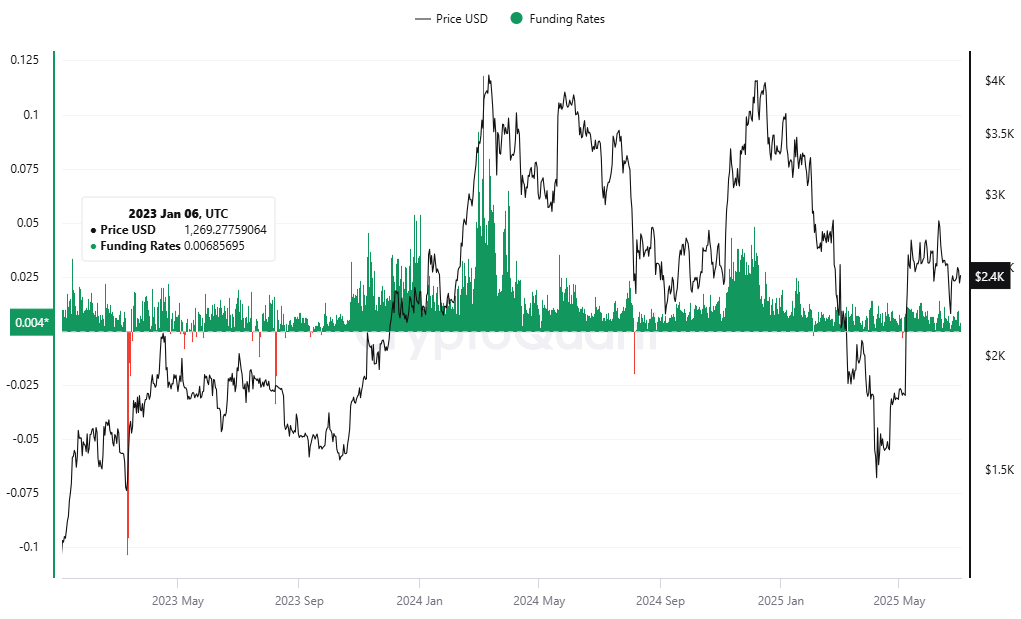
Banker suggests that the continuous withdrawal activity by large holders, coupled with stable leverage usage, creates a supply-side constraint, thereby limiting significant downward price movement.
Nonetheless, the analyst concludes that Ethereum is unlikely to escape its current trading range unless there is increased engagement from retail investors or a rise in daily address activity above the 400,000 mark.
In summary, while large holders are preventing significant price declines, a substantial breakout would necessitate a broader participation from the market or a distinct external factor acting as a catalyst.
Exchange Activity, Divergences, and Macro Factors Add Headwinds
In a separate analysis, CryptoQuant’s Amr Taha explored Ethereum’s exchange inflows and derivatives market data, implying potential near-term price swings.
Taha reported that on July 1st, over 100,000 ETH, valued at roughly $250 million, were transferred to Binance in two separate transactions. These substantial inflows usually signal possible selling pressures or preparations for trading, particularly when aligned with other indicators suggesting bearish sentiment.
Taha also called attention to a difference between Ethereum’s spot price and Binance’s Open Interest. Although ETH has established three local highs above $2,500 recently, the Open Interest has consistently declined, developing three lower highs. This failure by derivatives traders to confirm the upward movement suggests a hesitation to commit to long positions.
Concurrently, the US Federal Reserve’s net liquidity has decreased from approximately $6.2 trillion to $5.84 trillion, which restricts financial conditions and reduces the flow of capital into risk-associated assets such as cryptocurrencies.
Taha concludes that Ethereum may experience downward price pressures in the near future unless macroeconomic conditions improve or there is a surge in demand specific to Ethereum.
Featured image created with DALL-E, Chart from TradingView