

Recap: The Bitcoin Short Saga: An investor strategically shorted Bitcoin just moments before President Trump’s announcement of new tariffs, potentially reaping profits estimated between $160 million and $200 million.
Now, the crypto investigator, known as Eye, who played a key role in the narrative by tracing digital wallets and suggesting Garrett Jin could be a figurehead for a larger network, has announced a pause in their investigation, citing concerns for personal safety.
Eye halted their work on the Bitcoin short case following unsubstantiated claims alleging a connection between the trade and a network associated with World Liberty Financial.
Prior to stepping back on October 14th, Eye proposed that the wallet linked to Garrett Jin might be a channel for privileged information, flowing from individuals with inside knowledge to traders who could capitalize on policy announcements.
“Garret appears not to be the principal player. He is likely a front, serving as the initial point in tracing a genuine insider trading operation…
The critical intelligence provided to the HL whale probably originates from a group of insiders who have been consistently exploiting confidential details from White House rumors and forthcoming official announcements.”
The discussion brings up the names of World Liberty Financial’s co-founders, Zach Witkoff and Chase Herro, who have connections to Donald Trump Jr. The hypothesis suggests that a leak might have provided information to parties beyond Jin, supporting the idea of him being a “front.”
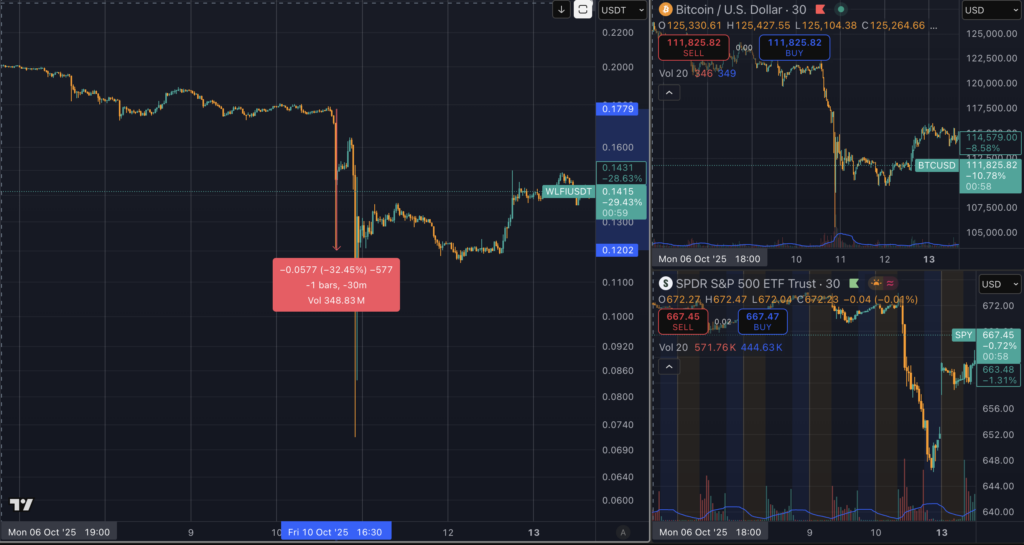
Notably, a 30% drop in WLFI token value hours before the tariff announcement, coinciding with a mere 3% dip in Bitcoin, has sparked considerable interest within the crypto community.
Eye announced a cessation of further publications, indicating having “dug too deeply,” and leaving open questions about who, if anyone, may have had access to confidential policy information.
The controversy emerged from a Bitcoin short trade executed on Hyperliquid just before President Trump’s tariff announcement on October 11th, as detailed in our previous report.
This event triggered approximately $19 billion in liquidations across various platforms within 24 hours, with Hyperliquid reporting widespread losses among its users.
According to CoinGlass, this liquidation event was among the largest single-day losses in crypto history. CoffeeZilla has also examined the trade, focusing on the final short position added at 20:49 GMT and the tariff announcement at 20:50 GMT – a one-minute interval fueling ongoing speculation about the trader’s knowledge and timing.
Jin has refuted the insider trading claims, repeatedly denying any wrongdoing. He asserted that the capital belongs to clients, his team provides in-house research and insights, and he has no connections to the Trump family.
He also criticized Binance co-founder Changpeng Zhao for sharing Eye’s initial findings with a wider audience, sarcastically thanking CZ “for sharing my personal and private information,” and maintained that his short position was based on macroeconomic and technical analysis, not non-public information.
Interestingly, Jin deleted a tweet denying any link to President Trump. The original tweet stated:
“Hi @cz_binance, thanks for sharing my personal and private information. To clarify, I have no connection with the Trump family or @DonaldJTrumpJr — this isn’t insider trading.”
He also declared, “There aren’t that many conspiracies in this world. Stop making excuses for your ignorance and unprofessionalism.”
Jin outlined a five-point rationale for his trading strategy, citing overbought conditions in US and Chinese tech stocks, and major crypto pairs, a positive correlation between crypto and US tech, a shift in US-China trade relations between September 26th and October 11th, a broader risk-off sentiment leading up to the trade, and high market leverage potentially leading to a deleveraging event like previous crashes.
He further suggested “stability funds” at major trading platforms, arguing that excessive leverage on assets without underlying cash flows increases the risk of disruptive price fluctuations regardless of market direction.
Commentator Quinten Francois questioned the direct mapping of a wallet allegedly used for these trades to publicly identifiable individuals through an ENS domain name, calling the connection too convenient and urging caution against drawing conclusions from limited data points.
Attorney John E. Deaton has called for a formal regulatory review, stating that if the allegations prove true, regulators should investigate the trades thoroughly.
The Wallet Associated with Jin Remains Active.
By October 13th, the account established a new Bitcoin short position with approximately $496 million notional value at 10x leverage, indicating a liquidation level near $124,270.
Tracking data reveals several million dollars in unrealized profit, with Bitcoin prices fluctuating between $114,000 and $117,000. Simultaneously, two other significant Hyperliquid traders opened roughly $182 million in new short positions across major cryptocurrencies and large-cap altcoins.
Jin’s past business ventures are also under scrutiny.
He managed BitForex between 2017 and 2020. The exchange ceased operations in February 2024 following the outflow of tens of millions of dollars from its hot wallets, and users reported being unable to access their funds.
Japan’s Financial Services Agency previously sanctioned BitForex for operating without proper registration, and Hong Kong’s Securities and Futures Commission issued warnings as issues escalated.
More recently, regional news outlets have reported on several ventures Jin launched after BitForex, culminating in a focus on an institutional staking project. Following the increased attention from Eye’s thread, observers noted that Jin modified his public social media profiles, removing references to certain projects and adjusting privacy settings.
The Regulatory Landscape Remains Uncertain.
In the US, the Commodity Futures Trading Commission (CFTC) regulates Bitcoin derivatives, while the Securities and Exchange Commission (SEC) handles securities-related cases. This division of authority affects any potential legal action concerning trading on material, non-public information.
As of October 15th, no US market regulator or law enforcement agency has announced an investigation or public inquiry into the trades that occurred on October 11th.
Regarding the WLFI connection, previous statements from the parties involved have dismissed any conflict-of-interest claims as “nonsense.” None of the individuals named by Eye issued any new statements responding to the network allegations during the relevant period.
To summarize the critical details since October 11th, here are the key figures and timestamps cited in publicly available information:
| Item | Detail |
|---|---|
| Final short add vs tariff post | 20:49 GMT order, 20:50 GMT post |
| Liquidations in 24 hours | Approximately $19 billion across crypto |
| New BTC short opened Oct. 13 | Approximately $496 million notional, 10x leverage, liquidation at $124,270 |
| Unrealized P&L Oct. 14 | Roughly $4–5.7 million with BTC near $114k–$117k |
| Other Hyperliquid whales | Approximately $182 million of new shorts across major cryptocurrencies |
| Investigator status | Eye suspends posts, citing safety concerns |
The market structure considerations highlighted in our initial report remain relevant over the coming weeks.
Monitoring open interest and funding rate trends across Bitcoin perpetual contracts remains crucial in determining whether leverage is accumulating again or if the market is still deleveraging.
Exchange stablecoin flows can foreshadow the willingness to take on risk across major trading platforms.
The correlation between equity futures, the US dollar, and crypto assets around tariff-related news continues to dictate intraday trading ranges during trade policy news cycles.
Real-time dashboards for open interest, funding rates, and exchange balances are accessible through data providers like CoinGlass.
The unresolved questions remain pivotal to the story’s future developments.
Jin has not disclosed the identities of the clients whose capital he manages. The link between public identities and the ereignis.eth and garrettjin.eth online presence has not been sufficiently clarified to resolve the questions around attribution.
Independent, non-social media sources have not corroborated Eye’s WLFI allegations, and the individuals implicated have not released new statements addressing the claims within the timeframe of this report.
No US regulator has initiated an investigation or commented publicly on the October 11th trades.