

Throughout July, the price of XRP demonstrated remarkable price stability on both Binance and Coinbase, a noteworthy observation given the clear differences in liquidity distribution between the two platforms.
While the price differences between XRP paired with USD and USDT remained minimal, typically within a few basis points, the trading volumes on each exchange painted a very different picture.
Binance effectively became the primary hub for XRP trading against USDT, while Coinbase saw the majority of activity in XRP pairs quoted against USD. This division of liquidity directly influenced the occurrence and magnitude of price differences observed during periods of reduced market participation.
Over the past month, closing prices for all four trading pairs displayed an almost perfect alignment, particularly the USDT pairs on Binance and Coinbase, showcasing a very high return correlation of 0.999.
On average, price discrepancies between any two pairs were less than a third of a cent. Even at their widest point, these differences only reached $0.0164, equivalent to approximately 55 basis points. This indicates a robust arbitrage mechanism effectively maintaining price consistency for XRP across these pairings and platforms.
Despite this overall price parity, some minor yet persistent pricing patterns were observed. On both exchanges, the USD pair tended to trade marginally higher than its USDT counterpart. On Binance, the XRPUSD pair averaged $0.00109 above XRPUSDT, about 3.6 basis points.
The difference was slightly less pronounced on Coinbase, with XRPUSD trading approximately $0.00079 higher than XRPUSDT, representing around 2.5 basis points. These subtle differences likely reflect the inherent friction in converting between fiat currency and stablecoins, along with nuanced variations in how USD and USDT order books are executed.
However, the most significant structural difference was not in price but in trading volume. Binance consistently dominated XRPUSDT trading, with a 24-hour rolling volume averaging over 790 million XRP.
Coinbase’s USDT pair averaged only 5.5 million, equating to a substantial market share split of 99.3%–0.7% in favor of Binance. This volume concentration helps explain the occasional price spikes observed on the Coinbase USDT order book, where lower liquidity amplified the impact of individual trades.
On several occasions, specifically on July 19 and August 2, the cross-exchange basis for USDT exceeded 40 basis points, temporarily pushing Binance prices more than a cent higher.
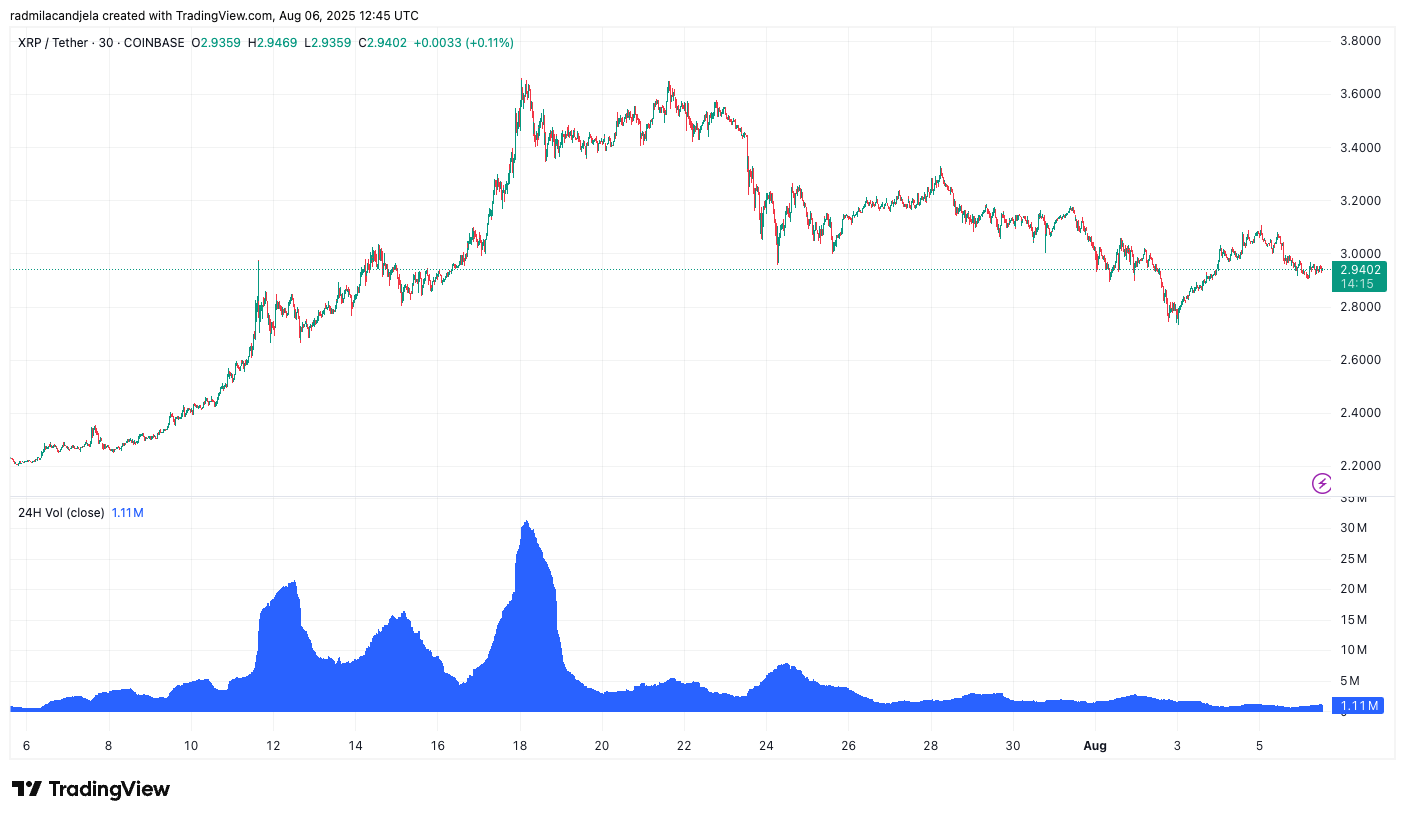
The opposite trend occurred with the USD pairs. Coinbase dominated with over 92% of the trading volume, averaging 398 million XRP in 24-hour rolling volume compared to Binance’s 30 million.

This imbalance resulted in tighter and more stable USD-based price spreads between the two exchanges. The Binance-Coinbase USD basis averaged $0.00027 (just under one basis point), exhibiting narrow ranges and minimal deviations beyond ±$0.005.
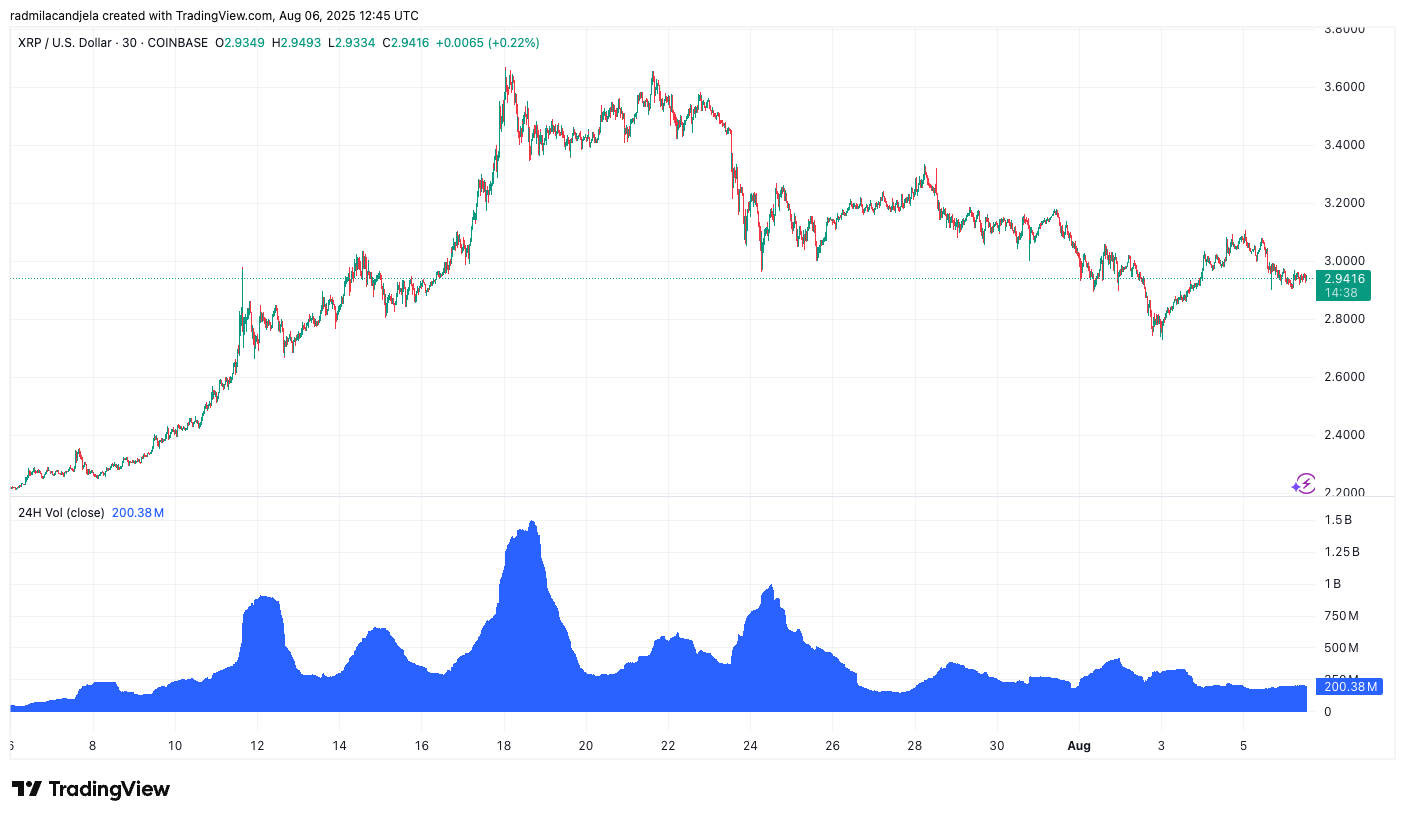
The inter-venue basis reflected this duality, with each exchange demonstrating leadership in one quoted currency and trailing in the other. The USDT pair on Coinbase showed the greatest price volatility compared to its peers, with short-lived price variations reaching 30 to 47 basis points. Although infrequent and brief, these events highlight how fragmented liquidity can expose otherwise efficient markets to localized volatility spikes.
The average four-way price dispersion across all four pairs was only $0.00283, less than 10 basis points at a $3 price level. Even during the most active periods, dispersion remained modest, peaking at $0.0164. This suggests that despite uneven liquidity distribution, price discovery is effectively shared across venues and quotes.
Correlations in 30-minute log returns further support the notion of unified price behavior. All pairs moved in sync, with cross-venue, same-quote correlations nearing 0.999, and cross-quote, same-venue correlations exceeding 0.997.
This high degree of alignment suggests that the prevailing trading dynamics on each platform do not exhibit diverging directional expectations. This is likely driven by the presence of cross-exchange algorithms, arbitrage traders, and liquidity providers operating across both platforms.
Nevertheless, certain effects of market structure are still apparent. On Coinbase, where USDT order books are less substantial, XRP pricing displayed greater variance and reduced consistency in its microstructure behavior. Conversely, on Binance, the USDT order books are deep and dominant, while the less active XRPUSD pair exhibited lower total volume and smaller intraday price fluctuations.
This divergence could be important for sophisticated traders, as large trades may experience significantly different slippage depending on the specific quote currency and exchange used.
The data highlights a well-functioning market with tight pricing, even with fragmented liquidity. Binance remains the dominant force in USDT trading, while Coinbase takes the lead in fiat currency exposure.
Basis levels remain relatively low, with USDT-USD price differences typically below four basis points and inter-venue differences rarely exceeding 10. Traders engaging across both exchanges should focus on the liquidity profile of each quoted asset rather than just the headline price.
The emerging picture is one of two interconnected markets: one predominantly driven by stablecoin liquidity and the other primarily supported by fiat currency systems.
XRP operates at the convergence of these two markets, and while its price may appear consistent regardless of the trading location or method, the underlying structure of those trades is influenced by the venue’s trading volume, quoted asset, and order book depth. While efficient, it is not perfectly symmetrical.
The post Tight price parity hides structural gaps in XRP liquidity on exchanges appeared first on CryptoSlate.