
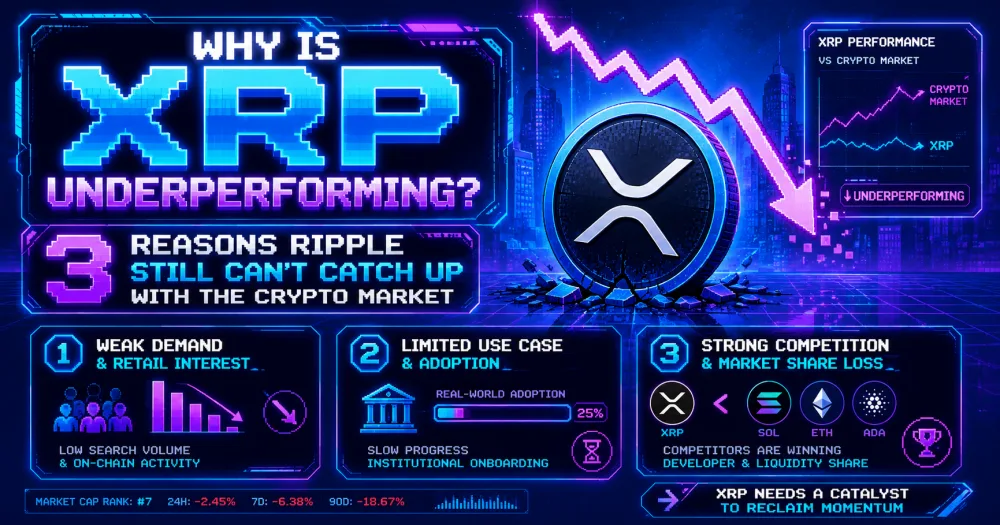
XRP▲$1.13 remains one of the most significant cryptocurrencies by trading volume. Nevertheless, its performance in 2026 has fallen short compared to the leading assets. XRP can experience notable spikes, yet these gains often diminish quickly.
This trend has fueled ongoing debates about the factors behind XRP’s lackluster showing this year. The decline in XRP’s value, which has outpaced many of its competitors, is due to various influences, including capital migration, fierce rivalry from alternative assets, and technical difficulties, all amplified by investor demands for solid evidence of actual utility.
Related: XRP Price Prediction 2026: Will Ripple Face a Significant Decline?
Contents
XRP Performance in 2026: What’s Behind Ripple’s Setback?
Comparative Performance Against Bitcoin, Ethereum, and Solana
After a successful 2025, where XRP gained regulatory and institutional credibility, the token was anticipated to perform better in 2026. While the initial rally was strong, it didn’t translate into sustained success. Bitcoin and Ethereum maintained robust institutional backing, with Ethereum gaining renewed focus as the leading smart-contract platform.
Solana, another key competitor, has emerged strongly, particularly appealing to traders focused on decentralized finance (DeFi). Its on-chain activity remains consistently high, with notable price surges. However, XRP has struggled to keep pace in its upward movement.
Indicators Highlighting XRP’s Relative Weakness
A clear indicator of XRP’s struggles in 2026 is its relative strength. Additionally, the lack of price appreciation following positive news is another contributing factor. XRP requires more compelling catalysts to achieve noteworthy gains, while other cryptocurrencies appreciate from minor favorable news. The trader’s skepticism, stemming from repeated setbacks in breaking essential price levels, has also dampened demand.
Consequently, the price movements may be misleading, particularly when examining the reasons for XRP’s stagnation. The token’s performance in 2026 is affected by a combination of factors during positive price movements. While XRP’s volume may peak during upward trends, buying interest often fades at critical resistance levels.
Is XRP Still Reflecting Broader Market Trends?
XRP partially reflects overall market trends, often moving in sync with Bitcoin or macroeconomic influences. Despite this, it tends to sell off quickly when the broader market declines.
A major reason for XRP’s struggles becomes clear during Bitcoin’s sharp downturns; XRP struggles to maintain stability during such times. Conversely, a market-wide correction rarely leads to a significant selloff in XRP.
Likewise, any positive movement in the overall market does not immediately benefit XRP. Capital typically flows first to Bitcoin, Ethereum, and Solana before XRP witnesses any significant price increase. Thus, discussions surrounding XRP’s performance should reference institutional demand and overall market liquidity.
Institutional Capital Is Shifting to Other Assets
Bitcoin ETFs and Ethereum Products Outperforming in Inflows
In 2026, Bitcoin and Ethereum have continued to attract institutional investment at a consistent rate. Their popularity is bolstered by built trust with traditional investors. Additionally, their deep liquidity and established infrastructure across various markets further enhance their appeal. Bitcoin is often viewed as the primary digital asset, while Ethereum provides access to advanced smart contracts.
Investment offerings tied to XRP do exist and attract some demand; however, they lack the substantial traction enjoyed by Bitcoin and Ethereum. Consequently, institutional investments in cryptocurrencies typically favor these giants first. This trend is especially relevant for large institutions aiming to mitigate risk by selecting well-established assets with reliable custodial and settlement systems.
Is Institutional Interest in XRP Declining?
While institutional interest in XRP remains, it has not matched levels from previous years. This decline contributes to XRP’s unexpectedly low position in 2026, as relevant investment solutions have not gained significant traction. Institutions may purchase XRP directly or through futures, while riding on long-term bullish trends.
A mixture of continued inflows and increasing interest is necessary to elevate XRP’s market price. Therefore, any examination of XRP’s decline should take into account the significance of institutional buying. However, a slow uptick in interest may lead to stagnation in price, with XRP failing to appreciate even amid growing bullish sentiment.
Implications for XRP’s Price
Most of XRP’s recent upward movements have been tied to inflows, but they rarely bring immediate price gains. An increase in institutional purchasing power is critical to overcoming resistance levels and triggering a rally. Therefore, analyses on XRP’s downturn must reflect that investment products do not consistently act as reliable indicators of market shifts.
Identifying conditions that can drive XRP’s price up, such as sustained demand, increasing spot volumes, and breaking through critical resistance, would yield more valuable insights.
Read more: Best Web3 Wallets 2026: Secure Options for DeFi, XRP, and Newcomers
Ripple’s Ecosystem Development Lags Behind Competitors
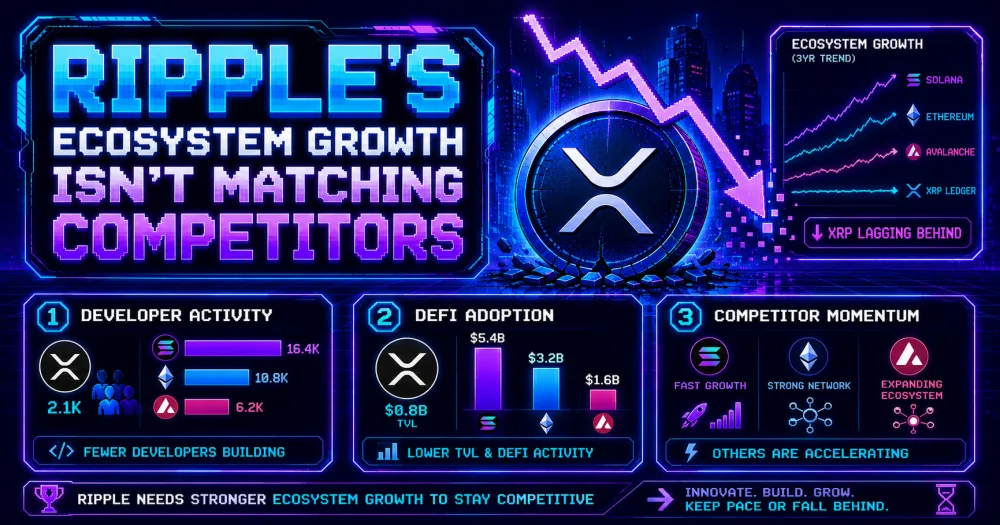
XRP Ledger vs. Solana, Ethereum, and Other Layer-1 Networks
Originally designed for quick settlement at minimal fees, XRP Ledger now faces stiff competition from rivals offering more diverse functionalities. This diminishing advantage has made XRP’s performance less favorable than other cryptocurrencies this year. Notably, Solana has experienced heightened activity across DeFi applications and other platforms.
Developer Engagement and DeFi Growth
At the same time, Ethereum’s growth as a developer hub continues to thrive, attracting new wallets and protocols, further undermining XRP’s attractiveness as an alternative. XRP’s DeFi sphere has also lagged recently, contributing to the discussions surrounding its underperformance linked to the broader trend of investors allocating capital elsewhere.
Can New Ripple Collaborations Shift the Paradigm?
Emerging partnerships within the ecosystem could provide vital momentum for XRP and Ripple’s forecasts in 2026. These alliances signal a growing demand for the token’s services, as businesses actively opt for XRP Ledger’s benefits. The most impactful partnerships would require substantial advancements in liquidity, stablecoins, custodianship, and related sectors.
Should these areas witness steady adoption growth, the question of why XRP is underperforming in 2026 may become less relevant. Ripple’s collaborations need to significantly enhance token usage across the board to boost its allure.
Technical Resistance Continues to Restrict Momentum
Key Resistance Levels Under Observation
One of the primary reasons for XRP’s lackluster show in 2026 is the technical barriers impeding price growth. Traders frequently face hurdles, as market peaks commonly occur near the $1.1 mark before retracing. For XRP to reestablish an upward trend, these levels must be revisited and surpassed, entering a more robust phase.
The significance of these resistance levels cannot be understated, given their influence on discussions about XRP’s sluggish growth. Positive developments can spur rapid price increases, yet these gains are frequently ephemeral. Sustained upward movement necessitates more than fleeting increases, especially those that lack buying momentum immediately after a surge.
Whale Transactions and Exchange Dynamics
Transactions undertaken by large holders, or whales, are significant to price movements, as they regularly liquidate substantial amounts of XRP. Recent months have also seen a downturn in exchange deposits, a trend some analysts link to decreased selling pressure. Both factors are essential in understanding the reasons behind XRP’s recent declines, but they should be considered within a broader perspective.
As highlighted throughout this analysis, accurate predictions regarding XRP’s price must take various factors into account. Monitoring large transactions and the flow of assets can greatly impact the supply-demand balance for XRP.
Futures Open Interest and Market Sentiment
Derivatives traders play a pivotal role in the fortunes of many cryptocurrencies, with their movements capable of affecting spot prices. The challenges facing XRP this year stem significantly from open interest and short position metrics, which illuminate crucial patterns. Typically, open interest rises alongside prices during market uptrends, reaching peaks before reversing.
The opposite scenario usually occurs during downtrends, with open interest tending to decrease at a faster pace than the price itself. One reason for XRP’s underperformance compared to rival assets is that short positions often gain more from market declines. The best indicator in this context is to evaluate funding rates, which reflect trader sentiment towards long and short positions.
What Could Spark an XRP Breakout?
Regulatory Developments
Regulatory clarity has previously led to significant increases in both XRP’s market price and overall capitalization throughout the year. The current downturn in XRP’s value is partly due to a lack of additional regulatory progress. New developments regarding digital assets, stablecoins, token offerings, and institutional settlements could drive prices upward.
However, further regulatory achievements for XRP may not suffice for another substantial price surge. Investors may need to witness several months of increased adoption, product offerings, liquidity, and transaction volumes before significant value changes occur.
Driving Forces Behind Institutional Adoption
Institutional endorsement remains one of the most critical elements influencing XRP’s price in 2026. A surge in institutional interest in investment products associated with XRP or greater involvement with the XRP Ledger could act as vital triggers. Enhanced usage of the XRP Ledger would bolster the token’s value, as its practical applications would foster more widespread adoption. Institutional trading would be crucial in this context, with funds and large investors fueling necessary price increases.
Such developments would be central to discussions surrounding why XRP is faltering. Essentially, the query of the asset’s demand across various functions is the key issue for predicting XRP’s price trajectory. For substantial upward momentum to develop, buying activity would need to be extensive and sustained over time.
Technical Signals Indicating a Trend Shift
As noted earlier, catalysts for an XRP breakout typically consist of more than one favorable event. Traders often look for a combination of positive indicators, including robust price movements, growing adoption and transaction volumes, alongside increased institutional investment. Achieving a strong close above resistance points would also signify a trend reversal.
Related: XRP Price Forecast for July 2026: Will it Rebound or Drop Below $1?
Is XRP Worth Monitoring in 2026?
Bullish Outlook
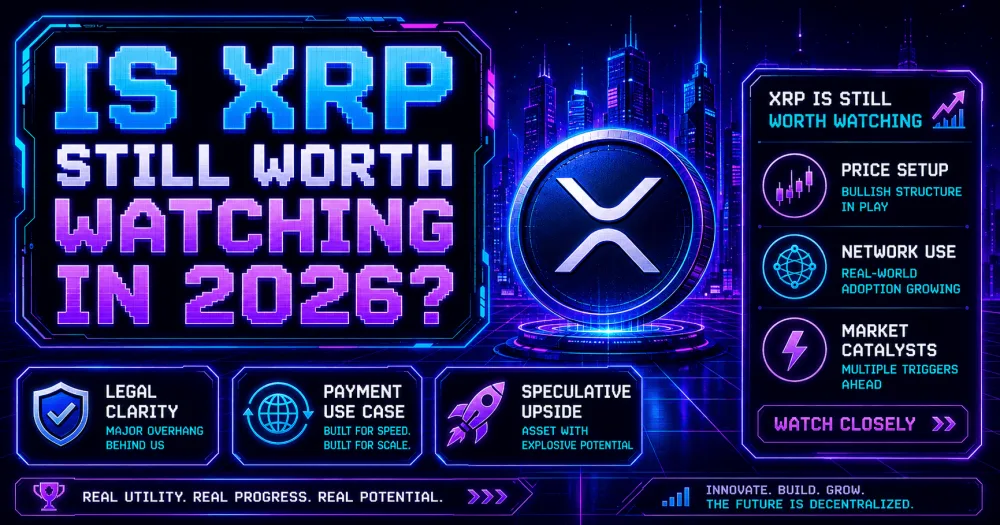
The question of why XRP is down in 2026 is valid, yet it overlooks potential positive sentiments about the asset. XRP enjoys substantial liquidity, widespread usage, and a solid institutional framework, with prospects for even greater adoption ahead. An increase in use cases should position the token for superior performance against its competitors, while liquidity serves as crucial support for future gains.
An optimistic outlook for XRP would be further supported by higher price movements, escalated institutional investments, and expanding adoption aligning with the token’s capabilities.
Bearish Challenges
One of the reasons XRP’s value has dropped more than others in 2026 is related to opportunity costs. The token often fails to appreciate as swiftly as other major digital currencies, with Bitcoin and Ethereum expected to benefit from rising institutional interest. Bears might suggest that the crowded institutional landscape could lead to capital moving toward alternative assets.
At the same time, these skeptics would point out that repeated failures to gain traction can create downward volatility that erodes value. The narrative around why XRP is down hinges on the potential loss of critical support and the next wave of selling pressure that could counteract previous buying trends.
Monitoring Future Developments
A key question regarding XRP’s future is what factors are contributing to its recent drops. Analysts should examine multiple aspects that may inform the asset’s trajectory, such as liquidity, adoption trends, and price patterns. As outlined here, these elements are best understood through three lenses: capital movement, ecosystem activity, and price flow.
Investment products are vital in the first area, with institutional interest providing essential insights into XRP’s valuation. Examination of exchange balances and whale transactions is also beneficial, yielding crucial data on supply-demand dynamics. The latter two facets are essential for assessing liquidity and adoption, which are pivotal for price determination.
Understanding the price structure is crucial when evaluating XRP’s future. Careful analysis of support and resistance levels, trading volumes, and short positions is necessary when predicting price direction. The question of why XRP is facing downward pressure must consider the risks associated with relying on isolated developments, as price is often the most telling indicator.
FAQ
What is Causing XRP to Underperform in 2026?
XRP is underperforming compared to other assets due to decreased capital inflow, slow adoption rates, and various technical issues.
Why Does XRP Decline When Bitcoin Gains?
The performance of Bitcoin doesn’t always influence other cryptocurrencies directly, as institutional funds can shift towards one asset, detracting from the others.
What Are Key Resistance Levels for XRP?
Short-term critical resistance for XRP appears to be around the $1.1 price level, with higher barriers still in place against the token’s favor.
Is an XRP Breakout Still Possible in 2026?
Currently, there is no evidence suggesting that XRP will be unable to break out and increase in price over the coming months.
Upcoming catalysts for XRP price changes include institutional interest, increased transaction activity, and significant upward price movements.