

Solana, once viewed as a less stable alternative to Ethereum, has drastically changed its narrative recently.
This week marked a pivotal moment for the blockchain ecosystem.
Stellar Debut
On October 28, Bitwise’s Solana Staking ETF (BSOL) launched with an impressive $69 million in initial inflows, setting a record for ETF launches within 2023, based on data from SosoValue.
The fund also recorded a substantial trading volume of $57.9 million, surpassing all other ETFs introduced this year.
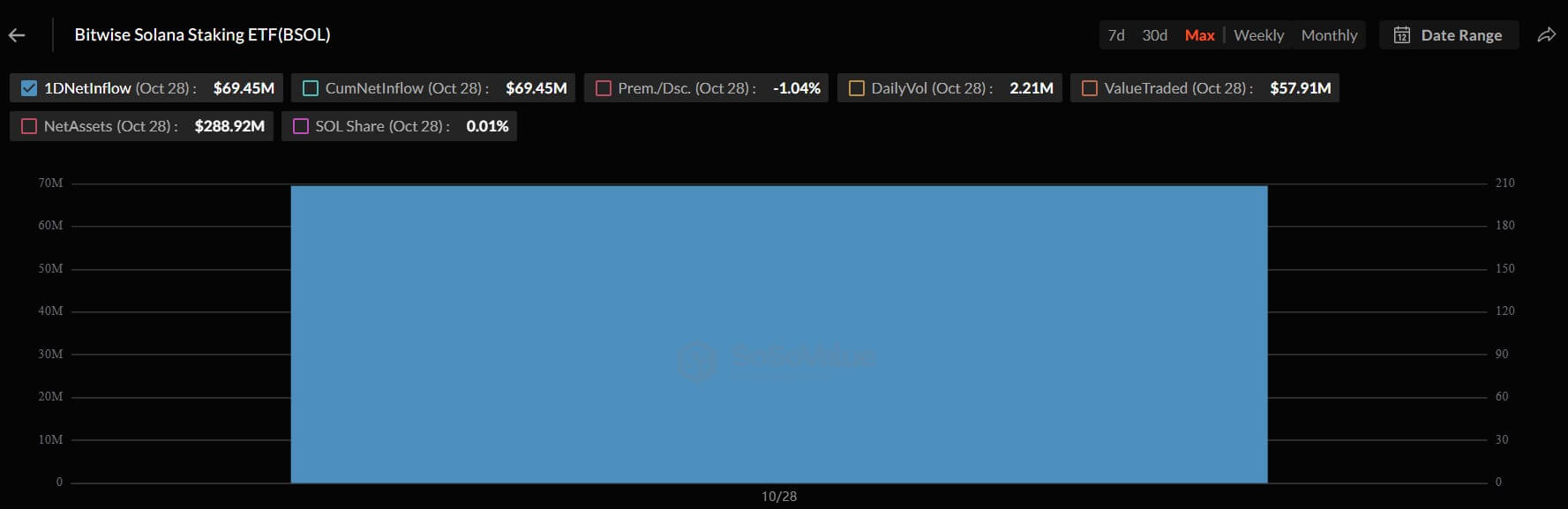
These inflows indicate a genuine interest from investors, contrary to high inflows that do not reflect active trading, which could suggest merely initial capital infusions.
As BSOL exhibited strong figures in both inflows and trading volume, this signifies authentic interest rather than speculative or passive involvement.
Bloomberg analyst Eric Balchunas remarked that the ETF’s debut is a “strong start,” highlighting a $220 million seed investment.
Balchunas noted that if the full seed amount had been utilized on its launch day, BSOL could have approached $280 million, putting it in competition with BlackRock’s Ethereum ETF for first-day performance.
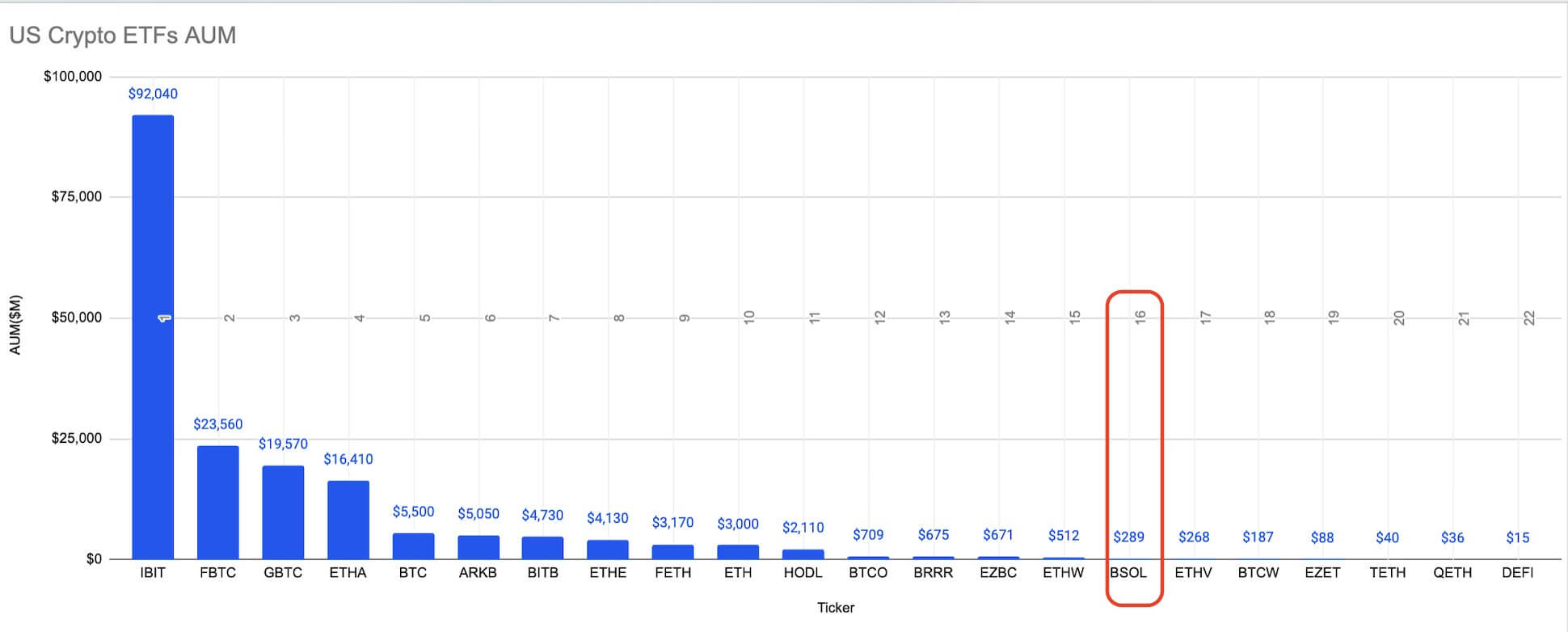
Thanks to the seed, BSOL’s net asset value jumped to $289 million, outperforming some Ethereum and Bitcoin ETFs in the U.S. rankings. In comparison, early Ethereum ETFs required months to achieve similar trading activity levels.
Factors Behind BSOL’s Strong Performance
BSOL distinguished itself by providing yield alongside market exposure, a feature not commonly found in many crypto ETFs.
In contrast to traditional ETFs that track prices, BSOL’s framework allows investors to earn staking rewards alongside potential price increases.
Approximately 82% of its Solana holdings are currently staked via Helius Labs, aiming for total staking, offering an average annual yield of about 7%. This allows institutional investors to engage with Solana’s ecosystem without the hassles of self-custody or node management.
The fundamentals of Solana further bolster this heightened demand.
The network has showcased excellent uptime since early 2024, while its DeFi total value locked has seen a tripling year-to-date, with transaction volumes frequently outpacing Ethereum.
The concurrent benefits of high throughput and minimal fees have positioned Solana as the leading revenue-generating Layer-1 blockchain.
In light of these factors, Matt Hougan, Chief Investment Officer at Bitwise, stated:
“Institutional investors love ETFs, and they love revenue. Solana has the most revenue of any blockchain. Therefore, institutional investors love Solana ETFs.”
In summary, BSOL’s success stems from its ability to convert Solana’s effective on-chain operations and staking yields into a regulated financial product that generates revenue.
Potential Impact on SOL Pricing
Historically, the launch of an ETF often leads to a significant price adjustment phase, as demonstrated by Bitcoin and Ethereum after their respective ETF approvals.
K33 Research’s data indicates a strong relation (R² = 0.80) between Bitcoin ETF flows and its 30-day returns, suggesting ETF inflows are responsible for about 80% of Bitcoin’s price fluctuations.
Similarly, analysts have observed consistent trends in Ethereum ETFs, where reduced circulating supply made ETH particularly sensitive to capital inflows compared to BTC.
Given the circumstances surrounding Solana, this effect may be amplified. Approximately 70% of SOL’s circulating supply is presently staked, removing it from available exchanges. With BSOL aiming for 100% staking, liquidity will further tighten as institutional demand rises.
Each additional dollar flowing into Solana ETFs could exert upward pressure on the price due to a limited supply.
If projections for ETF capital of $5-8 billion entering the Solana ecosystem materialize, this might lead to a price increase between 60-120%, based on historical trends observed for Bitcoin and Ethereum.
Furthermore, the surrounding fundamentals reinforce this optimistic perspective.
Galaxy Research describes Solana’s evolution from a speculative investment to an “infrastructure play,” which is crucial to support real-world asset tokenization, DeFi initiatives, and consumer-level financial solutions.
This narrative aligns perfectly with institutional goals of achieving scalable, yield-generating blockchain investments.
Ultimately, should ETF inflows remain robust and the fundamentals of on-chain activity stay strong, SOL could realistically reach values of $500 or more in the next market cycle.