


The stance of China regarding stablecoins has come under the spotlight once more.
During a recent financial policy forum, Pan Gongsheng, governor of the People’s Bank of China (PBoC), labeled stablecoins as a “new source of vulnerabilities” that threaten the global financial framework. He cautioned that these digital assets could weaken the monetary independence of smaller nations and facilitate unlawful financial operations.
Gongsheng pointed out that stablecoins exacerbate existing weaknesses in global financial regulations, which encompass money laundering, unauthorized cross-border fund transfers, and financing of terrorism. He further emphasized that a majority of stablecoin initiatives fail to comply with essential regulations such as customer identification and anti-money laundering measures.
This reinforces China’s long-held position: private digital currencies and stablecoins remain prohibited, even as Beijing seeks to expand its digital yuan (e-CNY) as a state-regulated alternative.
As the global market increasingly gravitates towards tokenized financial systems, a crucial question emerges: can stablecoins prosper without the influence of the world’s largest fintech hub?
A Global Market Advancing Without Beijing
The preliminary answer seems to be affirmative.
Despite China’s tightened regulations, global adoption of stablecoins has soared. Data from DeFiLlama indicates that the total market capitalization of stablecoins recently exceeded $308 billion, gaining almost $100 billion since the beginning of the year.
Moreover, a report from A16z reveals that transaction volumes in the stablecoin sector surpassed $46 trillion over the past year, comparable to major payment networks like Visa when adjusted for authentic activities.
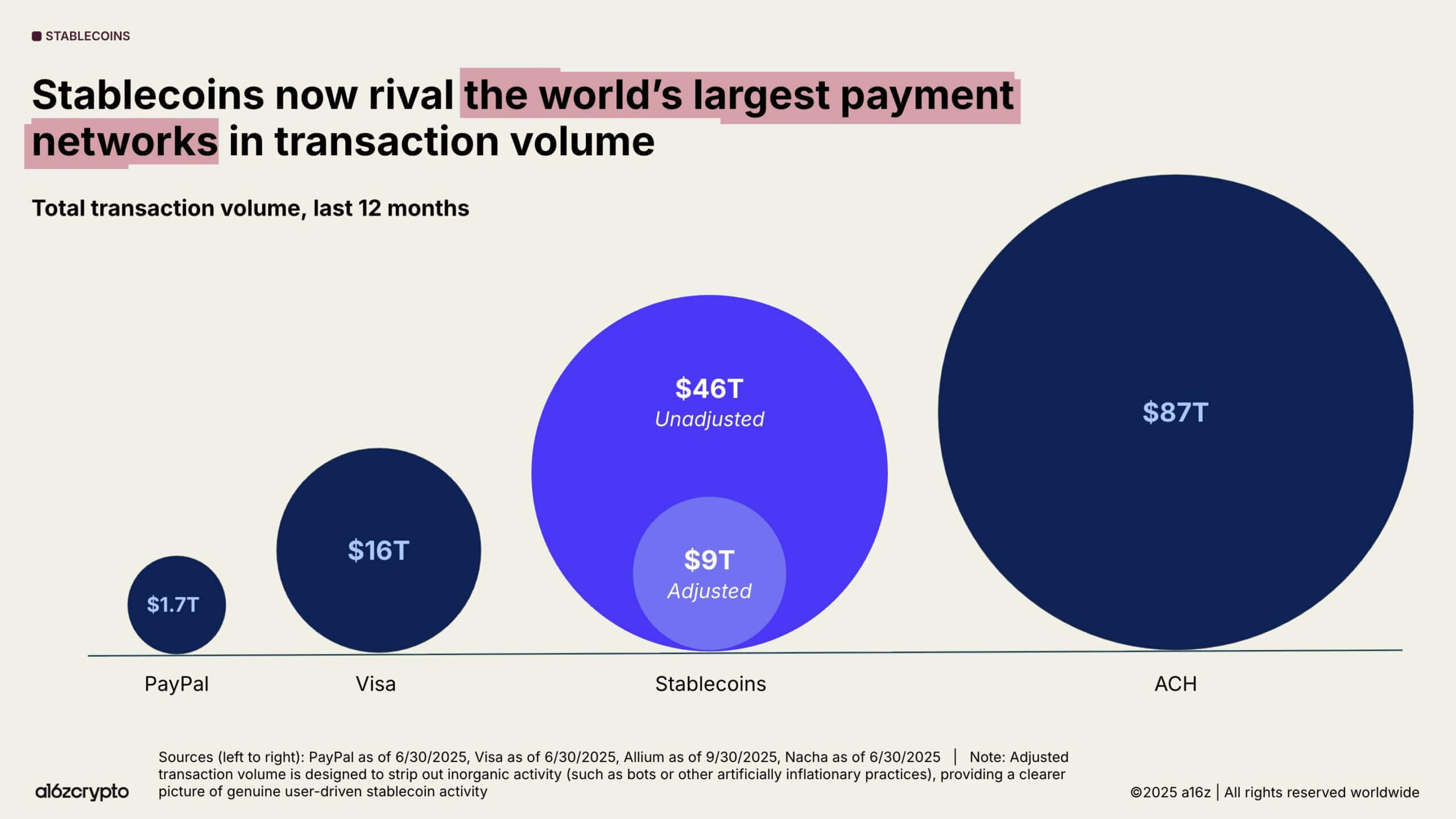
Chris Dixon, a partner at A16z, stated:
“Stablecoins have gone mainstream. [They] have found product-market fit, rivaling the world’s largest payment networks in transaction volume.”
This surge isn’t surprising as many governments across Asia, who previously mirrored Beijing’s cautious approach, are setting the pace in the opposite direction.
This year, Japan entered the market with fiat-backed stablecoins, witnessing the launch of the first fully compliant yen-token by fintech company JPYC Inc. on Ethereum, Avalanche, and Polygon.
Additionally, other key jurisdictions such as South Korea, Hong Kong, and Singapore are developing regulatory frameworks aimed at licensing issuers and safeguarding consumer interests.
In the West, the United States is moving towards formal regulation through initiatives like the GENIUS Act, with prominent institutions including PayPal and Western Union introducing their own tokenized settlement solutions.
These developments are transforming stablecoins from speculative investments into a regulated infrastructure for repayments, remittances, and on-chain treasury management.
This trend indicates that the market can indeed thrive absent China’s participation, as the technology has evolved past its initial crypto-centric origins.
Today, stablecoins serve as the crucial liquidity backbone for decentralized finance and essential for on-chain commerce, enabling instantaneous settlements across numerous platforms.
Thriving Independently: But Not Free from China’s Influence
Nonetheless, China’s impact persists even as the sector expands.
The country’s vast market size, international trade capabilities, and digital payment systems remain unmatched. Platforms like Alipay and WeChat Pay handle a greater volume of transactions annually than several entire regions combined. Excluding this ecosystem limits the reach and potential scalability of stablecoins.
Notably, the ban has failed to eliminate stablecoin activity in China; it has merely driven it underground.
Chinese individuals and businesses continue to utilize dollar-pegged tokens such as USDT through offshore exchanges and private OTC transactions for international fund transfers or to hedge against the volatility of the yuan.
This underground utilization highlights how this vibrant sector could benefit should China eventually embrace the technology.
A fully integrated Chinese involvement—whether via regulated participation or interoperability with the e-CNY and compliant stablecoins—could seamlessly connect the world’s largest trade economy to blockchain-centric payments, thereby enhancing the network effect that stablecoins currently lack.
As it stands, two parallel systems are developing: an open, market-driven ecosystem dominated by dollar-pegged tokens and a closed sovereign digital currency model centering around the e-CNY.
A Potentially Strengthening Absence?
The choice of China to remain apart may, ironically, bolster the appeal of decentralized finance and stablecoins.
By opting out of integration, Beijing compels the rest of the world to independently innovate. This process has led to a more diversified, regulation-conscious, and institutionally bolstered market.
Stablecoins have become essential to global liquidity, fueling decentralized exchanges, tokenized bond markets, and US Treasury instruments. Their growth persists despite challenges like regulatory ambiguity, cyber threats, and skepticism from central banks.
Every step forward reinforces their enduring relevance and affirms that a borderless digital dollar can thrive without China’s endorsement.
Nevertheless, the long-term outlook remains complex.
A world without China means stablecoins miss out on one of the largest pools of fintech innovation and international trade facilitation. Conversely, inclusion from China could pave the way for true interoperability between these digital assets and the traditional financial ecosystem.