
Bitcoin Market Recap: A Cautious Bounce on Thin Conviction
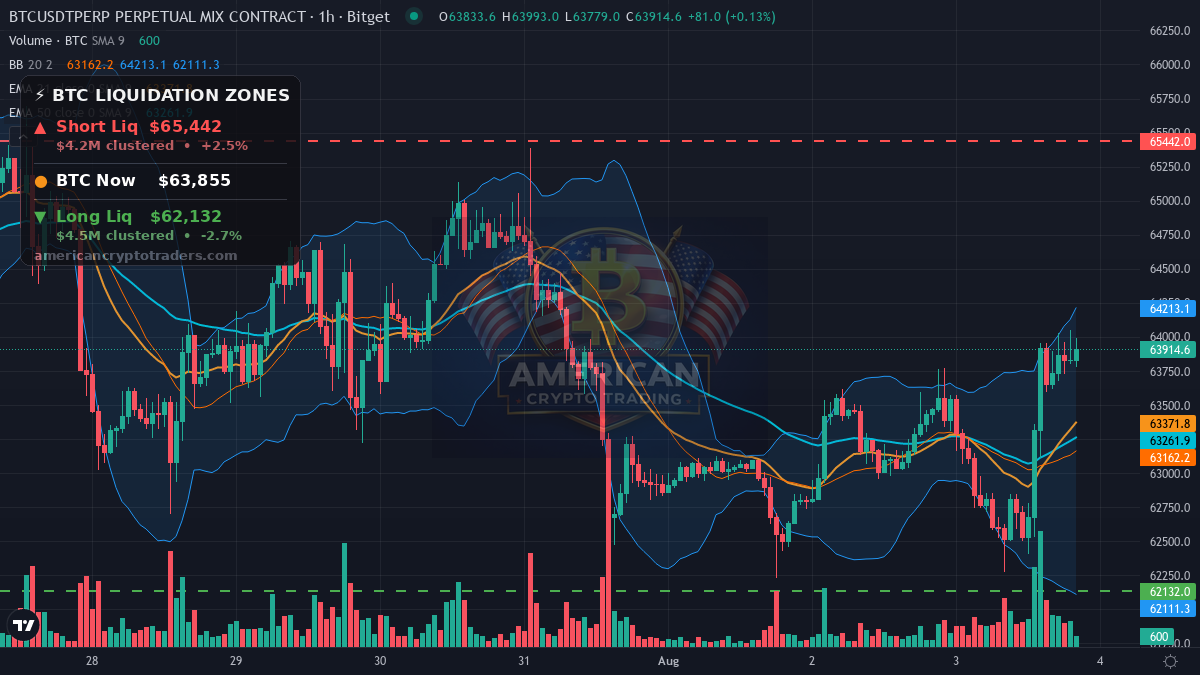
Monday’s New York session handed Bitcoin a modest but meaningful recovery, with BTC closing near $63,914 — up 0.84% on the day — after printing a session low of $62,276 in early trade. The bounce was more relief than revival, driven primarily by a macro tailwind rather than crypto-native buying. For a full picture of where this fits in the longer-term structure, see our 28-for-28 monthly candle analysis.
The broader crypto market cap gained 0.44% to sit at approximately $2.27 trillion. BTC dominance held firm at 56.5%, a level that reflects ongoing caution among altcoin traders unwilling to rotate aggressively into risk until Bitcoin establishes cleaner direction. The session’s narrative was shaped by three distinct catalysts — one bullish for the ecosystem, one quietly bearish for BTC directly, and one macro wildcard that deserves attention heading into the week.
What Moved Markets Today
BlackRock launched tokenized money market funds on Solana and Ethereum, injecting fresh credibility into the real-world asset narrative. This wasn’t simply a headline — it represents one of the largest traditional asset managers signaling that public blockchain infrastructure is mature enough for institutional-grade products. The announcement appeared to provide a lift to mid-session altcoin resilience, particularly in ecosystems tied to DeFi and on-chain finance. When BlackRock moves, it tends to shift the Overton window for other institutions sitting on the sidelines.
Strategy sold 1,638 BTC to fund dividends and STRC share repurchases, introducing a mild but real sell-side overhang during the session. The sale is not an existential event for the market, but it matters at the margin. When a well-known institutional accumulator becomes a net seller — even for corporate treasury reasons — it tempers the narrative that large holders are uniformly adding exposure at these levels. Combined with already-cautious sentiment, the sale helped cap any momentum that the BlackRock news might otherwise have generated.
The U.S. hinted at further yen intervention, introducing a macro uncertainty signal that the desk is watching carefully into the London open. JPY volatility has a documented history of correlating with BTC drawdowns, particularly during periods when carry-trade unwinds force broad deleveraging across risk assets. With the DXY sitting flat near 99.97 and the 10-year yield already down 1.24% on the session to 4.69%, currency markets are in a sensitive position. A disorderly yen move could overwhelm any crypto-specific tailwinds in early Asia hours.
The S&P 500 rallied 1.48% to 7,600 and 10-year Treasury yields declined, easing the risk-off pressure that had weighed on crypto over the weekend. Lower yields reduce the opportunity cost of holding non-yielding assets and tend to loosen financial conditions at the margin. Bitcoin’s correlation with equities remains meaningful in stressed environments, so today’s equity strength was a necessary — if not sufficient — condition for the BTC bounce to hold.
Altcoin Action
The altcoin session was bifurcated. ATOM surged 7.9% and ALGO added 6.3%, leading the gainers board. VVV posted a respectable 5.6% gain as well. The ATOM move stands out given the broader RWA theme — Cosmos ecosystem projects have been positioning around interoperability with institutional-grade on-chain products, and BlackRock’s multi-chain deployment likely amplified that narrative today.
ETH was a notable disappointment, shedding 0.42% to close at $1,871 despite being one of the two chains BlackRock chose for its tokenized fund launch. The high of $1,898 was rejected intraday, and ETH found a session low of $1,828 before recovering partially. ETH funding remains marginally positive at 0.0005%, suggesting no extreme positioning there — just a lack of buying interest. SOL held up slightly better with a 0.6% gain, closing near $73.98 and printing a tight 24-hour range between $71.93 and $74.31.
On the downside, UNI dropped 6.2% with no clear headline catalyst, suggesting the move may have been driven by position unwinding or rotation out of DeFi governance tokens. BEAT was the session’s worst performer at -10.1%, though volume context is thin on that name. DOGE slipped a quiet 0.24%, largely irrelevant to the session’s themes.
Positioning and the Liquidation Map
The most interesting sub-surface development today was BTC funding flipping negative to -0.0076%. When funding goes negative, shorts are paying longs to hold their positions — a dynamic that historically compresses the trade and can trigger a squeeze if spot buying emerges. It doesn’t guarantee a rally, but it shifts the asymmetry: a sustained bid above $63,000 into Asia could become self-reinforcing as shorts cover.
The liquidation map as of the close shows short liquidations clustered at $65,442, representing approximately $4.21 million in short exposure that would be forced to cover on a move to that level. A push through $65,442 would represent a roughly 2.5% move from current prices and could create a short-squeeze feedback loop into that zone. On the other side, long liquidations sit at $62,132 — about 2.7% lower — where approximately $4.49 million in leveraged long positions would be washed out. A break below $62,132 would likely accelerate selling and retest the session lows near $62,276, potentially undercutting them.
The Macro Picture
The macro setup entering this week is a study in cross-currents. Equity markets finished strong, yields pulled back, and that combination provided the floor under crypto today. Gold at $4,107 remains elevated, reflecting persistent demand for hard assets even as equities rallied — a sign that not everyone in macro-land is fully risk-on.
The yen intervention signal deserves its own line of attention. If currency volatility spikes overnight, Asian risk assets tend to reprice quickly, and Bitcoin — liquid 24/7 — often becomes the first instrument to feel that pressure. The desk is watching JPY cross rates as a leading indicator for the Asia session rather than a background variable.
FalconX’s reported 10% workforce reduction is a sobering reminder that despite institutional headlines, the infrastructure layer of crypto is still navigating a prolonged slump. Headline news can diverge significantly from the ground-level health of the industry.
Levels to Watch
For the Asia and London sessions ahead, the key upside level is $65,442 — the short liquidation cluster. A clean move through that price on volume would signal a potential trend shift and shake out a meaningful slug of short positioning. Resistance on the way up includes the 24-hour high of $64,050, which acted as a ceiling during the NY session.
On the downside, $63,000 is the psychological line in the sand that corresponds with the negative funding setup — Asia bids holding above this level would sustain the short-squeeze setup. Below that, the long liquidation level at $62,132 is the more significant structural test. A close below $62,132 on meaningful volume would invalidate the bounce and likely reopen a path toward the session low of $62,276 and beyond.
Upcoming Catalysts
The macro calendar is relatively quiet for the immediate sessions ahead. There are no scheduled U.S. economic releases or Federal Reserve speakers flagged in today’s data that would serve as near-term binary catalysts. The primary exogenous risk remains currency market volatility — particularly any follow-through on yen intervention signals from U.S. officials — which could move quickly and without a scheduled announcement window.
Sentiment Check
The Fear & Greed Index closed today at 28 — Fear. That reading is consistent with a market that has absorbed multiple weeks of pressure and is not yet pricing in recovery. Contrarian frameworks suggest that Fear-zone readings historically precede mean-reversion bounces, but conviction requires follow-through, not just a single green session. For the longer-term structure of how monthly candle closes factor into directional bias, the desk continues to reference our 28-for-28 monthly candle analysis.
Negative funding plus a Fear reading is a combination that often marks washout conditions — but only in hindsight. In real time, it simply means the market is leaning short and nervous, and any sustained bid has an outsized structural reason to accelerate.
Bottom Line
Monday’s session gave Bitcoin a floor, not a launchpad. The 0.84% gain off session lows reflects genuine macro relief — lower yields, stronger equities — but the absence of crypto-native buying conviction was apparent in ETH’s divergence and the muted volume. BlackRock’s RWA expansion is architecturally bullish for the ecosystem over time; Strategy’s BTC sale was a near-term headwind that kept a ceiling on the bounce.
Negative funding is the most actionable signal on the board right now. If Asia session buyers defend $63,000 and the yen stays orderly, the path to $65,442 opens and the short-squeeze setup becomes relevant. If currency volatility spills over or spot demand fails to materialize, $62,132 becomes the risk level to watch. The desk is leaning cautiously constructive on structure but fully respects that a Fear reading of 28 means the crowd is not — and the crowd can be right.
Disclaimer: This recap is for educational and informational purposes only and does not constitute financial advice. Cryptocurrency trading involves substantial risk of loss. Always do your own research. American Crypto Traders and its contributors may hold positions in the assets discussed.
Originally published on American Crypto Traders
This article was syndicated from the American Crypto Traders daily brief. For original analysis and trading signals, visit americancryptotraders.com