
Bitcoin Market Recap: Crypto Sits Out the Party at $64K
Tuesday’s bitcoin market recap tells a quietly frustrating story for bulls: while traditional risk assets staged a broad rally on Strait of Hormuz reopening optimism, Bitcoin ended the New York session nearly unchanged at $64,093, up just 0.28% on the day. The 24-hour range stretched from $63,283 on the low end to $64,378 on the high — a spread of roughly $1,100 that signals consolidation rather than conviction. The total crypto market cap edged 0.22% higher to approximately $2.27 trillion, but the modest headline number masked meaningful divergence under the surface.
The macro backdrop was unambiguously constructive. The S&P 500 surged 1.79% to 7,736, gold jumped 2.45% to $4,132, and the 10-year Treasury yield fell 1.26% to 4.63% — a trifecta of risk-on signals that in prior cycles would have sent Bitcoin meaningfully higher. Instead, BTC decoupled, sitting on its hands. With Fear & Greed at 25 (Extreme Fear), the market is telling us that participants are not yet willing to deploy capital even when the broader environment invites it.
What Moved Markets Today
The Hormuz reopening timeline drove a powerful risk-on wave across traditional assets. Easing geopolitical pressure in the Strait of Hormuz — a chokepoint responsible for roughly 20% of global oil flows — sparked relief buying in equities and safe havens alike. The S&P 500 climbed 1.79% to a record-setting level that pushed U.S. market cap past $70 trillion for the first time, a milestone that would historically correlate with crypto inflows. That correlation broke down today, suggesting crypto’s current paralysis is sentiment-driven rather than macro-driven.
Falling Treasury yields removed a key headwind, yet crypto inflows stayed absent. The 10-year yield’s 1.26% decline to 4.63% is exactly the kind of rate relief that loosens risk appetite and theoretically benefits speculative assets like Bitcoin. The fact that it didn’t translate into fresh bids is a clear signal that Extreme Fear is actively suppressing allocation decisions — investors appear to be watching the door rather than walking through it. Until sentiment shifts, macro tailwinds alone may not be enough to move price.
The US-UK joint stablecoin and tokenization framework was announced during the session. The two governments reaffirmed coordinated support for stablecoins and tokenized financial instruments in joint regulatory talks, a development that carries genuine long-term significance for crypto’s integration into mainstream finance. Markets, however, gave it no immediate price credit — regulatory clarity tends to compress risk premiums over months, not hours. Separately, BNY Mellon announced it will offer institutional crypto staking through a Galaxy partnership, another slow-burn institutional signal that adds to the structural bull case without moving today’s tape.
A confirmed Coldcard hardware wallet vulnerability emerged as the session’s most urgent non-price headline. At least 15 attackers have been confirmed to have exploited the vulnerability, according to Galaxy Research, raising immediate concerns for self-custody holders on affected devices. The exploit relates to entropy and key generation integrity — details that matter deeply to anyone relying on that hardware for cold storage. This is not a market-moving event in price terms today, but it is a material security event that demands action from affected users before the Asia session opens.
Altcoin Action
Altcoins finished the session flat to slightly red, consistent with BTC dominance holding firm at 56.5%. ETH slipped 0.05% to $1,870, SOL added a marginal 0.10% to $74.05, and DOGE shed 0.23% to $0.0702 — none of these moves are signal-worthy on their own, but collectively they confirm that capital is not rotating out of Bitcoin and into the broader market.
The session’s most notable alt action was on the extremes. TAO gained 4.7% and ZEC added 4.3%, representing selective rotation into AI-adjacent narratives and privacy assets respectively — pockets of the market where specific catalysts can override macro torpor. On the downside, BEAT collapsed 18.3%, leading all losers by a wide margin, with VVV and CC also declining 4.6% and 4.5% respectively. A Solana governance proposal that would increase daily SOL burns more than tenfold surfaced during the session — a deflationary mechanism that could be meaningful for SOL’s long-term supply dynamics if it passes, though price barely reacted today.
Positioning and the Liquidation Map
BTC funding rates are slightly negative at -0.0045%, indicating a mild short bias in perpetual futures markets. This is a nuanced signal — it tells us that marginal positioning leans bearish, but it also means that a move higher could force short covering and accelerate any breakout attempt. ETH funding, by contrast, sits in slight positive territory at +0.0048%, suggesting longs remain modestly in control on that pair.
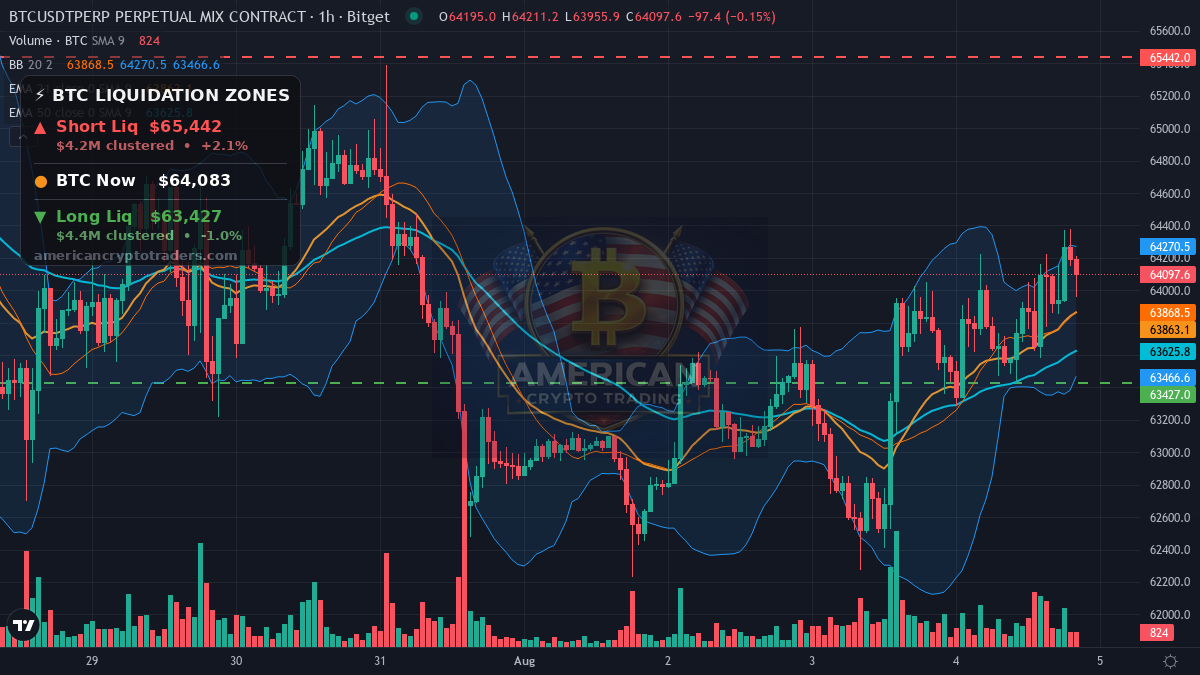
The liquidation map is tightly coiled around current price. To the upside, a cluster of $4.24 million in short liquidations sits at $65,442 — just 2.1% above current price. A clean break above that level would trigger a cascade of forced short covering and could push price meaningfully higher in a low-liquidity Asia session. To the downside, $4.44 million in long liquidations are stacked at $63,427 — only 1.0% below current price. That proximity makes the long-side liquidation level the more immediate threat; a slip through $63,427 could accelerate selling into thin overnight books. The range between these two levels — roughly $2,000 wide — defines the battlefield heading into the Asia open.
The Macro Picture
The dollar index (DXY) dipped 0.10% to 99.86, remaining below the psychologically significant 100 level and keeping some pressure off dollar-denominated assets. A weaker dollar environment is structurally supportive for Bitcoin and commodities, as evidenced by gold’s 2.45% surge today. The disconnect between gold’s strength and Bitcoin’s flatness is worth noting — both assets are often framed as inflation hedges, but today gold captured the geopolitical relief trade while crypto did not.
Hashdex’s announcement that it will shut down its Bitcoin ETF after struggling to accumulate assets is a minor headwind for the institutional narrative in the near term, though it reflects product-level competition rather than waning institutional interest broadly. BNY’s staking partnership with Galaxy, announced the same day, arguably tells the more important institutional story. The macro environment remains supportive on balance; the problem is sentiment, not fundamentals.
Levels to Watch
For the Asia and London sessions ahead, the key upside level is $65,442 — the short liquidation cluster. A sustained push through that price on meaningful volume would flip the near-term bias and could trigger a momentum run. Bulls need to hold $63,427 with conviction; a break below invites a test of the session low at $63,283 and potentially the broader $62,000–$63,000 support zone. The 24-hour high at $64,378 is the first minor resistance to watch in thin overnight trading.
Upcoming Catalysts
The macro calendar appears quiet for the immediate Asia and London sessions ahead — no scheduled high-impact data releases are present in today’s data set. With no external catalysts on deck, price action is likely to be driven by order flow, the Coldcard news cycle, and any overnight developments on the Hormuz situation that could either extend or reverse today’s risk-on impulse.
Sentiment Check
The Crypto Fear & Greed Index closes Tuesday’s session at 25 — Extreme Fear. This reading sits deep in territory historically associated with capitulation or prolonged accumulation phases, and it explains why macro tailwinds aren’t translating into price action: when sentiment is this suppressed, participants need more than one good day in equities to feel comfortable adding exposure. For a longer-term perspective on how monthly candle structure interacts with sentiment cycles, see our 28-for-28 monthly candle analysis. Contrarian buyers will note that Extreme Fear readings have historically preceded some of Bitcoin’s strongest reversals — but timing those reversals requires patience and risk management, not just a low number on a sentiment gauge.
Bottom Line
Bitcoin ended August 4 at $64,094, coiling in a tight range while the rest of the risk complex celebrated a geopolitical relief rally. The Coldcard exploit is the session’s most actionable headline for self-custody holders and deserves immediate attention. With short liquidations at $65,442 and long liquidations at $63,427 bracketing current price, the next directional move — whichever way it goes — could be swift and amplified in thin overnight conditions. Sentiment remains deeply fearful, macro is supportive but not catalytic, and the tape is waiting for a trigger. Watch the levels.
Disclaimer: This recap is for educational and informational purposes only and does not constitute financial advice. Cryptocurrency trading involves substantial risk of loss. Always do your own research. American Crypto Traders and its contributors may hold positions in the assets discussed.
Originally published on American Crypto Traders
This article was syndicated from the American Crypto Traders daily brief. For original analysis and trading signals, visit americancryptotraders.com