
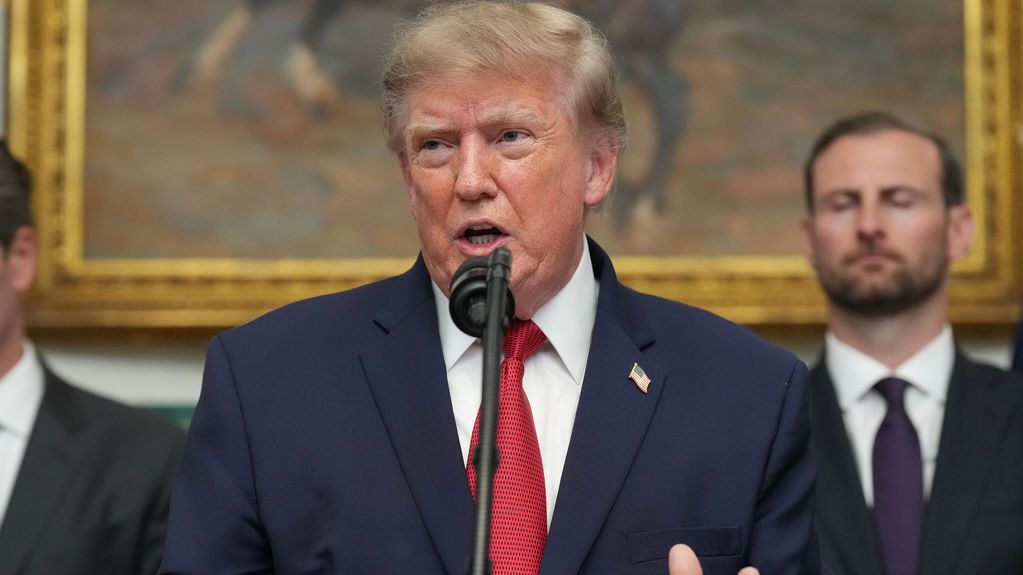
On Wednesday, President Donald Trump gathered leaders from the cryptocurrency sector and their regulatory counterparts at the White House. He commended them for their efforts to ensure that the future of commercial markets is developed and refined in the United States and urged Senate members to support the Clarity Act.
“We are committed to maintaining America’s position as the leading force, not just in Bitcoin and crypto, but also in innovative fields such as prediction markets, artificial intelligence, and beyond,” the president stated during the event, which featured key figures from the Securities and Exchange Commission, New York Stock Exchange, Commodity Futures Trading Commission, and notable cryptocurrency platforms like Coinbase, Kraken, and Robinhood.
Passing the Clarity Act, he emphasized, will “position the U.S. ahead of China” and “pave the way for the next generation of innovations and innovators.”
The Digital Asset Market Clarity Act is a proposed U.S. legislative initiative that aims to create a clear regulatory framework for the cryptocurrency sector, according to Congress.gov. Its main objective is to halt the Securities and Exchange Commission’s current method of regulation through enforcement by clarifying which digital assets qualify as securities versus commodities.
This legislation features consumer protection measures, including roughly $150 million allocated for anti-fraud initiatives and resale limitations on insiders to combat “pump-and-dump” schemes, wherein the prices of cryptocurrencies are artificially inflated for profit, leaving unsuspecting investors with substantial losses.
Currently, the bill is facing delays in the Senate, where partisan ethical concerns have led to a standstill. The Senate is anticipated to revisit the legislation after the recess ending on September 15.
“This would solidify all the advancements made by this administration for future generations, ensuring they endure for decades,” remarked Coinbase CEO Brian Armstrong during the gathering.
However, the Clarity Act has encountered significant resistance from congressional Democrats who worry about potential conflicts of interest involving the president.
“Donald Trump has profited over $1.4 billion from cryptocurrency projects, and this legislation does not prevent him from potentially gaining another $1.4 billion in crypto gains,” Senator Elizabeth Warren, D-Mass., stated regarding the bill last month. “This proposal still does not adequately safeguard investors, our financial systems, or national security. It should not be permitted to advance.”
In June, Trump revealed that he earned nearly $1.2 billion from his cryptocurrency enterprises in 2025, which included $526 million from World Liberty Financial, a crypto venture he launched with his sons Donald, Eric, and Barron along with other partners. Another venture, CIC Digital LLC, generated over $600 million from sales of novelty “meme” coins featuring his likeness.
These profits have raised concerns among critics, including former special counsel Ty Cobb, who suggested that Trump’s engagement with various crypto businesses may be unlawful.
“It’s evident that his actions promote policies that benefit only himself and his family, a matter that should astonish the average American,” Ty Cobb commented to CNN last month.
“This is an individual who is fixated on accumulating wealth and power,” Cobb added, referring to the president.
On Tuesday, the Securities and Exchange Commission put forth a new Crypto Assets Rule allowing crypto entrepreneurs to raise funds in the U.S. using digital assets.
“This initiative aligns with our belief that Congress should prioritize passing the Clarity Act for your approval, and the SEC is doing everything in its power to facilitate that dialogue,” SEC Chairman Paul Atkins informed the president on Wednesday.
On Thursday, the Commodity Futures Trading Commission will convene its first meeting of an innovation advisory committee to discuss plans for industry regulation.
“Innovation thrives on regulatory clarity,” CFTC Chairman Michael Selig stated during the White House event. “Clear regulations build confidence, and that confidence draws investment, resulting in job creation, market strengthening, and attracting top talent to America.”
As an independent federal agency, the CFTC is responsible for overseeing the U.S. derivatives market, including cryptocurrencies. Analysts believe Selig’s perspective towards digital asset regulation is geared towards fostering innovation.