

Bitcoin (BTC) is facing downward pressure, trading near $77,600 on Wednesday following a 1.45% dip the previous day. Recent exchange-traded fund (ETF) outflows, soaring energy prices due to renewed US-Iran tensions, and heightened anticipation of impending interest rate hikes by the Federal Reserve (Fed) are all contributing to this decline in the market’s leading cryptocurrency.
Signs of Caution Among Institutional Investors
There are emerging indicators of weakening institutional interest in Bitcoin. According to SoSoValue data, spot ETFs experienced outflows totaling $236.46 million on Tuesday, suggesting a measured approach from investors. Should these outflows persist and escalate through the week, Bitcoin might continue to experience price corrections.
Inflation Concerns Limit Bitcoin’s Potential
The ongoing conflict in the Middle East has driven energy prices up, with West Texas Intermediate (WTI) reaching highs of $90.78 per barrel on Wednesday. Rising crude oil prices are fueling inflation worries among traders, reinforcing expectations of further rate hikes from the US Federal Reserve.
Additionally, on Tuesday, the US Central Command (CENTCOM) reported airstrikes on targets associated with the Islamic Revolutionary Guard Corps (IRGC). In retaliation, Iran has heightened hostilities by launching significant missile and drone attacks on US interests in Bahrain, Kuwait, and Jordan on Wednesday. This situation continues to elevate geopolitical risks, sustaining support for crude oil and the US Dollar (USD) while dampening overall market risk appetite.
Investors remain apprehensive that persistent high energy prices will rekindle inflation fears, compelling major central banks, including the Fed, to adopt a more aggressive monetary policy. Further complicating matters, Fed Chair Kevin Warsh’s remarks at the Jackson Hole Symposium on Friday have heightened expectations for a rate increase in September.
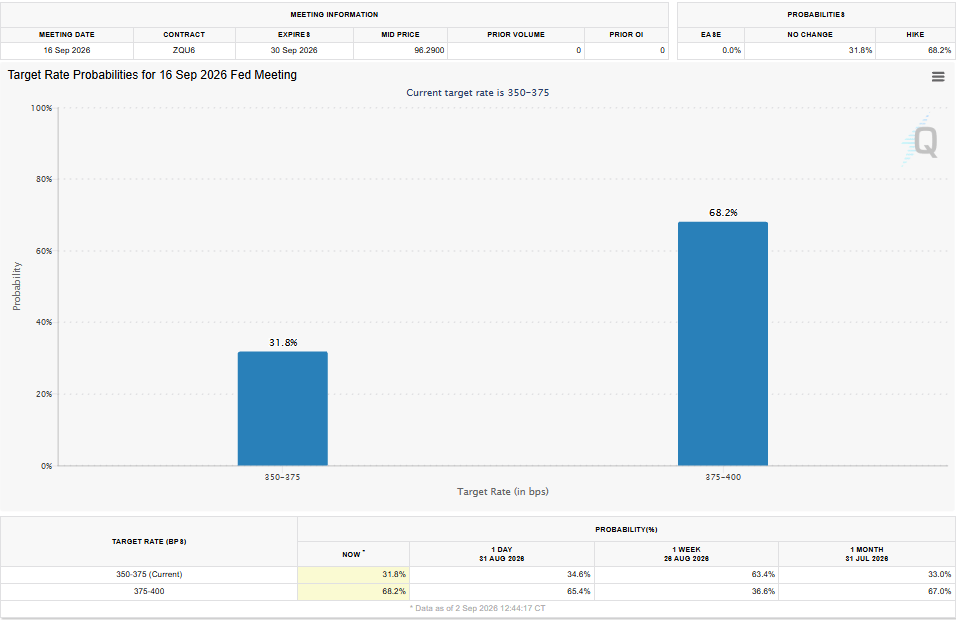
The CME Group’s FedWatch Tool indicates that traders are now factoring in approximately a 70.2% likelihood that the Fed will raise interest rates at the upcoming meeting on September 15-16, a notable rise from 41.43% just a week ago.
This anticipated tightening, combined with concerns regarding fiscal debt, has contributed to a significant sell-off in global bond markets, causing the yield on the benchmark 10-year US Treasury to surge to its highest level since January 2025. Increased Treasury yields may exert downward pressure on Bitcoin by making riskier assets less appealing and raising the opportunity cost of holding non-yielding investments like BTC.
Current Bitcoin Weakness: A Liquidity-Driven Correction?
In a recent exclusive interview, Bitunix analyst Dean Chen informed FXStreet that the present market weakness appears to be more of a liquidity-driven correction than an early signal of a structural decline.
“If capital costs decrease and ETF flows stabilize, Bitcoin has the potential to bounce back – but for now, overall liquidity is the primary constraint,” Chen explained.
He added that the recent downturn is largely attributable to elevated interest rates and fierce competition for global liquidity, rather than indicating a significant deterioration in Bitcoin’s market infrastructure.
Outflows from ETFs, rising energy costs, and the increasing likelihood that the Federal Reserve may maintain or further tighten rates are all raising the opportunity cost of holding Bitcoin. Increased energy prices are crucial, as they could reinforce inflation expectations and hinder the Fed’s ability to loosen its policy further.
However, Chen does not believe this current weakness necessarily signals an accelerating bear trend. A drop in Treasury yields, a less hawkish Fed, and stabilization in ETF flows could provide room for Bitcoin to recover as broader liquidity improves.
“The crucial factor is whether global liquidity continues to decline – not just how far BTC falls in the short term,” Chen commented.
At present, the analyst believes the market is adjusting its expectations, with Bitcoin still in search of a price level supported by global capital in a climate of higher capital costs.
Bitcoin’s Technical Perspective: Will BTC Reach Key Support?
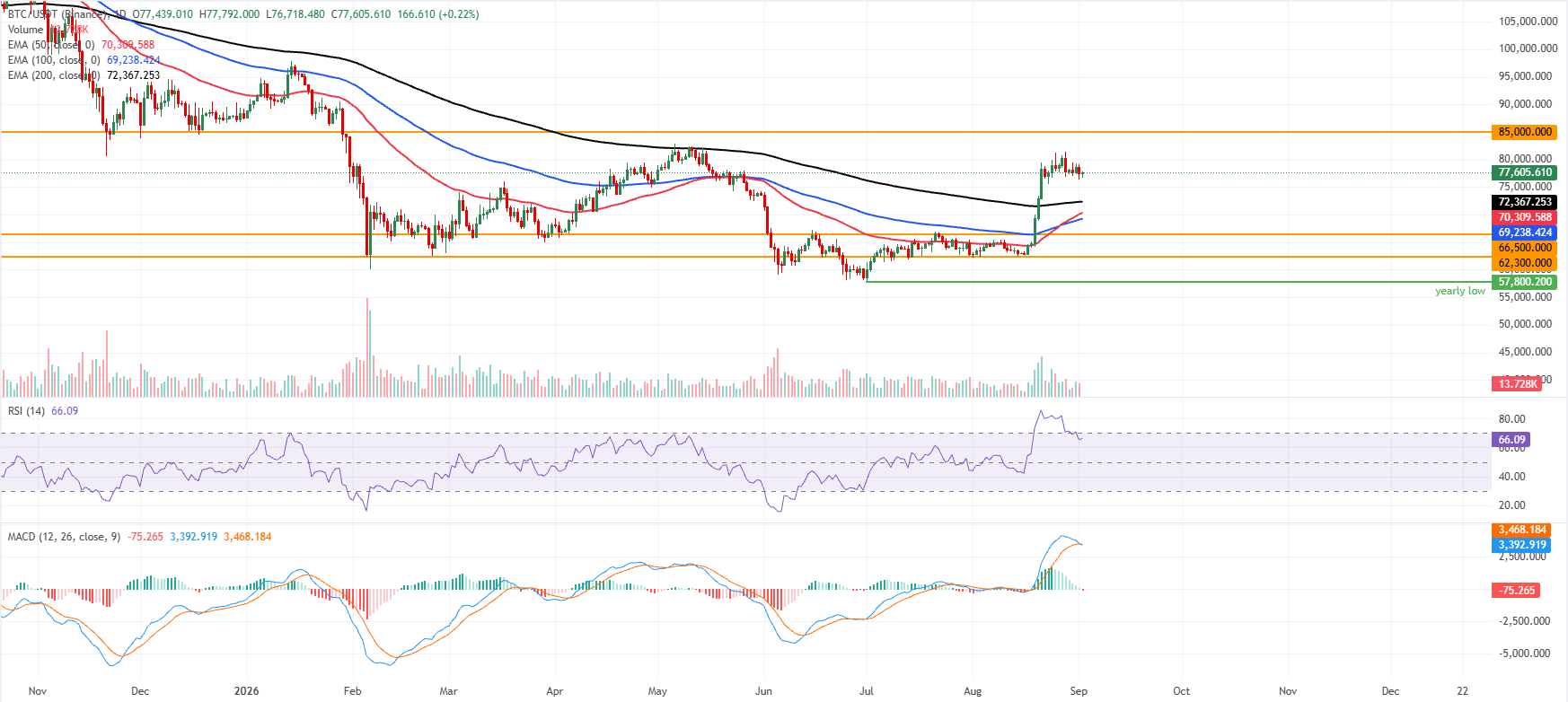
Bitcoin’s price is currently at $77,605 on Wednesday after a slight correction the previous day. Despite this pullback, BTC maintains a positive short-term outlook as it remains comfortably above the 50-day, 100-day, and 200-day Exponential Moving Averages (EMAs), which cluster between approximately $69,300 and $72,400.
The Relative Strength Index (RSI) is around 66 on the daily chart, reflecting robust but not excessive buying pressure. Meanwhile, the Moving Average Convergence Divergence (MACD) has dipped back below the zero line, indicating a slowdown in upward momentum rather than a complete reversal.
On the downside, immediate support levels are set at the 200-day EMA around $72,367, the 50-day EMA at about $70,309, and the 100-day EMA near $69,238. Additional structural support might be found at $66,500 and $62,300 if a more significant downturn occurs.
On the upside, the key resistance level is identified at $85,000; a daily close above this mark would reignite the bullish trend. A failure to break this level could prompt further consolidation back toward the EMA support range.
(This technical analysis has been produced with the assistance of an AI tool. Learn more.)
Bitcoin, Altcoins, and Stablecoins FAQs
Bitcoin is the largest cryptocurrency by market cap and is designed as a digital currency to function as money. Its decentralized nature means that no single entity controls it, eliminating the need for intermediaries in financial transactions.
Altcoins refer to any cryptocurrency other than Bitcoin. Some consider Ethereum to be an exception to this definition because many alternative coins are derived from Bitcoin and Ethereum. In this context, Litecoin is recognized as the first altcoin, created from a fork of Bitcoin’s protocol, thus representing an “enhanced” version.
Stablecoins are designed to maintain a stable price, often backed by reserves of the assets they represent. To achieve price stability, the value of stablecoins is pegged to a commodity or financial instrument like the US Dollar (USD), with supply regulated through algorithms or demand. Their primary purpose is to facilitate entry and exit points for investors in the cryptocurrency market, allowing them to store value in a volatile environment.
Bitcoin dominance measures Bitcoin’s market capitalization relative to the total market value of all cryptocurrencies. This ratio provides insight into Bitcoin’s appeal to investors. High BTC dominance often precedes or occurs during bull markets, indicating a trend where investors prefer stable, high-market-cap cryptocurrencies like Bitcoin. Conversely, a decline in BTC dominance suggests a shift of capital towards altcoins in pursuit of higher returns, which can trigger significant altcoin rallies.