

Bitcoin ($BTC) surged past the $85,000 mark, reaching a peak of $87,363.76 within 24 hours before retreating to around $85,500. This notable price surge represents a substantial change in market dynamics, driven by a significant short squeeze that compelled bearish traders to close their positions, leading to over $648 million in short liquidations.
Traders in the cryptocurrency market are now evaluating whether the rally is propelled by new investments or if it’s predominantly driven by liquidation of short positions.
Bitcoin Surpasses $85K Amidst $648 Million in Short Liquidations
On September 21, 2026, Bitcoin reached nearly $87,300-$87,400, breaking through the $85,000 threshold for the first time since January before stabilizing. A wave of forced liquidations in the derivatives market significantly contributed to this breakout.
Data from CoinGlass shows approximately $648 million worth of short positions were liquidated in just 24 hours as the price ascended. Total liquidations stood at around $746.77 million, with shorts responsible for approximately 86% of this figure.
The situation mirrored a traditional short-squeeze scenario, characterized by a high concentration of short interest around the $83,000-$86,000 range. The breach of significant resistance levels from $82,000 to $84,000 prompted forced buying, further enhancing the upward momentum, and resulting in additional stop-outs.
In a particularly intense one-hour period following the breach of $84,000, over $260 million in short positions were eliminated. Despite the aggressive liquidations, total open interest in cryptocurrency derivatives increased by 7.59% to approximately $156 billion, suggesting that traders were opening new leveraged positions even as they closed existing shorts.
Was the Breakout in $BTC Driven by Genuine Demand or a Short Squeeze?
The recent breakout of $BTC was influenced by both authentic demand and an amplified impact from derivatives trading, rather than a single driving force. In terms of real demand, U.S. spot Bitcoin ETFs recorded around $999 million in net inflows on September 21, marking the year’s highest net inflow and the most substantial in nearly 11 months.
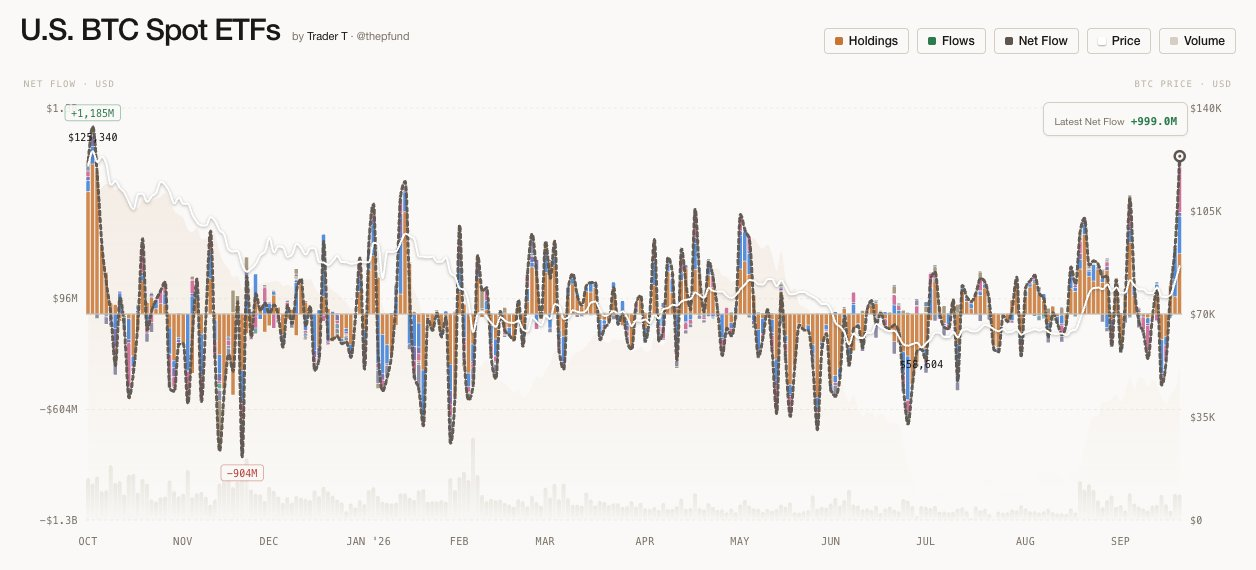
BlackRock’s IBIT raised $381 million, ARK 21Shares’ ARKB garnered about $289 million, and Fidelity’s FBTC attracted $239 million. These funds indicate new capital entering the market through regulated products, providing $BTC with significant buying pressure and contributing to its ability to overcome major resistance levels.
Simultaneously, the short squeeze played a pivotal role in amplifying the breakout. The forced closure of short positions increased buying pressure, propelling the price upward where there had been high levels of short interest.
What Lies Ahead for Bitcoin Prices?
As of the latest updates, $BTC was trading at $85,865.22, reflecting a 1.4% gain in the last 24 hours. The immediate target for price increases stands at the $87,000–$88,000 range, followed by the psychologically significant $90,000 level. Analysts have noted that $90,000 will serve as a critical near-term benchmark. Consistent trading in this price area will pave the way for tackling higher resistance levels.
Looking to the downside, the previous resistance area between $82,000 and $83,000, along with the broader support zone around $80,000-$82,000, has now become crucial. Maintaining the breakout structure above these levels is essential; otherwise, a further price retracement could occur. As $BTC probes higher price ranges, it is vital for traders to monitor ongoing real demand, sustained ETF inflows, and leverage dynamics closely.
Related: Bitcoin Short Squeeze Propels $BTC Towards $71,000 Following $2.74B in Liquidations