

- Bitcoin futures have seen a rise in leverage and open interest, reaching figures similar to those observed before last October’s significant market drop. However, analysts indicate that the current market conditions are not as heated, reducing the likelihood of a domino effect of liquidations.
- The analysis highlighted that perpetual futures funding rates, a decrease in the supply of derivatives-related stablecoins, and the liquidation intensity (the volume liquidated with each 1% price drop) are all considerably lower than what was experienced in October of last year.
- Key elements influencing whether Bitcoin’s value will decline further or regain the $86,000 mark include the upcoming U.S. FOMC meeting, the Bitcoin $82,300 support level, and the inflow of spot ETFs.
Trend Forecast Report for Upcoming Period


The increase in leverage within the Bitcoin futures market raises alarms that a repeat of last October’s “great liquidation” might occur. Nevertheless, some experts believe the market shows less overheating than in the past, indicating that large-scale liquidations remain a low risk.
According to CoinGlass, as of October 7, the open interest in Bitcoin futures has surged by 4.0% in the last week, reaching 650,480 BTC. This mirrors the trend prior to last October’s mass liquidation on October 10, when open interest jumped by 4.1% over the previous five days.
On that fateful day, forced liquidations increased sharply as the cryptocurrency market plummeted. Bitcoin dropped more than 2% to around $83,000, and Ether fell by 3.5% to about $2,600. Long positions were particularly hard hit, with approximately $403.58 million liquidated within a single hour.
Market participants are noting the similarity between the recent uptick in leverage and events before last October’s downturn. At that time, U.S. President Donald Trump announced increased tariffs on Chinese goods, leading to a sharp selloff. CoinGlass reports that over $19 billion in cryptocurrency positions were liquidated between October 10 and 11 last year, with long positions accounting for around 90% of that total—approximately $17 billion.
Leverage in comparison to market size has also approached previous levels. Currently, Bitcoin’s open interest represents 3.2% of its market cap, nearing the 3.7% seen right before October 10 last year. For Ether, this figure stands at 10.4%, down from 11.3% at that time.
Leverage Increases, Yet Overheating Appears to Be Limited; Liquidation Intensity Lower
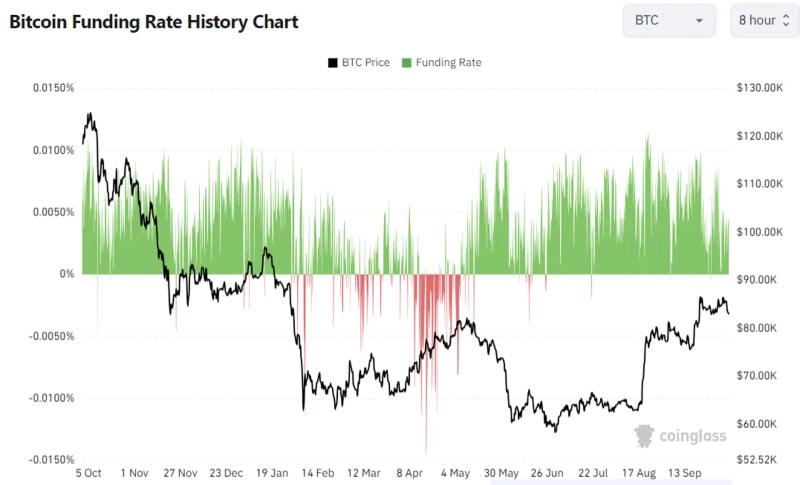
Analysts suggest the current leverage environment differs significantly from conditions last October. Ananda Banerjee, an on-chain analyst at BeInCrypto, noted that while leverage is indeed growing, there are no signs of the overheating characteristic of a year ago. He attributes this mainly to the substantial decrease in the cost of maintaining positions.
One critical indicator of market overheating is the funding rate within the perpetual futures market, which represents the fees exchanged between long and short traders. High positive funding rates are typically viewed as evidence of overcrowding in bullish long positions.
Just prior to last October’s liquidation, Bitcoin and Ether funding rates on exchanges like Binance and Bybit exceeded an annualized 8% on 18 out of 32 trading days. In contrast, only one out of 28 recent observations crossed the 8% threshold, and three reflected negative rates. Similarly, Deribit indicated a downturn in Bitcoin funding, dropping to 7.1% recently from an annualized 26.9% before last fall’s liquidation. Thus, while leverage has increased, the costs associated with betting on further price gains are notably lower.
Another significant difference lies in the fall in the supply of derivatives-linked stablecoins. CoinGecko highlights that Ethena’s USDe supply has declined by 66% since last October, now totaling $4.99 billion. This reduction implies a decrease in capital available for leveraged trades.
The intensity of liquidations amid price drops has also diminished. In the last 24 hours, approximately $487.02 million in long positions were liquidated as Bitcoin experienced around a 2% decline. This equates to about $248 million in liquidations for each 1% drop in Bitcoin’s price. Last October, the figure stood at roughly $2.2 billion for every 1% decrease, thus positioning the current level at about one-ninth of that amount.
Attention Shifts to Bitcoin’s $82,300 Support; ETF Inflows Remain Vital
The upcoming U.S. Federal Open Market Committee meeting on October 27-28 will be a pivotal factor for the market. Banerjee remarked that if another rate hike occurs following September’s meeting, Treasury yields could rise, potentially driving Bitcoin down to the $82,300 support level. He added that the likelihood of a large-scale liquidation event akin to last October remains low as long as funding rates remain below the annualized 8% mark.
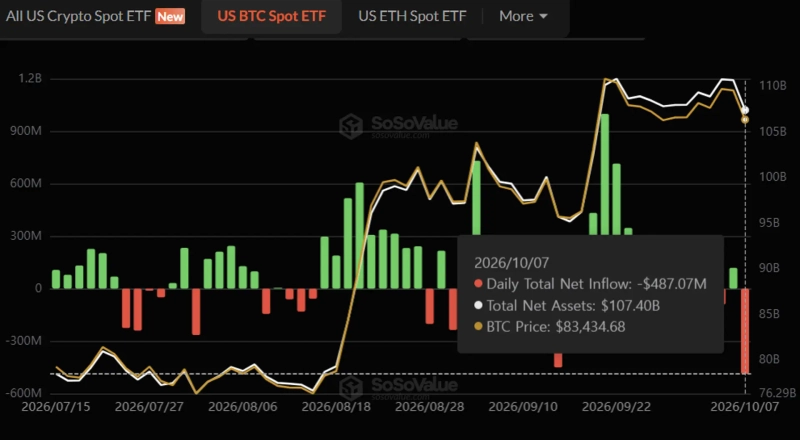
Moreover, a resurgence in institutional purchases through U.S. spot exchange-traded funds is crucial for any recovery. Omkar Godbole, an analyst at CoinDesk, noted that ETF inflows were a significant force behind Bitcoin’s rally in September. For Bitcoin to return to the $86,000 mark and maintain momentum, institutional interest must be rekindled.
According to SoSoValue, U.S. spot Bitcoin ETFs saw net inflows of $2.65 billion in September; however, last week saw only $241 million in net inflows, with this week witnessing negative flows totaling $487.07 million as of October 7.
Oliver Kading, marketing head at Tesseract Group, indicated that the current level of ETF purchases has not yet sufficiently countered macroeconomic pressures. He suggested that daily inflows exceeding $300 million across multiple trading sessions would signal a robust return of institutional demand.