
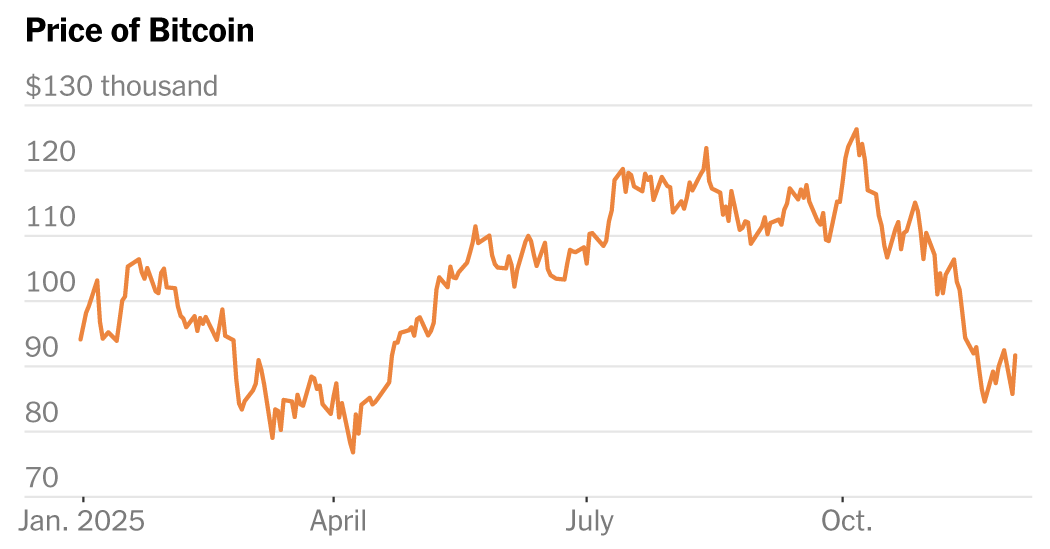
One year ago, Bitcoin reached a significant milestone of $100,000, celebrating a major win in the cryptocurrency community. With a pro-cryptocurrency president about to start his term, many in the industry anticipated that Bitcoin could potentially rise to $250,000 by the close of 2025.
However, those optimistic forecasts have not materialized.
Recently, Bitcoin has experienced a sharp decline, dropping to $82,000 in late November from a high of $126,000, marking a decrease of nearly 35 percent that reversed almost all of its yearly gains. (As of Wednesday, Bitcoin saw a slight rebound, reaching $93,000.) Other prominent cryptocurrencies have also suffered, with Ether falling almost 40 percent since August.
This downturn highlights the intertwined nature of cryptocurrency with the traditional economy. A mix of factors, including economic challenges like potential tariffs and speculation over interest rates, has played a role. Additionally, risky trading behaviors, where many investors borrow funds to amplify their trades, have deepened the losses as the market struggles.
Even the most established cryptocurrencies continue to demonstrate erratic behavior, revealing the inherent risks in investing in digital assets despite their growing acceptance in political and financial realms.
“The recent market downturn serves as a stark reminder of the risks associated with this sector,” stated Adam Phillips, managing director of investments at EP Wealth Advisors. “Cryptocurrency remains an unpredictable investment and is certainly not for those who are faint-hearted.”
This decline came at a time when the crypto sector was gaining mainstream traction. President Trump lifted restrictions on cryptocurrency and enacted laws that officially endorsed one of the industry’s most lucrative services. He also integrated crypto into his family’s business portfolio by launching the World Liberty Financial firm alongside his three sons.
The increased acceptance of digital currencies magnified the fallout from the downturn. Throughout this year, multiple publicly traded companies began investing in crypto, convinced that the rising popularity of digital currencies would boost their stock values.
However, as their share prices plummet, many of these companies are now facing difficulties, announcing share buybacks and management reshuffles.
Among these companies, Strategy, a software enterprise, stands out as the largest player in the “digital asset treasury” space with over $58 billion in Bitcoin holdings. However, its stock has dropped by more than 30 percent in the past month, raising concerns that the firm may need to liquidate some of its Bitcoin, further depressing crypto prices. (Strategy did not reply to requests for comments.)
“Investors will be closely monitoring for any indication of that,” remarked Hilary Allen, a law professor and cryptocurrency specialist at American University.
Last December, such a scenario would have seemed improbable when Bitcoin celebrated its $100,000 milestone. Since then, the crypto industry successfully garnered support in Washington, aided by a fundraising campaign that filled Congress with advocates for cryptocurrency.
The Securities and Exchange Commission dismissed lawsuits against several major crypto firms, alleviating legal hurdles that had stymied the industry’s growth for years. Additionally, Trump announced a plan for the U.S. to create its own Bitcoin reserve, a governmental repository of digital assets.
On October 6, Bitcoin peaked at $126,000, but then experienced a crash.
Following Trump’s declaration on October 10 to introduce new tariffs on China, the global market reacted sharply, and Bitcoin dropped approximately 10 percent, with other cryptocurrencies seeing even steeper declines.
The impact was immediate for traders. Many platforms allow crypto investors to borrow funds to increase their investments, using collateral to secure these larger amounts. This system can amplify gains when the market is performing well.
However, during declines, this can exacerbate losses, leading to liquidation of the collateral put up by traders. On the day of Trump’s tariff announcement, over 1.6 million traders faced liquidations, totaling around $19 billion, as reported by CoinGlass, a crypto analytics service.
Such crashes are not uncommon in the cryptocurrency sector. Back in 2022, significant price drops forced numerous crypto companies into bankruptcy, exposing fraudulent activities and leading to legal actions and extensive prison terms.
However, the current market fluctuations have not resulted in such severe consequences. Bitcoin’s value is still significantly higher compared to late 2022, when the FTX exchange’s collapse drove prices below $20,000. This indicates that many seasoned crypto investors may still enjoy considerable profits.
Moreover, declining prices have not entirely dampened the enthusiasm within the cryptocurrency community.
On Monday, Michael Saylor, chairman of Strategy, announced that his company had acquired an additional $12 million worth of Bitcoin.