
If you’re curious about Chainlink crypto, it’s an oracle network that bridges blockchains and smart contracts with external information, systems, and computational tasks. Its decentralized oracle networks offer various services ranging from market data provision to cross-chain interoperability and automation.
Contents
Understanding Chainlink Crypto and the Functionality of LINK
What Exactly Is Chainlink (LINK)?
Chainlink LINK▲$7.97 serves as the native token for the Chainlink blockchain. While it does not function as an independent Layer 1 blockchain, it provides essential infrastructure for applications that operate on various other blockchain networks.
How Does Chainlink Work?
Due to the inherent limitations of blockchains when it comes to accessing external data, decentralized oracle networks (DONs) are commonly utilized to address this oracle dilemma. A DON comprises nodes that collaborate to collect and authenticate information from various sources, passing it along to smart contracts.
Chainlink has evolved to include functionalities such as Data Feeds, Data Streams, Automation, a Verifiable Random Function (VRF), and the Cross-Chain Interoperability Protocol (CCIP), which facilitates interaction and token exchange across compatible blockchains.
| Component | Functionality | Significance |
| Chainlink | Links smart contracts to external data and systems | Broadens access for blockchain applications |
| Decentralized Oracle Networks | Aggregate and verify data from diverse sources | Minimize dependency on a single oracle |
| Data Feeds & Data Streams | Provide market and external data on-chain | Support decentralized finance (DeFi) applications reliant on data |
| CCIP | Facilitates token transfers and messaging across blockchains | Ensures cross-chain compatibility |
| LINK Token | Used for payments, incentives, and staking | Implements an economic and security framework for the network |
| Chainlink Reserve | Accumulated LINK through revenue from on-chain and enterprise services | Links network revenue with LINK |
What Functions Does LINK Serve?
For those asking what LINK crypto’s purpose is, the token facilitates payments to oracle operators and incentivizes dependable service, allowing qualified participants to bolster oracle security while earning rewards through staking.
Chainlink has introduced two mechanisms to enhance the connection between network revenue and LINK: Payment Abstraction, which enables fees payable in other tokens to be converted into LINK, and the Chainlink Reserve, which gathers LINK from on-chain and enterprise sources. Although growing infrastructure does not necessarily predict the value appreciation of the linked token.
Reasons Chainlink Might Ascend to the Top 5 Cryptocurrencies
Chainlink: Essential Infrastructure for DeFi
Chainlink has already been integrated into several DeFi platforms, reporting $43.3 billion in Total Value Secured and $32.18 trillion in cumulative Transaction Value Enabled as of July 2026.
It plays a crucial role in lending, derivatives, and other on-chain markets, being utilized by prominent names such as Aave, GMX, and Lido.
This extensive infrastructure promises Chainlink’s potential since its adoption is linked not to any single blockchain or application, but to services that function seamlessly across various ecosystems. This positions Chainlink to tap into a wider range of DeFi activities without reliance on one specific chain dominating the market.
CCIP: Broadened Horizons for Chainlink
CCIP significantly extends Chainlink’s market reach by allowing interoperability applications to relay tokens and messages among different blockchain networks. Chainlink reports that CCIP connects more than 70 networks. The momentum has continued into 2026, as seen with Canton launching in July.
This is pivotal when exploring the potential for Chainlink to rise. Its role has shifted from being merely an external data provider to an infrastructure that interlinks assets, applications, and blockchain networks. CCIP is actively being utilized for DeFi purposes, with established companies like Swift and ANZ employing it for institutional applications.
Tokenization of Real-World Assets: A Target for Chainlink
Tokenization represents another growth avenue. Chainlink’s framework enables off-chain data to be integrated with tokenized assets, allowing for reserve validation, interoperability, and cross-platform settlements.
For instance, DTCC’s Smart NAV pilot utilized Chainlink to deliver structured NAV data on-chain for tokenized-fund applications.
Beyond testing, progress is being made; in November 2025, UBS Tokenize and DigiFT successfully implemented a subscription and redemption process for a tokenized fund using Chainlink’s Digital Transfer Agent standard.
Furthermore, Chainlink is collaborating with 24 major banks and market infrastructures, including Swift, DTCC, Euroclear, and UBS, to establish an infrastructure for processing corporate actions, positioning Chainlink as a crucial interoperability layer between traditional finance and blockchain markets.
Learn More: Chainlink Price Forecast for August 2026: Analyzing LINK’s Market Trends
Could Institutional Adoption Shift LINK’s Position?
This institutional aspect is one reason why many inquire whether Chainlink could be the next prominent altcoin. Institutions like Swift, Euroclear, Fidelity International, UBS, and ANZ are known users of Chainlink, which now offers institutional solutions for data, interoperability, compliance, and asset management.
Nonetheless, just because institutions leverage Chainlink’s technology doesn’t necessarily imply LINK will rise to be among the top five cryptocurrencies.
In stronger terms, ongoing infrastructure utilization might create enough economic demand for the token in the long run, which is critical for evaluating the increasing significance of Chainlink.
Key Catalysts for Chainlink in 2026
Adoption of CCIP and Cross-Chain Expansion
CCIP continues to be a primary growth driver for Chainlink as it fosters both cross-chain messaging and token bridge capabilities. In July 2026, Chainlink rolled out Cross-Chain Token support, and noted ongoing deployments including Arbitrum, BNB▲$572.56 Chain, and Mantle.
Additionally, CCIP support was initiated on the Robinhood Chain mainnet on July 1. Continued adoption across various chains may bolster the infrastructure rationale for LINK’s potential, although such adoption doesn’t inherently ensure token-price growth.
The Emergence of Robinhood Chain in Mainstream Finance
On July 1, 2026, Robinhood introduced its public Chain mainnet, which serves as a Layer 2 infrastructure for DeFi and other real-world assets. Developers benefit from Chainlink’s array of infrastructure solutions, including Chainlink Data Streams and CCIP.
This integration with Robinhood allows Chainlink to connect traditional assets to on-chain markets. According to Robinhood, Stock Tokens are accessible to eligible users in over 120 countries, with availability varying by region. The ultimate usage levels for the new chain remain to be seen.
Tokenization Initiatives and Institutional Collaboration
Another significant trigger for institutional engagement is tokenization. Chainlink collaborates with organizations like Swift, UBS, DTCC, and Euroclear. UBS Tokenize has executed a production workflow for a tokenized fund’s subscription and redemption process, utilizing Chainlink’s Digital Transfer Agent standard.
In July 2026, Swift announced its blockchain ledger was ready for early adoption, anticipating live tokenized deposit transactions involving 17 banks. Chainlink has also been part of Swift’s experiments focused on interoperability between traditional banking and both public and private blockchain systems.
While institutional usage lends credence to Chainlink’s tokenization infrastructure projections, institutional adoption does not guarantee demand for LINK.
New Data Feeds, Oracles, and Blockchain Integrations
Throughout 2026, Chainlink’s Data Streams service continues to expand, encompassing assets like cryptocurrencies, equities, tokenized Treasuries, forex, and various financial data. Additional data sources were integrated via the Robinhood Chain in July.
Currently, Chainlink oversees more than 1,600 data feeds as displayed on its Data Feeds dashboard, collaborating with over 30 networks. This enhances the usability of Chainlink’s infrastructure, making the growth of oracle adoption crucial as we move into 2026.
| Catalyst | 2026 Developments | Potential Impact |
| CCIP Expansion | New Cross-Chain Token support and further deployments on various networks | Strengthens Chainlink’s cross-chain infrastructure |
| Robinhood Chain | CCIP and Data Streams available on Robinhood Chain mainnet | Links Chainlink infrastructure with an ecosystem geared towards on-chain finance and tokenized assets |
| Institutional Tokenization | Ongoing collaborations with Swift, UBS, DTCC, and Euroclear | Could fortify Chainlink’s standing in institutional blockchain infrastructure |
| Tokenized Funds | UBS Tokenize implemented Chainlink’s Digital Transfer Agent standard in a real-world workflow | Indicates legitimate institutional use extending beyond pilot projects |
| Data Infrastructure | Over 1,600 Data Feeds across 30+ networks | Diversifies the markets and applications utilizing Chainlink services |
Is LINK Crypto Currently Undervalued Compared to Other Leading Altcoins?
LINK Market Cap Comparison with Major Cryptocurrencies
Determining whether LINK crypto is undervalued largely hinges on how market analysts assess Chainlink’s infrastructure against larger networks. According to CoinGecko, LINK is currently the 23rd largest crypto asset. At one point, it held the 18th spot in terms of market capitalization, standing at roughly $6.2 billion, while BNB boasts a market cap of around $75.6 billion, USDC▲$0.9999 is valued at approximately $72.1 billion, XRP▲$1.13 at about $66.7 billion, and Solana’s at $42.4 billion.
This indicates that despite Chainlink’s reported Total Value Secured at $43.3 billion and Transaction Value Enabled at $32.18 trillion as of July 2026, its market cap remains lower than that of the top three altcoins.
How Much Would LINK Need to Rise to Reach the Top 5?
To ascend to the fifth position, LINK would have to surpass USDC’s market valuation of approximately $72.1 billion. Given that the circulating supply is nearly 748 million tokens, achieving that market cap would imply a price around $96—over 11 times its current value of approximately $8.45. Note that this is a market-cap estimation, not a definitive forecast.
A moving target influenced by fluctuating market sizes, circulating supply, and competitor valuations means there isn’t a fixed LINK price that could ensure a top-five ranking.
LINK Compared to XRP, SOL, BNB, and Other Prominent Altcoins
At present, LINK trades at a significantly lower value than XRP, SOL▲$82.41, and BNB, with CoinGecko indicating market caps of $66.7 billion for XRP, $42.4 billion for SOL, $75.6 billion for BNB, and $6.2 billion for LINK.
Their utilization differs as well. BNB and SOL serve as native assets for their respective Layer 1 ecosystems, while XRP is the native asset for the XRP Ledger. Chainlink’s role as an oracle and interoperability solution traverses multiple networks, with CCIP backing over 75 networks and 190 tokens.
Learn More: Will the Crypto Market Recover by End of 2026? 5 Factors That Could Decide Crypto’s Trajectory
Does Chainlink Have Sufficient Growth Potential to Close the Gap?
The expectation is that protocol adoption rather than mere popularity will fuel growth, considering Chainlink has a Total Value Secured of $43.3 billion as of July 2026 and is integrated with Canton and Robinhood Chain.
However, determining whether Chainlink represents a sound investment is another issue. Closing the considerable market capitalization gap between LINK and a broadly utilized infrastructure would necessitate a significantly higher valuation for LINK, but this remains uncertain.
| Asset | Market Cap | Approximate Gap vs LINK | Primary Function |
| BNB | $75.6B | 12.2× | Layer 1 ecosystem asset |
| XRP | $66.7B | 10.8× | XRP Ledger’s native asset |
| SOL | $42.4B | 6.8× | Layer 1 ecosystem asset |
| LINK | $6.2B | — | Oracle and interoperability infrastructure |
Factors That Could Propel LINK into the Top 5
Increased Adoption of CCIP
CCIP has the ability to bolster Chainlink’s business model by facilitating token and message transfers between blockchains. This would orient Chainlink towards a growing multichain economy rather than one confined to a single ecosystem.
While integrations might not be the sole determining factor for Chainlink’s price performance, ongoing usage of the Chainlink network to develop fee-generating services enhances the network’s economic viability.
Accurate pricing, reserve verification, interoperability across networks, and other off-chain data are essential for tokenized assets. Chainlink has been instrumental in providing these data solutions to UPS, Swift, DTCC, and other significant entities.
Should tokenized securities, funds, and other RWAs transition from pilot stages into full-scale production infrastructures, Chainlink’s involvement in the UBS tokenized fund workflow demonstrates how institutional tokenization is advancing beyond mere proofs of concept into practical applications.
Growing Demand for Chainlink’s Oracle Services
Chainlink’s oracle service remains a fundamental narrative, with Total Value Secured at $43.3 billion, Transaction Value Enabled standing at $32.18 trillion, and the verified message delivery tallying at 19.59 billion by July 2026.
An uptick in DeFi and the asset tokenization trend will likely correspond with heightened demand for Chainlink’s services, especially since many DeFi lending platforms already leverage its extensive data infrastructure and Data Streams for real-time information in sensitive markets and structured products.
This illustrates why Chainlink’s crypto value trends upwards as network adoption accelerates, though it’s essential not to confuse network scaling with token performance.
Enhanced Value Capture for the LINK Token
In a broader context, how LINK captures value may play a more substantial role down the line. Chainlink’s Payment Abstraction feature enables payment of service fees via other tokens, which are then converted into LINK. Furthermore, Chainlink Reserve accumulates LINK from its revenues generated through on-chain services and enterprise clients.
Staking also serves as a functional utility, allowing LINK holders to secure oracle service guarantees and earn rewards. Chainlink envisions that staking could grow increasingly independent of emissions, relying more on user transaction fees.
This lays out a clear rationale for why higher adoption should translate into greater token demand; however, whether these mechanisms are robust enough to warrant a top-five valuation remains an open query. Nonetheless, strengthened value accrual would bolster the argument for LINK as an asset.
Learn More: What’s the Next Major Narrative in Crypto Post-AI Tokens? Key Sectors to Monitor in H2 2026
Challenges Chainlink Might Face in Hitting the Top 5
The LINK Token Economics and Value Capture Challenges
One of Chainlink’s major hurdles is creating demand for LINK driven by the usage of its infrastructure. The protocol’s Payment Abstraction enables the exchange of fees in other cryptocurrencies for LINK. A portion of the revenue from on-chain services and enterprise clients is utilized by Chainlink Reserve to acquire LINK, establishing a direct relationship between staking and the security of the network.
However, uncertainties remain regarding the scalability of these mechanisms. LINK appreciation can only be seen as positive if the rising service demand leads to consistently increasing enough interest to maintain substantial LINK price predictions.
Competition from Other Oracle and Interoperability Solutions
Chainlink currently operates the largest oracle deployed by value, totaling $32.7 billion across 514 protocols as per the DeFiLlama rankings. Several competing oracle initiatives exist, including Chronicle, RedStone, Pyth, and API3, with Pyth implemented in 310 protocols.
Additional competition arises in the interoperability domain from LayerZero V2 and various other bridges cataloged by DeFiLlama alongside Chainlink’s CCIP product.
Weak Market Conditions Among Altcoins
Nonetheless, LINK operates in a broader context. CoinGecko indicates Bitcoin’s market share at 56.5%, meaning more than half of the total cryptocurrency market (valued at $2.27 trillion) is comprised of Bitcoin. High Bitcoin dominance might restrict large-cap altcoins from capturing market shares sufficient to surpass Bitcoin’s overall value.
Thus, LINK’s value fluctuations might not solely depend on Chainlink’s developments, but are also influenced by liquidity availability, risk tolerance, and capital movement among various coins.
Institutional Engagement Doesn’t Ensure LINK Demand
Chainlink has forged partnerships with several institutions, including Swift, Euroclear, Mastercard, Fidelity International, UBS, and ANZ, all listed as Chainlink adopters. It has been part of a consortium comprising 24 financial institutions and market infrastructures focusing on corporate actions processing.
However, extensive usage of Chainlink’s technology does not correspond with widespread demand for LINK itself in trading markets. Mechanisms such as Payment Abstraction and the Reserve aim to directly connect revenue from Chainlink services to LINK, yet the scale of this impact remains uncertain.
This disconnect poses significant risks for any Chainlink price expectations following increased institutional engagement: the returns on investment from Chainlink’s infrastructure may not translate proportionately to LINK’s token value.
Chainlink Price Forecast: Will LINK Break Out in 2026?
Current LINK Price and Market Dynamics
As of August 11, LINK is trading at approximately $8.45, with CoinMarketCap estimating the market cap around $6.3 billion and total circulating supply near 748.1 million LINK tokens.
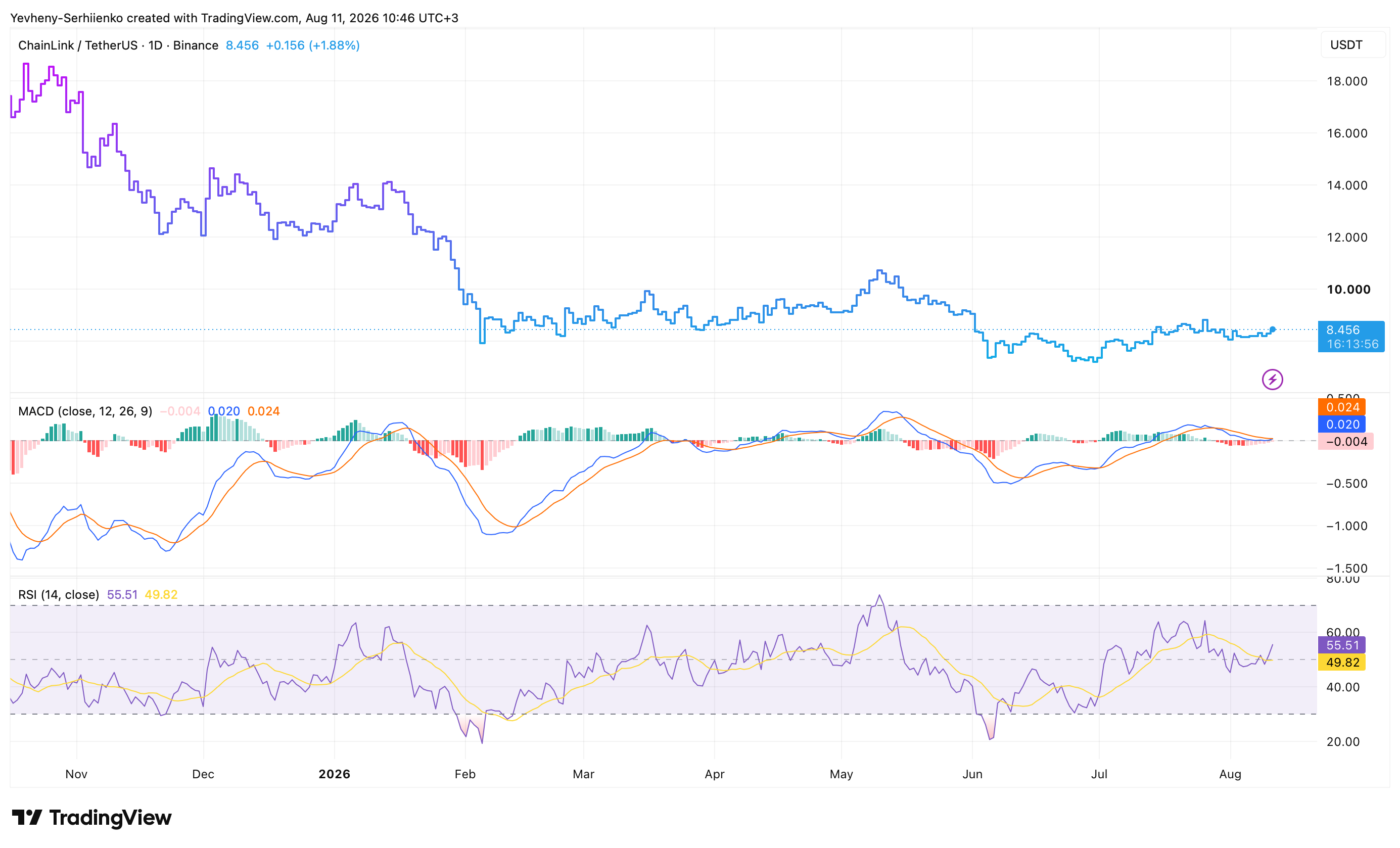
On the daily chart, LINK has entered a consolidation phase following a slip from above $18 in late 2025. The market momentum is neutral: RSI stands at 55.51, which is above the neutral zone of 50, while the MACD shows a slight decline, with the MACD line at 0.020 and the signal line at 0.024. TradingView also categorizes LINK/USDT’s daily technical outlook as neutral currently.
Critical Resistance Levels for LINK
The first solid resistance level identified in the above chart is the $8.80-$9.00 zone, which has faced testing since early July. A more significant barrier lies in the $10.00-$10.70 range, where LINK’s upward trend halted in May. Surpassing this range would indicate a shift from the sideways market activity seen recently.
Support is solid around the $8.00 mark, with key lows observed between $7.20 and $7.50 during June and July. Thus, whether LINK is set for a breakout hinges on its ability to exit this ongoing range rather than just amassing a series of positive trading sessions.
Potential Bullish and Bearish Outcomes for LINK
In a favorable scenario, LINK could maintain a valuation above $8, break through the $8.80-$9.00 resistance, and move towards the $10-$10.70 range. Surpassing the May high would lend strength to the technical outlook, although it would still lie beneath the $14-$18 range observed in late 2025 as per the Binance chart analysis.
A close under $8.00 could bring the range of $7.20 to $7.50 back into focus; however, the hourly momentum indicators do not present a strong directional tendency. Given the RSI just above 50 and a neutral MACD, any predictions regarding LINK should be viewed as analysis scenarios rather than fixed targets.
Learn More: Upcoming Crypto Movers? A Look at the Top 7 Altcoins That Might Excel in H2 2026
Potential Pricing of LINK If It Enters the Top 5
Currently, the fifth largest cryptocurrency as per market capitalization on CoinGecko has an approximate valuation near $72.18 billion. If LINK’s circulating supply of 748.1 million remains unchanged and mirrors USDC’s market cap, the LINK price could theoretically reach $96.5 each, which would be approximately 11.4 times its present value of $8.45. Note this isn’t a prediction of LINK’s price, as the top five market caps fluctuate daily based on other cryptocurrency performances. Additionally, the circulating supply of LINK will continue to vary, affecting its price accordingly.
| Metric | Current Value | Implications |
| LINK Price | ~$8.45 | Price remains in a phase of consolidation |
| RSI (Daily) | 55.51 | Momentum is neutral to mildly positive |
| MACD / Signal | 0.020 / 0.024 | Indicates weak momentum |
| Immediate Support | ~$8.00 | A key level for sustaining the current range |
| Major Support | $7.20-$7.50 | Support seen during June and July |
| First Resistance | $8.80-$9.00 | Initial challenge for breakout |
| Major Resistance | $10.00-$10.70 | Critical zone above the current trading range |
| Top-5 Equivalent* | ~$96.50 | Based on a market cap of ~$72.18B |
Is Chainlink Crypto Prepared for the Top 5?
The Bullish Outlook for LINK
Advocates for LINK cite its growth within DeFi and institutional finance. A report released in July 2026 indicates a Total Value Secured of $43.3 billion, with a Transaction Value Enabled totaling $32.18 trillion and 19.59 billion verified messages. CCIP’s integration with token support and cross-chain functions further enhances its appeal.
Chainlink’s collaborative work with financial institutions like Swift, Euroclear, UBS, and ANZ reinforces the argument for whether Chainlink is ready to break into the top 5 but does not guarantee it will achieve that status.
An Unfavorable Scenario for LINK
The most apparent challenge lies in the fact that institutional implementations of infrastructure do not automatically translate into market demand for LINK since these organizations often build on Chainlink services with little incentive to acquire its tokens. Furthermore, LINK’s performance may not necessarily surpass that of larger cryptocurrencies.
Competition from alternative projects, along with the evolving blockchain ecosystem, necessitates Chainlink to continually draw users to its oracle and interoperability network. LINK’s value is also susceptible to liquidity and risk trends in the broader altcoin market.
Essential Conditions for LINK to Secure a Top 5 Spot
Achieving this goal requires sustained high levels of CCIP and oracle service consumption, alongside increased institutional-scale tokenization of data. Additionally, it is vital to transition service-generated revenue into tangible demand for LINK.
The mechanisms of Payment Abstraction and staking are crucial, as the growth of the infrastructure must ultimately lead to value capture at the token level.
Even taking market volatility into account, LINK will have to narrow a substantial margin in market capitalization to break into the top five.
Therefore, the speculation surrounding whether Chainlink could emerge as the next major altcoin is just that, a hypothesis: the core question remains whether escalating adoption can significantly drive sustained demand for LINK, transforming its market standing.
FAQ
What distinguishes Chainlink from traditional blockchains?
Chainlink is not a general-purpose Layer 1 blockchain but rather serves as a decentralized oracle infrastructure and interoperability solution for blockchain-based smart contracts.
Why are decentralized oracles vital for DeFi?
Since smart contracts cannot directly access external information, decentralized oracle networks deliver crucial data to applications that typically depend on external sources, without reliance on a single centralized entity.
What role does CCIP play in Chainlink’s broader ecosystem?
CCIP serves as a protocol for moving tokens and messages between blockchain networks equipped with CCIP, thus enhancing Chainlink’s functionality beyond simply delivering data.
How could the tokenization of real-world assets benefit Chainlink?
Tokenized securities, funds, and other real-world assets may necessitate data feeds, reserve proofs, or interoperability connections between legacy systems and blockchain infrastructure, which may drive demand for Chainlink’s services.
What are the main risks to Chainlink’s future growth?
Key risks for the project include competition within the oracle and interoperability sectors, the state of the cryptocurrency market, and whether there will be adequate token demand should the network achieve widespread adoption without a corresponding increase in value.