
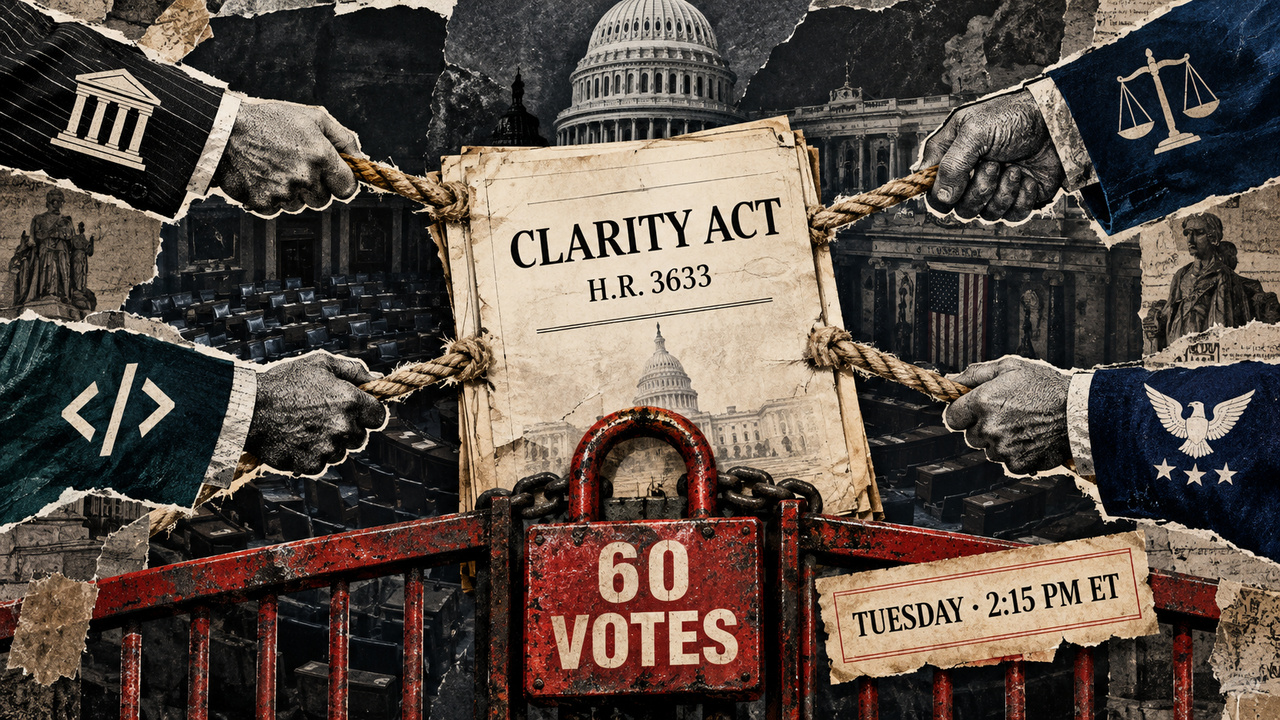
On September 14, opposition to the CLARITY Act expanded significantly as banks, Democrats, state attorneys general, and advocates for developers voiced their rejection of significant compromises made in the legislation.
This criticism arose shortly after Senate Republicans unveiled their final iteration of the pivotal crypto market-structure bill, which included 126 major amendments requested by Democrats, alongside new measures aimed at resolving issues related to ethics, stablecoin incentives, developers, and prediction markets.
Yet, these modifications have not succeeded in gaining the support of several key critics. Banking groups expressed concerns that the new safeguards against deposit outflows would be ineffective, while Democrats questioned the adequacy of the ethics regulations involving President Donald Trump.
The existing disputes heighten the importance of the upcoming cloture vote on Tuesday, which will decide whether the Senate can start deliberating on the bill. The motion regarding H.R. 3633 is set to occur at 2:15 p.m. Eastern and requires a total of 60 votes.
Democrats contest ethics arrangement amid warnings from states about enforcement authority
Opposition initially solidified around the ethics provisions, a key area Republicans aimed to finalize before the vote.
The new provisions stipulate that federal officials with significant crypto-related financial interests must either divest these assets or place them in qualified blind trusts, and they involve state attorneys general in enforcing some of these limitations.
Staff members for Sen. Elizabeth Warren, a well-known critic of crypto, have circulated arguments indicating that state enforcement capabilities are not as robust as Republicans have claimed, as reported by Punchbowl News journalist Brendan Pedersen noted.
Warren’s team argues that the Justice Department retains critical enforcement power, suggesting state actions could be obstructed if conducted under circumstances cleared by White House ethics officials.
This critique challenges a central selling point of the compromise: empowering enforcement outside an administration that could monitor conflicts of interest involving its own personnel.
Sen. Richard Blumenthal also disapproved of the adjusted language, accusing Trump of using cryptocurrency for personal gain during his presidency and labeling the legislation’s constraints as “insufficient.”
Sen. Chris Van Hollen joined in opposition, asserting that the bill still permits loopholes regarding Trump’s crypto dealings and does not do enough to tackle illicit financing or safeguard consumers. Van Hollen noted that he had previously proposed amendments to address these issues, which Republicans blocked.
In addition to Democrats’ resistance, New York Attorney General Letitia James led a bipartisan group of 17 attorneys general who oppose the bill over its implications for state enforcement.
This coalition cautioned that the CLARITY Act could diminish state registration and anti-fraud capabilities, while granting the Securities and Exchange Commission (SEC) more authority to negate state regulations. James’ office reported that states have initiated over 330 crypto-related anti-fraud enforcement actions since 2017.
James emphasized:
“My office has actively fought to safeguard New Yorkers and all Americans from rampant cryptocurrency fraud. As currently drafted, the CLARITY Act would empower scammers and may strip attorneys general of the authority to protect our investors and their finances.”
Banks argue that stablecoin safeguards react too late
Republicans also did not manage to resolve tensions with banks even after introducing a Treasury “circuit breaker” aimed at addressing concerns that stablecoin incentives might divert deposits away from community institutions.
The finalized draft allows the Treasury Secretary to intervene if stablecoins lead to significant deposit withdrawals from community banks. Treasury Secretary Scott Bessent expressed support for this provision, stating he would act if stablecoins start damaging the banking sector.
Bessent mentioned:
“If stablecoins negatively affect community banks, I will not hesitate to utilize these tools to ensure their protection.”
Banking organizations contended that this approach allows harm to occur before regulators can respond.
Eight trade associations, including the American Bankers Association (ABA) and Independent Community Bankers of America, urged Congress to ban stablecoin rewards and incentives akin to deposit interest, rather than waiting for signs of deposit outflows.
The banking sector has long lobbied for Congress to tighten these prohibitions, arguing that incentives provided via crypto exchanges and affiliates could position stablecoins as alternatives to deposits, thus reducing the funds available for local investment.
The ABA and state banking groups had already called on senators to address what they term an interest loophole prior to the release of the latest draft.
Christopher Williston VI, president and CEO of the Independent Bankers Association of Texas, dismissed the new Treasury mechanism as “insignificant” and “a joke.”
Meanwhile, advocates for developers identified another concern with the final agreement.
The bill retains regulatory safeguards preventing developers from being classified as money transmitters or financial institutions solely based on their software creation, while extending this coverage to miners and validators. However, Republicans eliminated specific protections related to 18 U.S.C. Section 1960, which governs unlicensed money transmitting operations.
Jason Somensatto, Coin Center’s director of policy, described the omission as disappointing. He stated that while the established regulatory protections benefit developers, the lack of criminal law safeguards heightens the stakes for Michael Lewellen’s legal challenge against the Justice Department.
Tribal opposition remains as startup support persists
Another attempt at compromise failed to resolve the ongoing conflict regarding prediction markets and tribal gaming.
The final version narrows decentralized finance protections, ensuring they don’t alter derivatives regulations or create any new exemptions affecting prediction markets. David Z. Bean, Chairman of the Indian Gaming Association, stated that these adjustments still “do not address the concerns of Indian Country.”
The association is seeking explicit protections for tribal and state gaming laws, as well as the Indian Gaming Regulatory Act, coupled with restrictions preventing federally regulated prediction market platforms from offering betting on sports and casino-style contracts.
Bean has argued that otherwise, the legislation would broaden the Commodity Futures Trading Commission’s authority to the detriment of tribal sovereignty.
However, Sen. Cynthia Lummis, a prominent proponent of the CLARITY Act, challenged Bean’s characterization, asserting that she had engaged with him and the association on June 25 and that consultations had occurred without any indication of opposition from the group.
Nevertheless, support for the bill continues to thrive within segments of the technology and cryptocurrency sectors. Y Combinator expressed optimism regarding the Clarity Act, claiming that clearer regulatory guidelines will facilitate US fintech entrepreneurs in developing blockchain-based products.
This backing sets the stage for Tuesday’s vote, which will serve as a definitive test of whether the compromises made by Republicans can counterbalance the mounting resistance.
The finalized draft has tackled many issues that delayed the bill for an extended period. However, critics from the banking sector, Democratic politicians, state enforcement, developer rights, and tribal gaming all argue that the solutions presented fall short of their expectations.
A failure to secure 60 votes would hinder a Senate debate initiation, leaving Republicans with a significantly altered bill and little proof that these changes have created the broad coalition necessary for its advancement.