

Bitcoin and the Nasdaq Composite index are currently showcasing a complicated interplay. Their recent divergence indicates a fierce contest for risk capital. The impressive gains in the Nasdaq, driven by AI innovations, have left Bitcoin holders pondering the cryptocurrency’s potential future, especially amid fears that it may remain stagnant, even with an overall optimistic risk appetite.
The Nasdaq Composite index hovers around record levels at $26,644, while Bitcoin struggles at $64,237, marking around a 50% decline from its peak of over $126,000 reached in October 2025, as per TradingView data. This divergence highlights ongoing trends and prompts vital inquiries among investors keen to decipher Bitcoin’s future trajectory.
Nasdaq is Drawing Investment Away From Bitcoin
It is important to recognize that the ongoing strength in technology stocks throughout 2026 has effectively siphoned both institutional and retail funds from the cryptocurrency sector. Investment has heavily clustered in major tech companies, buoyed by strong earnings and record investments in AI infrastructure.
Data from Glassnode reveals this trend, pointing out that AI-driven trading fuels the tech market while Bitcoin is sidelined from this capital flow. However, the analytics platform also highlighted a decline in Consumer Confidence, presenting a stark contrast to the US Stock Market Index.
Source: Glassnode
As the Nasdaq sees significant capital inflows, subdued demand for spot ETFs and structural hindrances in essential regulatory processes, including the postponed vote on the CLARITY Act in the US Senate, have left Bitcoin lacking in aggressive new liquidity. Consequently, Bitcoin has remained stagnant while traditional tech indices push near historical highs.
Is $BTC a Better Investment Compared to Nasdaq?
There’s no denying that tech stocks are enjoying momentum. However, it’s vital to remember that many of these stocks, especially those tied to AI, are trading at historically high valuations. Pursuing these stocks at current levels increases the risk of reaching a temporary peak. In contrast, Bitcoin is currently range-bound and trading well below its historical averages.
In terms of structure, Bitcoin presents a more favorable risk/reward ratio compared to overvalued AI stocks. Acquiring $BTC near the bottom of its protracted accumulation zone reduces downside risk. However, investors must exercise patience, as a significant catalyst will be necessary for the asset to regain its usual bullish momentum.
$BTC Price Levels to Monitor for Breakout Confirmation
Bitcoin’s price movement in recent months has established several critical structural boundaries. Keeping an eye on these levels could provide valuable insights for traders seeking to confirm a directional change.
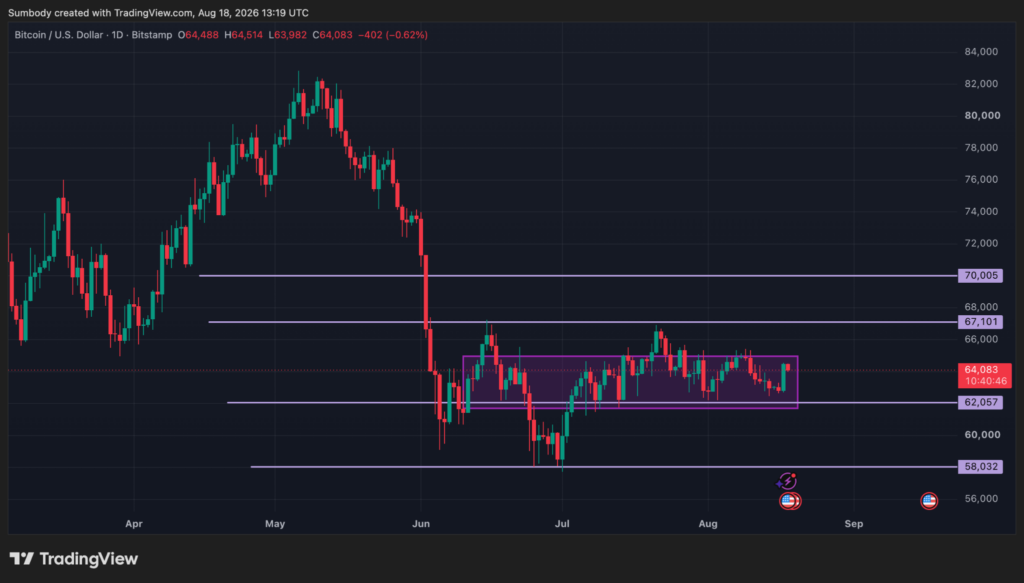
BTCUSD Daily Chart on TradingView
The $64,000-$65,000 range represents an immediate resistance for Bitcoin. This zone, characterized by strong trading volume, needs to be surpassed to signal an initial sign of upward movement. A confirmed close above this range would denote a technical breakout, indicating that the range-bound sellers might be losing momentum.
If Bitcoin continues its upward trajectory and achieves a decisive daily close above $67,000, it will have breached a crucial multi-month barrier. This would confirm a stronger technical breakout and shift the outlook from a static accumulation phase to a more active uptrend targeting the $70,000 level.
Conversely, if Bitcoin fails to hold the $62,000-$58,000 support levels, it risks retreating to the macro floor at $58,000.
What Impact Would a Nasdaq Reversal Have on $BTC?
Historically, sharp declines in tech stocks have usually had a negative impact on Bitcoin before potentially benefiting it. Therefore, predicting a pullback in the ascending index leading to a capital shift towards $BTC might not be a realistic expectation for cryptocurrency holders. However, it’s reasonable to anticipate that a slow, orderly cooling of equity markets could lead to profit-taking that moves towards alternative value stores.
To provide context, when the Nasdaq experiences a sudden drop, the correlation between these two assets tends to spike temporarily. This often occurs when institutional investors liquidate high-risk positions across the board to meet margin calls or to amass cash, resulting in a simultaneous decline in Bitcoin and tech stocks before any constructive rotation occurs. Consequently, Bitcoin may ultimately benefit from any Nasdaq reversal in the long term.
Which Market Exhibits Stronger Momentum: Bitcoin or Nasdaq?
As previously mentioned, the Nasdaq is currently trading near its historical highs with a clear and defined trend, supported by robust corporate earnings. On the other hand, Bitcoin finds itself trapped in a horizontal range exhibiting low volatility. Thus, the momentum of the Nasdaq index significantly surpasses that of Bitcoin, which currently lacks a definitive direction.