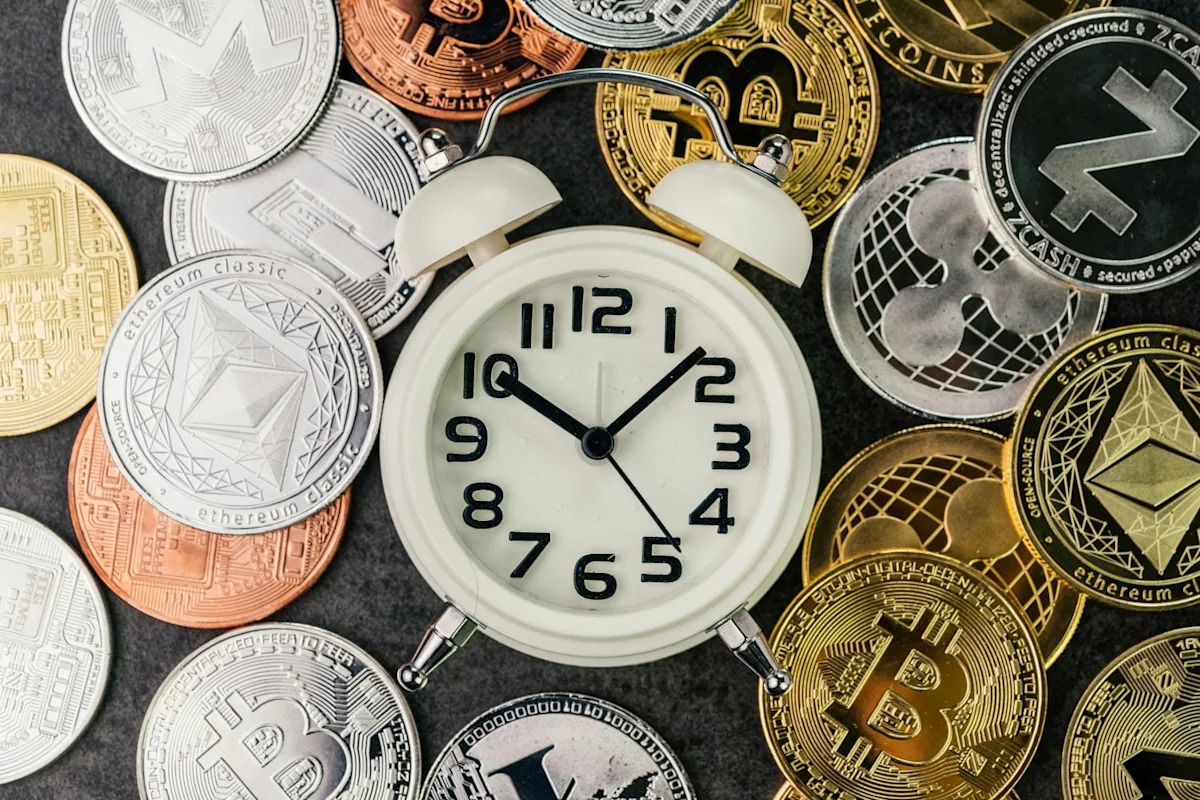
Speed Showdown: Can Solana’s 200ms Transactions Outpace Bitcoin’s 10-Minute Wait?
Quick Overview
Solana operates with a block time of 200 milliseconds, making it 3,000 times quicker than Bitcoin’s 10-minute interval, yet SOL’s value fell by 7.9% in the week following the upgrade’s implementation.
Block speed differs from finality; it’s important to note that XRP already settles transactions in 3 to 5 seconds, while Solana’s Alpenglow feature is still pending.
Bitcoin witnessed a 29% increase over three months without any changes in speed, implying that market trends rather than technical improvements might influence cryptocurrency valuations.
Creating an investment portfolio and sustainably withdrawing from it are distinct abilities, and few educate on the latter. The Definitive Guide to Retirement Income addresses this issue and is available free today. Learn more here. (Sponsor)
Recently, Solana (CRYPTO:SOL) has enhanced its system to release a new block every 200 milliseconds, while Bitcoin (CRYPTO:BTC) does so roughly every 10 minutes, making Solana’s speed about 3,000 times quicker. Bitcoin users usually wait for six confirmations, which can total about an hour before a transaction is deemed secure.
On October 9, 2026, Solana transitioned to a 200-millisecond block timing system. Despite this advancement, as of October 10, Solana’s price was around $110, reflecting a 7.9% drop in the past week, marking it as the poorest performer among major cryptocurrencies. This prompts the question: does increased speed equate to greater value?
eamesBot / Shutterstock.com
Block Speed vs Finality in Solana’s 200 Millisecond Performance
Thapana_Studio / Shutterstock.com
Blockchain technology functions as a decentralized digital ledger that clusters transactions into blocks, added sequentially. Block time indicates how quickly new blocks are introduced to the chain. Solana progressively improved this timing, reducing it step-by-step: from 400 milliseconds to 350, then to 300, 250, and ultimately 200 milliseconds by October 9.
Introducing: The Definitive Guide to Retirement Income
Many accomplished investors eventually find themselves in a similar situation. They’ve saved diligently, built a portfolio, and begin to question not how to continue growing their wealth, but how to begin extracting it. Missteps here can undo years of prudent investment within a short timeframe.
This transition is what The Definitive Guide to Retirement Income seeks to address. It discusses the real costs of retirement, valuable income sources, and the calculations necessary for sustainable withdrawals. This guide is free today thanks to Fisher Investments. Learn More Here ›
Merchants and exchanges prioritize finality over speed; finality signifies the point at which a transaction cannot be reversed. Though a block may be generated swiftly, it could remain reversible for a period post-creation. In Bitcoin’s framework, each confirmation adds another block to the one with the transaction, complicating potential reversals with every subsequent confirmation.
Ethereum (CRYPTO:ETH) can generate a block roughly every 12 seconds and achieves finality in about 13 minutes. On the other hand, the XRP Ledger supporting XRP (CRYPTO:XRP) completes transactions in 3 to 5 seconds. Solana’s forthcoming update, Alpenglow, aims for a finality of around 150 milliseconds, but it is not yet operational.
However, these statistics alone do not tell the entire story. Each network must balance speed with costs and the number of nodes necessary for validating each block. Satoshi Nakamoto, the creator of Bitcoin, intentionally set its pace at 10 minutes to allow computers globally enough time to receive and agree on each block. This slower rhythm reflects a set of priorities rather than an inherent flaw in the system.
Solana’s Speed Increase Meets a 7.9% Price Drop in a Week
Summit Art Creations / Shutterstock.com
Even though Solana’s network implemented its speed update on October 9, the coin’s value dropped by 7.9% in the past week, the largest decline among major cryptocurrencies. As the date of the final upgrade neared, investors seemed to liquidate their holdings.
Nevertheless, a longer-term perspective portrays a more positive outlook for Solana investors. Over the last 30 days, the coin has risen by 8.7%, 43% over 60 days, and 42% over 90 days, benefiting from the initial speed improvement on August 21 and a surge in September, which supporters may interpret as positive results from the updates.
Conversely, Bitcoin’s value has surged by 29% during the past 90 days without any changes in its block timing. This indicates a wider market uptrend, suggesting that Solana’s percentage increases may illustrate the usual volatility characteristic of smaller assets during favorable market conditions, rather than being solely due to its accelerated block generation.
At present, Solana’s trading value is around 63% lower than its record high of $293, achieved in January 2025, needing a significant 167% rise to return to that peak. Although the network is at its rapid processing pace, the coin’s price is still significantly below its peak value.
Is Solana’s Speed Advantage Over Bitcoin Worth More Value?
Ultimately, increased speed does not inherently enhance the value of a cryptocurrency. Solana’s recent improvements haven’t produced price growth, indicating that technological enhancements must appeal to genuine users and generate fees to elevate demand.
While faster transaction times are a noteworthy technical achievement and may provide a competitive edge, they do not guarantee an increase in price on their own. Until Solana’s Alpenglow upgrade is fully functional and more users are drawn to the network, the effects of these speed enhancements on SOL’s market value remain ambiguous.
The true measure will be whether Solana experiences a notable increase in transaction fees and activities compared to its pre-October 9 statistics once Alpenglow is operational. If so, the demand for SOL may positively affect its price.
Now Available: The Definitive Guide to Retirement Income
(Sponsor) Most individuals dedicate their careers to accumulating wealth, only to find that the skill they truly require in retirement is practically the opposite. They need to transform their savings into a sustainable income stream that lasts through prosperous and difficult times alike, without depleting their resources.
This transition remains one of the least discussed yet most crucial facets of personal finance; many otherwise prudent investors embark on this journey with no solid plan. This is where The Definitive Guide to Retirement Income becomes invaluable. It’s a complimentary guide from Fisher Investments that outlines the genuine costs of retirement, where to source cash flow, and how much can be safely withdrawn each year. Discover more here. Learn More Here ›